APR: Releasing Pain in the Belly
APR — the abdominal-pain-releasing treatments — are Neurotherapy (LMNT)'s group of formulas for belly pain. They are chosen by one plain question: how many loose motions a day? The group also includes Jeevan Dhara, the formula its patients named, and the HCl treatment.
Overview
APR — the abdominal-pain-releasing treatments — are Neurotherapy (LMNT)'s group of formulas for belly pain. They are chosen by one plain question: how many loose motions a day? The group also includes Jeevan Dhara, the formula its patients named, and the HCl treatment.
The man who named the pain before he touched it
At health camps, Guruji — Dr. Lajpatrai Mehra — used to do something that looked like a conjuring trick. A patient with belly pain lay on the mat, and he asked the room to choose which pain he should take out: the one on the right above the navel, or the one low on the left. He said aloud what he would do, worked at the thighs and arms — never on the painful spot — and the named pain was gone.
He had spent years learning which organ, stimulated in which order, clears which corner of the belly. Instead of keeping that skill, he made it simple enough for anyone to learn, and taught it freely. The APR group is what came out of that simplification.
Releasing, not just relieving
APR stands for abdominal pain releasing treatment. The word is releasing, not relieving: the pain is seen as something the belly is holding for a reason, and the formula removes that reason. The thinking runs in four steps. Old infection in the food canal turns into inflammation (swelling and irritation). The pain also shows that the stomach and intestines are short of blood, so food passes through undigested. When the large intestine is also short of blood, it cannot take water out of the waste — and that is diarrhoea. So the speed of the bowel has to be slowed.
Body science agrees on the basic picture. The bowel moves food along with slow squeezing waves called peristalsis. The large intestine's main job is to take water back from what passes through it; if the contents rush past too fast, the stool stays watery. Slowing the wave does not block the bowel — it gives it time.
In the APR formulas, (30) Medulla and (6) Adr are used to calm the inflammation, (6) Swt to slow the bowel, and the belly organs are then worked in a reversed order — the Ulta Normal pattern — which also slows movement.
Three classes, chosen by one question
The first APR helped many patients, but not those with many loose motions. The reason was clear: more loose motions means stronger inflammation, and until the inflammation is settled there is no point stimulating the belly organs. So the group was divided into three classes, by the number of loose motions alone — not by the disease name or a report.
- Class A — belly pain with up to four or five loose motions a day.
- Class B — belly pain with more than five or six loose motions: more work on the inflammation, and the belly organs only once the motions begin to settle.
- Class C — belly pain with no loose motions: the bowel's speed is correct, so it is left alone and only the organs are supplied with blood.
Two points taken out, and the day not to forget
Some patients still did not get full relief. Then came the thought that changed the whole group: the bile of the gall bladder is antiseptic, and the spleen makes white cells and antibodies, so stimulating Gal and Spl could increase inflammation. In the revised classes these two points were removed. Nothing was added and nothing was made stronger — and the patients who had not improved began to.
Because these treatments slow the bowel on purpose, one instruction closes every course: when the motions become completely normal, give NAN or FAN for at least one day to bring the bowel's ordinary movement back. Skipping it is the most common mistake in the group. The motions are asked about every day, and the answer decides the next day's treatment.
Jeevan Dhara — the stream of life
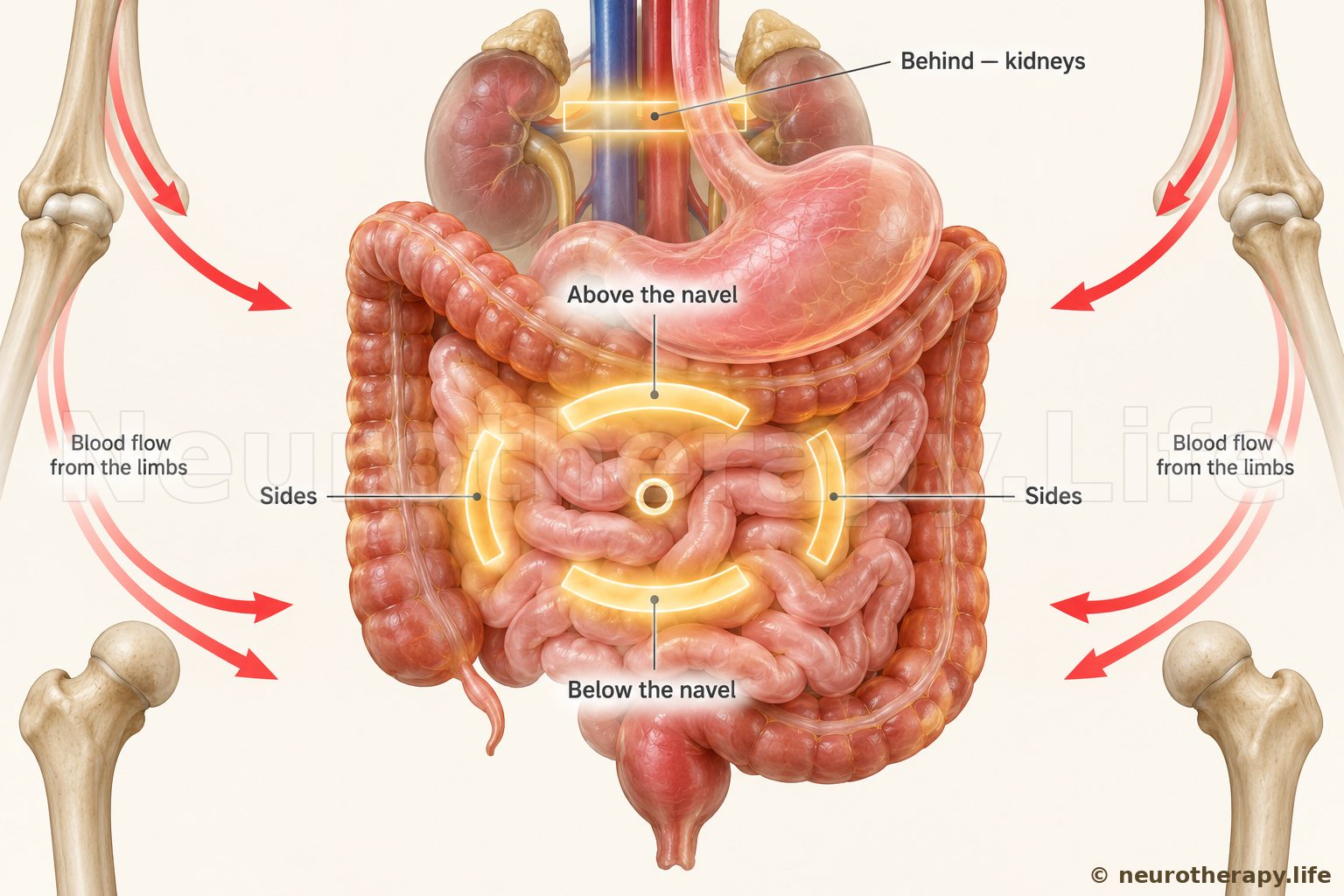
For pain without loose motions, Guruji found a simple answer: if blood flow is increased above, below, beside and behind the navel, the pain comes out by itself. You do not need to know exactly where the pain is; you go round it. The organs are worked in their normal order, which supports the bowel's healthy movement.
Elderly people and those with no particular complaint reported a quick sense of freshness after it, and many women said they had received a new life. So the treatment got the name its patients gave it: Jeevan Dhara. Today a lighter version is used, and the therapy calls it more effective than the old heavy one. It can be given at any age for tiredness and weakness too.
APR releases today's pain; UDF asks why the pain keeps coming back. The group closes with the HCl treatment, given after a UDF formula to raise the stomach's own acid. Choosing the class and giving each formula correctly is taught hands-on in the course.
Key points
- APR is a group of treatments for belly pain, chosen by one question: how many loose motions a day?
- The painful belly is never pressed; the work is done through the limbs and back.
- More loose motions means more inflammation, which is treated before the belly organs are stimulated.
- In an inflamed belly, Gal and Spl are left out.
- When the motions become normal, NAN or FAN is given for at least one day.
- Jeevan Dhara supplies every side of the navel; its lighter version is the one used today.
Topics in this guide
Go deeper
Abdominal pain
Abdominal pain — causes and care
Loose motions with abdominal pain
Loose motions with belly pain
APR class A, revised
APR class A, revised
APR class B, revised
APR class B, revised
APR class C
APR class C, for pain without loose motions
Jeevan Dhara, light version
Jeevan Dhara, the light version used today
Ulta Normal
Ulta Normal, the reversed order that slows the bowel
Clearing the Ash: The UDF Formulas
UDF: why the pain keeps coming back
Safety: when it is held back
- (6) Adr lowers immunity and raises alkali, so it is not given in septicaemia, HIV/AIDS, cancer or high blood pressure. Ask these questions before it is written into a plan. (6) Adr
- (30) Medulla is never given in cancer, and is not given to heart patients. (30) Medulla
- With many loose motions, water matters more than any formula. Drink water with a little salt and sugar all day. If you cannot keep it down, feel faint on standing, pass very little urine, or see blood in the stool, stop and see a doctor the same day. Diarrhoea (loose motions)
- Severe or worsening belly pain, a hard tender belly, fever or repeated vomiting are not treatment questions — see a doctor first. How to tell a patient to see a doctor
- Slow development in a child must be checked by a doctor; several causes are fully treatable when found early. The HCl treatment goes alongside that check, never in place of it. Mental slowness (intellectual disability)
- Never stop or change your tablets because of Neurotherapy (LMNT), and tell the therapist about every medicine you take, including blood-pressure tablets.
Guruji says
“If the blood circulation is increased above the navel, below it, in front of it and behind it — on all sides — then the pain will come out of itself.”
Common questions
My pain is in my stomach. Why are you working on my back and legs?
The organs inside your belly are supplied by nerves and vessels that can be reached from the back and the limbs, and that is the route this therapy uses. A sore belly is not made sorer. If the pain leaves while the hands are nowhere near it, the treatment is working as intended.
Why do you keep asking about my stools?
Because it is the one thing that shows truthfully how the treatment is going, and your answer decides what is given tomorrow. All that is needed is how many times, and whether loose, soft or formed.
My motions are normal now. Can I stop coming?
Almost. One more day. The treatment slowed your bowel on purpose, and one session of NAN or FAN puts its ordinary movement back. Skipping it can bring the opposite complaint back within weeks.
My mother is seventy. Is she too old for this?
Not at all — Jeevan Dhara was largely made for people her age. She will get the lighter form, which is the better one. If she is tired when she gets up, the treatment is reduced.
Watch

A demonstration of the Ulta Normal formula for loose motions: (8) Pan on both thighs, then Spl before Gal and Mu before Liv — the Normal formula's order reversed to slow the bowel.
The video's counts ((3) Spl, (3) Gal, (5) Mu, (7) Liv) differ from LMNT teaching, which gives (1) Spl, (1) Gal, (1) Mu – 3 points and (1) Liv – 3 points. Ulta Normal is stopped as soon as the stool is formed, and the Normal formula is given for at least one day.
Test yourself
Explore more
Organs
Body systems
Diseases
Points
Formulas
Topics
Read more
This page explains what a Neurotherapy (LMNT) treatment is for; it is not a self-treatment guide and does not diagnose. Neurotherapy (LMNT) works alongside your medical care — keep taking the medicines your doctor prescribed.