Abdominal pain: three kinds, told apart by the loose motions
The first APR treatment helped many, but not those with many loose motions. So abdominal pain was divided into three kinds by one plain question, how many loose motions a day, with a treatment for each.
Overview
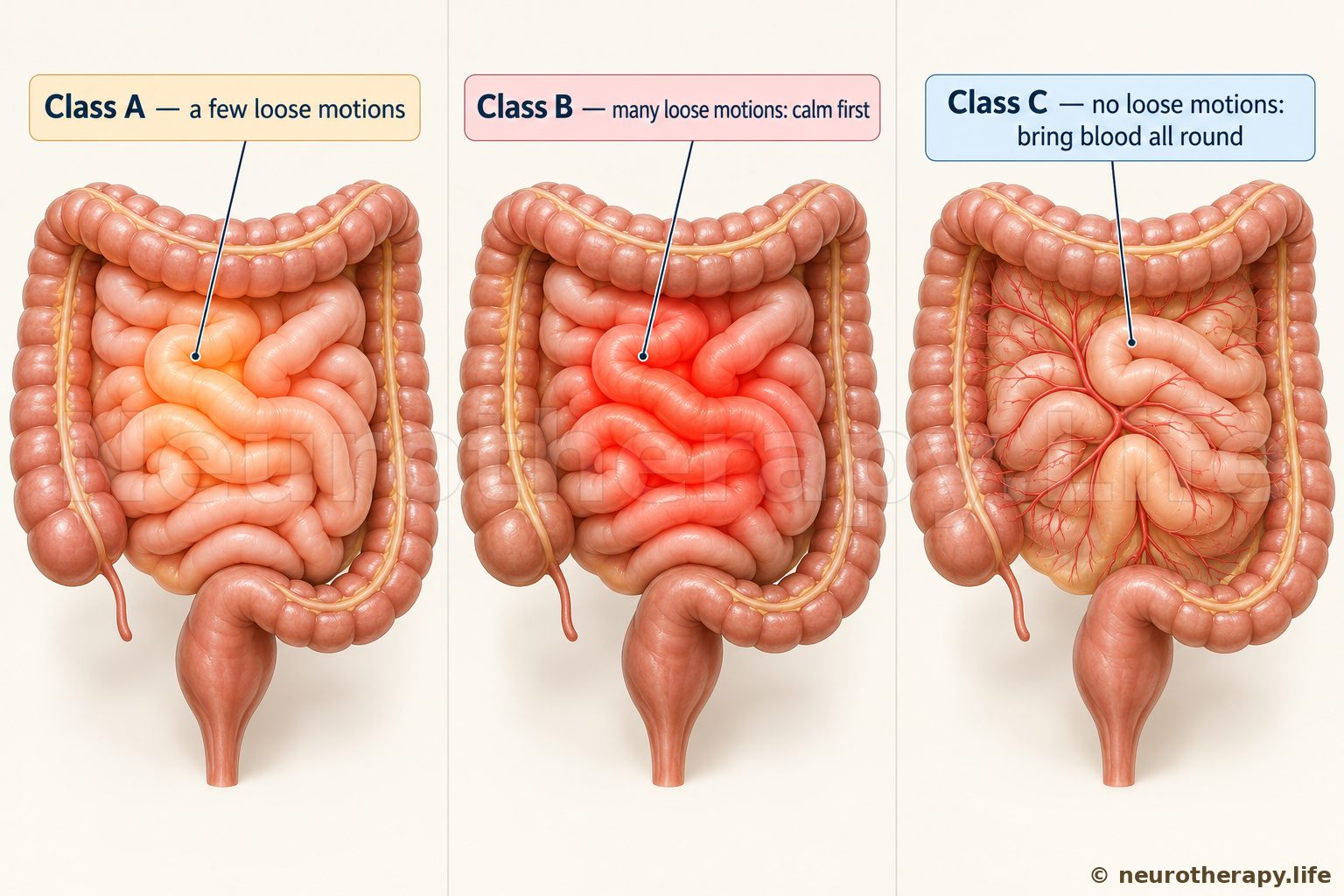
Those whose loose motions were fewer benefited from the first treatment. Those with more did not. The reason, when it came, was not a new point: more loose motions mean the infection is stronger, so there is more inflammation. Until the inflammation is finished, there is no meaning in provoking the other organs of the abdomen.
So abdominal pain was divided into three kinds. Class A is pain with up to four or five loose motions a day. Class B is pain with more than five or six; here the anti-inflammation work is given more, and the digestive organs wait until the motions begin to answer. Class C is pain with no loose motions at all. The name of the illness, the report and how long it has lasted do not decide the class; a plain question does.
Later came a revision that added nothing. The bile of the gall bladder is antiseptic, and the spleen makes white cells and antibodies, so provoking Gal and Spl in an inflamed belly could increase the inflammation. Both were taken out, and patients who had not been getting full relief began to get it. An omission can be an instruction.
Class C works the other way round. If the motions are normal, the gut's movement is correct and must not be tampered with. Only the organs are provoked: if blood circulation is increased above the navel, below it, in front of it and behind it, the pain comes out of itself. This treatment became known as Jeevan Dhara. And for A and B, when the motions become completely normal, NAN or FAN is given so the bowel gets its speed back.
Key points
- The number of loose motions chooses the class.
- More motions mean more inflammation, so the organs wait.
- Gal and Spl are left out of an inflamed belly.
- With no loose motions, the gut's movement is left alone.
- Once motions are normal, NAN or FAN gives the bowel its speed back.
Go deeper
APR: the treatments that release abdominal pain
What APR is, and the reasoning behind it
APR class A, revised
APR class A, revised
APR class B, revised
APR class B, revised
APR class C
APR class C, for pain without loose motions
Jeevan Dhara: the abdominal treatment its patients named
Jeevan Dhara, the name of class C
Gall bladder
Why bile is antiseptic
Spleen
The spleen and the body's defences
Diarrhoea (loose motions)
Diarrhoea
Read the full guide
This topic is part of: APR: Releasing Pain in the Belly
Safety: when it is held back
- Blood or mucus in the stool with fever, black tarry stool, sudden or severe belly pain, a hard swollen belly, vomiting that will not stop, or a drowsy patient: see a doctor the same day. These are not treatment questions.
- Diarrhoea harms mainly by the water it takes out. Oral rehydration (sugar-salt solution) comes first, and any treatment is given alongside it, never in its place. Diarrhoea (loose motions)
- Relief of pain is not exclusion of disease. A belly that eases on the mat has said nothing about what caused the pain.
- (6) Adr lowers immunity, so it is not given where immunity is already low, such as septicaemia, HIV/AIDS or cancer. It also raises alkali, so it is not given in high blood pressure. (6) Adr
- Neurotherapy (LMNT) works alongside your medical care. Do not stop or change any medicine on your own; ask the doctor who prescribed it.
Watch

A demonstration of the Ulta Normal formula for loose motions: (8) Pan on both thighs, then Spl before Gal and Mu before Liv — the Normal formula's order reversed to slow the bowel.
The video's counts ((3) Spl, (3) Gal, (5) Mu, (7) Liv) differ from LMNT teaching, which gives (1) Spl, (1) Gal, (1) Mu – 3 points and (1) Liv – 3 points. Ulta Normal is stopped as soon as the stool is formed, and the Normal formula is given for at least one day.

An overview of LMNT's diagnostic pain points — the places around the navel that the therapist presses to read the body before choosing a treatment.
This page explains what a Neurotherapy (LMNT) treatment is for; it is not a self-treatment guide and does not diagnose. Neurotherapy (LMNT) works alongside your medical care — keep taking the medicines your doctor prescribed.