APR class B, revised, is the present Neurotherapy (LMNT) treatment for belly pain with more than five or six loose motions a day. It gives the anti-inflammatory and gut-slowing work as needed, and treats the abdomen without Gal and Spl only once the motions begin to answer.
Overview
What is APR class B, revised?
APR stands for the abdominal-pain-releasing treatments. 'Releasing' is the key word: not covering the pain over, but removing the reason the belly is holding it. APR is a group, not one formula. Guruji split it into three classes, chosen by one plain question — how many loose motions a day?
The revision made three changes to class B. Gal and Spl were taken out of the abdominal step. Swt was restored to its full variant, (6) Swt. And the repeat of the adrenal-and-Swt work is now written 'as needed', governed by how the motions respond.
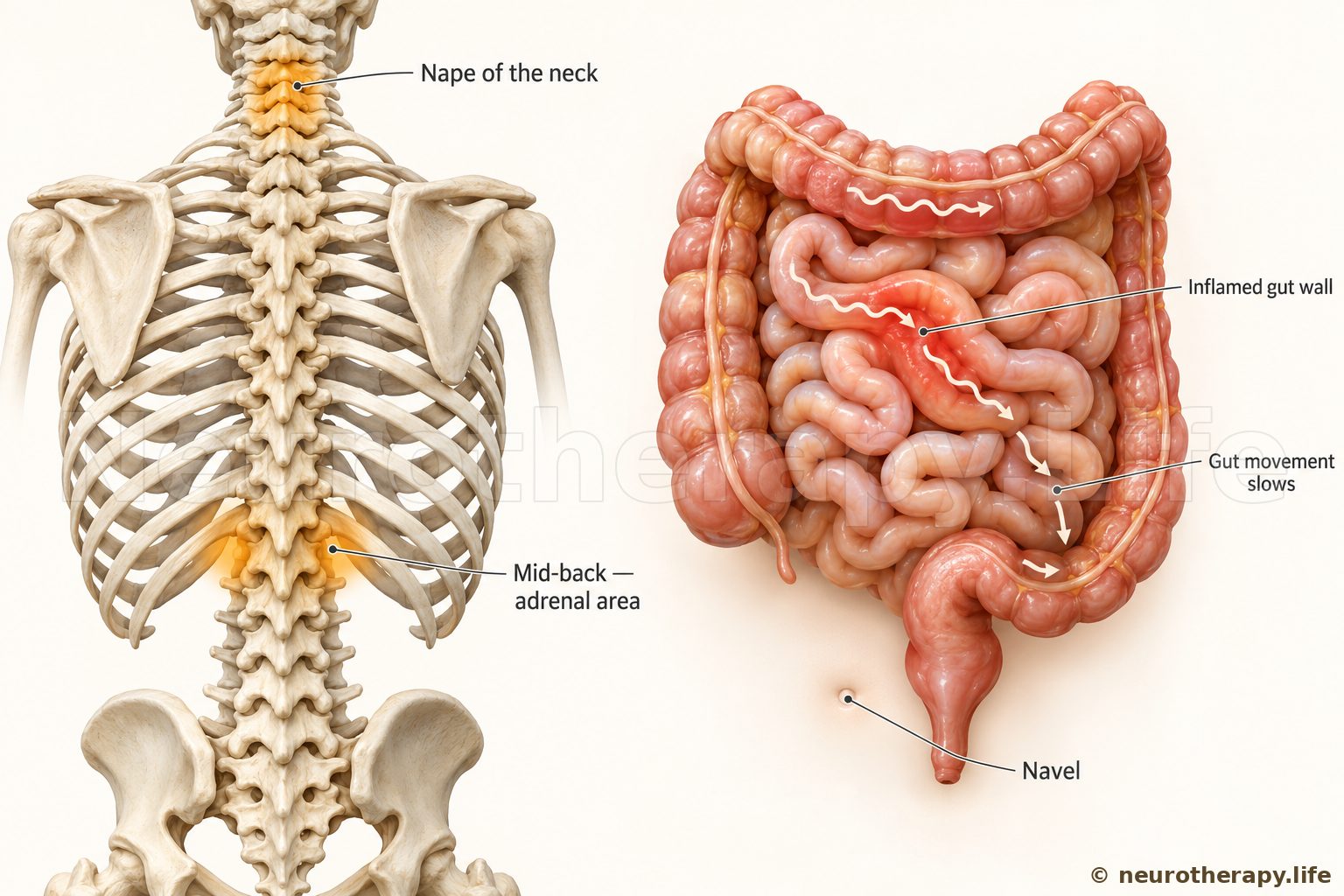
APR for loose motions calms the inflammation first, then slows the gut, and only then treats the abdominal organs.
What it is for
What is it used for?
Belly pain with more than five or six loose motions a day.
To finish strong inflammation first, without rousing bile or the spleen.
To slow a gut that is running much too fast, and stop at the right time.
Points it works through
Which points does it work through?
I (30) Medulla · II (6) Adr (6) Swt × 2 treatments (as needed) · III (6) Adr (6) Swt + (8) Pan (1) Mu – 3 points (1) Liv – 3 points
The points below are listed as a set, with what each contributes. The exact method, including the order, is taught hands-on in the Neurotherapy (LMNT) course. This page lists the points of the formula and what each one contributes; it does not describe how any point is given. For the method, watch the demonstration video of each point on its own page and learn hands-on from a trained Neurotherapist. Please do not give a formula from a written description alone.
Liv – 3 points — the liver point at three stations.
Position:Seated for the neck work, face down for the back, and lying on the back for the abdominal organs.
The exact technique is taught hands-on in the Neurotherapy (LMNT) course. See the course →
How it works
How does it work?
The reasoning behind APR is laid out in four steps. An old infection in the food canal turns into inflammation (swelling and irritation), which causes the pain. The pain also shows that the stomach and intestines are short of blood, so food passes through without being digested or absorbed. The large intestine, short of blood too, cannot take the water back out of the waste — and that watery waste is diarrhoea. So the movement of the gut has to be slowed.
Two findings of the therapy supply the tools. (30) Medulla and (6) Adr calm inflammation, and the pain at the Mu point eases. (6) Swt rouses the adrenal medulla, through which the body's 'slow down' nerves calm the gut. And giving the abdominal organs in reversed order — as in the Ulta Normal formula — slows the gut's movement rather than speeding it.
In class B the inflammation is stronger, so the anti-inflammatory work is given more, and the abdominal organs wait. The adrenal-and-Swt work may be repeated according to need, and the abdominal step is given only once the motions begin to answer.
Why were Gal and Spl taken out? Some patients were not getting full relief. Then came the thought: the bile of the gall bladder is antiseptic, and the spleen makes white blood cells and antibodies. Rousing them could increase the inflammation. So they were taken out — nothing was added, nothing made stronger — and patients who had not been getting full relief began to get it.
In the revised forms, Mu is given before Liv — the reverse of normal. On the written card a line is ruled under that pair as a reminder, and as a daily prompt to ask about the stools.
Its family
Which formulas are related?
The APR group grew in generations: a first version, three classes, and a revision.
Some bellies are a doctor's question before they are a treatment question: blood or mucus in the stool with fever, black tarry stool, sudden severe or worsening pain, a hard swollen belly, vomiting that will not stop, or a patient who is drowsy or cannot keep fluids down. Send the patient to a doctor; do not press the abdomen. How to tell a patient to see a doctor
Diarrhoea harms mainly by the water it takes out. A quiet small child, a frail elder passing little urine, a dry mouth or dizziness on standing need oral rehydration (sugar-and-salt solution) early — treatment by hand never replaces or delays it. Diarrhoea (loose motions)
With this many loose motions, dehydration comes quickly. Check for it at every visit, and send the patient to a doctor if fluids cannot be kept down. Diarrhoea (loose motions)
(6) Adr lowers immunity, so it is not given where immunity is already low — septicaemia, HIV/AIDS or cancer — and it raises alkali, so it is not given in high blood pressure. (6) Adr
(30) Medulla is never given in cancer, and is not given in heart disease. (30) Medulla
Swt is on the LMNT blocking list for heart patients. SWT
Pan raises alkali, so it is not given in fits, convulsions or seizures, and never to people with schizophrenia. Pan
Liv is not given if there is cancer in the liver. Liv
When the motions become completely normal, the slowing work stops and NAN or FAN is given for at least a day, to give the bowel its normal speed back. Forgetting this step can end a week of good work in constipation. NAN
Relief of pain is not proof that nothing is wrong. A belly that eases on the mat still needs a diagnosis if the pain keeps coming back.
No treatment is given without first examining that day's pain points — not even 'the same as yesterday'.
Keep taking the medicines your doctor prescribed. Neurotherapy (LMNT) works alongside your medical care, never instead of it.
Common questions
How is it decided whether to repeat the first steps?
By the stools. Usually the patient feels well soon and the motions begin to stop. If they do not, the anti-inflammatory and gut-slowing work is repeated according to need, and the abdominal step waits.
Why does my therapist ask about my stool every day?
Because the stool is how the treatment reports. How many motions and what form decide whether to continue, repeat, or stop and switch to the closing step.
My motions are normal now. Can I just stop?
Come for one more step. The treatment slowed your bowel on purpose; NAN or FAN for at least a day gives it its normal speed back. Then you are examined again from the beginning.
Should I still drink ORS?
Yes. Sugar-and-salt solution replaces the water and salt that loose motions take out. It comes first, and the treatment works alongside it.
Surprising facts
1Bile really does kill bacteria
Bile acids act like a detergent that breaks open the outer coat of many bacteria. That sound fact is why LMNT later removed Gal from an inflamed belly — rousing bile and the spleen's defence cells could stir the inflammation further.
Source: Begley M, Gahan CGM, Hill C. The interaction between bacteria and bile. FEMS Microbiology Reviews. 2005;29(4):625–651.
2The gut has its own nervous system
The wall of the gut holds a web of hundreds of millions of nerve cells — the enteric nervous system — that runs the squeezing waves of digestion. The 'fight or flight' nerves slow it down; the 'rest and digest' nerves speed it up.
Source: Furness JB. The enteric nervous system and neurogastroenterology. Nat Rev Gastroenterol Hepatol. 2012;9:286–294; Guyton & Hall, 14th ed.
3A kitchen drink made diarrhoea survivable
The gut has a doorway that illness does not close: it takes up sugar and salt together, and water follows. So a drink of sugar and salt in the right balance is absorbed even by a bowel that is pouring fluid out. This oral rehydration has saved millions of lives.
About one and a half litres of fluid reach the large intestine each day, and it takes back almost all of it, leaving only a small amount in the stool. When it cannot, the stool turns watery.
Source: Guyton & Hall, Textbook of Medical Physiology, 14th ed. — absorption in the large intestine.
Test yourself
Research
Strong evidence
This review shows that bile has strong antibacterial action: its acids dissolve bacterial membranes and damage bacteria in several ways. It is the body science behind the reason given for taking Gal out of an inflamed abdomen.
This page explains what a Neurotherapy (LMNT) treatment is for; it is not a self-treatment guide and does not diagnose. Neurotherapy (LMNT) works alongside your medical care — keep taking the medicines your doctor prescribed.
Ready to begin?
Send COURSE for course details, or your name, age and health issue for a consultation.