(6) Swt is the form of the Swt point given without a side, face down beside the spine of the middle back. Through noradrenaline it is used to slow the movement of the intestines in loose motions, and it is a regular part of the abdominal-pain treatments.
Overview
What is (6) Swt?
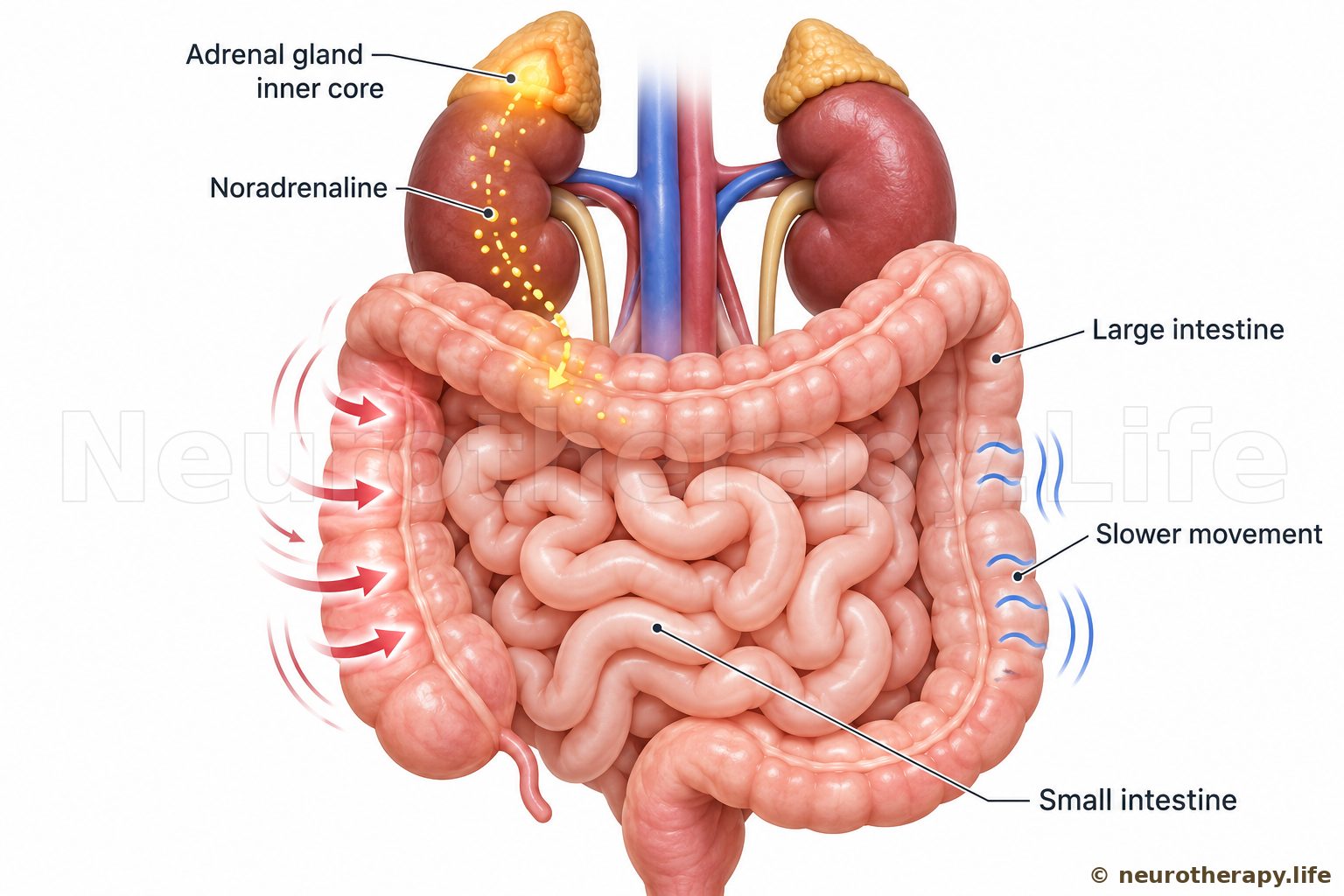
(6) Swt is one named form of the Swt point, which is aimed at the inner core of the adrenal gland. That core makes noradrenaline, a 'fight or flight' messenger that, among other things, slows the gut. Neurotherapy (LMNT) teaching uses (6) Swt to reduce the movement of the intestines when motions are loose.
It is written as one point, without a side. That makes it different from (6) Left Swt and (6) Right Swt, which carry the same number but are given on one side and do opposite things. The number and the side together name the treatment.
Its main home is the APR family — the abdominal-pain-releasing treatments for belly pain with loose motions. There, (6) Swt follows the anti-inflammatory work and slows the gut before the abdominal organs are treated.
(6) Swt is aimed at the adrenal core, whose noradrenaline slows the gut in loose motions.
Where it is given
Where is (6) Swt given?
PositionLying face down
Body areaBeside the spine (never on it) in the middle of the back, about the level where the shoulder blades end; lying face down
You lie face down with pillows under the chest so the head stays straight. The place is the groove beside the spine at about the level of the lower tip of the shoulder blade — the same place as Swt; the number names the form. The demonstration video shows it.
How it is given
How is (6) Swt given?
How this point is given — the tool, the pressure, the count and the exact movement — is deliberately not described here. A demonstration video for this point is being prepared; until it is on this page, learn the method hands-on from a trained Neurotherapist before giving it. Please do not give any point from a written description alone: a point given in the wrong place or the wrong way can do harm.
The number written before a point's name is not a strength setting. Each numbered form is a separate named treatment with its own method and timing, taught hands-on in the course.
SideNone — it is one point without a side
The exact technique is taught hands-on in the Neurotherapy (LMNT) course. See the course →
What it does
What does (6) Swt do in the body?
Neurotherapy (LMNT) teaching describes (6) Swt as reducing the motility — the pushing movement — of the intestines in loose motions, by way of noradrenaline. Body science confirms that noradrenaline and the 'fight or flight' nerves do slow the gut; how a press beside the spine reaches the adrenal core is the therapy's own explanation from clinical experience.
Slows the movement of the intestines in loose motions.
In the abdominal-pain treatments, follows the anti-inflammatory points so that the gut is calmed before the abdominal organs are treated.
Is given in loose motions in place of points that would speed the gut, such as Gas 'I' and Const.
Organs it reaches
Intestines — The small and large intestine, whose pushing movement it is aimed at slowing.
Adrenal glands — The inner core of the adrenal gland — the source of noradrenaline.
Bowel — Loose, frequent stools are the finding that calls for it.
Its family
Which forms is (6) Swt related to?
(6) Swt is one member of the Swt family. Each form is its own treatment with its own cautions.
SWT — The parent point — the adrenal core and the sweat glands.
(6) Right Swt — Same number, right side only — also used in loose motions, and to narrow a widened passage. Not in high blood pressure.
(6) Left Swt — Same number, left side only — the opening side. Not in diabetes.
(3) Swt — The mildest form — smell of sweat or urine, and pimples.
(6) Adr — Its usual partner in the abdominal-pain treatments — for inflammation.
What it is used for
What is (6) Swt used for?
(6) Swt is chosen for loose motions, mostly as part of a formula, after the blocked list has been checked.
Inside the abdominal-pain formulas, (6) Swt is paired with (6) Adr, which carries its own bars: not where immunity is already low (septicaemia, HIV/AIDS, cancer) and not in high blood pressure. (6) Adr
Loose motions with blood, high fever, severe belly pain, drowsiness, or signs of dehydration (very little urine, dry mouth, dizziness) need a doctor and fluids today — especially in children and older people. How to tell a patient to see a doctor
(6) Swt is given on both sides, without a side, to slow the gut. (6) Right Swt is given on the right side only; it also slows the gut but is aimed at narrowing a widened passage, and it is barred in high blood pressure.
Will (6) Swt stop my loose motions straight away?
It is given to slow the gut, usually inside a formula that first calms inflammation. Many patients feel better quickly, but keep drinking fluids, and see a doctor if there is blood, fever or weakness.
Why is it given after Adr?
In the abdominal-pain treatments the reasoning is: first calm the inflammation (Adr), then slow the gut (Swt), and only then treat the abdominal organs.
Surprising facts
1The gut has its own brain
The wall of the gut holds a network of hundreds of millions of nerve cells that can run digestion on its own. The 'fight or flight' nerves act as a brake on it.
Source: Furness JB. The enteric nervous system and neurogastroenterology. Nat Rev Gastroenterol Hepatol. 2012;9(5):286–294.
2Fear slows digestion
In a fright, noradrenaline and adrenaline divert blood away from the gut and slow its movement, so the body's energy goes to the muscles instead.
Source: Hall JE, Hall ME. Guyton and Hall Textbook of Medical Physiology, 14th ed. Elsevier, 2021 — sympathetic control of the gut.
3Loose motions drain water and salt
Diarrhoea can drain large amounts of water and salt. That is why oral rehydration solution — water with the right amounts of salt and sugar — remains the most important first treatment.
Source: World Health Organization. Diarrhoeal disease — fact sheet, 2024.
This page explains what a Neurotherapy (LMNT) treatment is for; it is not a self-treatment guide and does not diagnose. Neurotherapy (LMNT) works alongside your medical care — keep taking the medicines your doctor prescribed.
Ready to begin?
Send COURSE for course details, or your name, age and health issue for a consultation.