Food poisoning
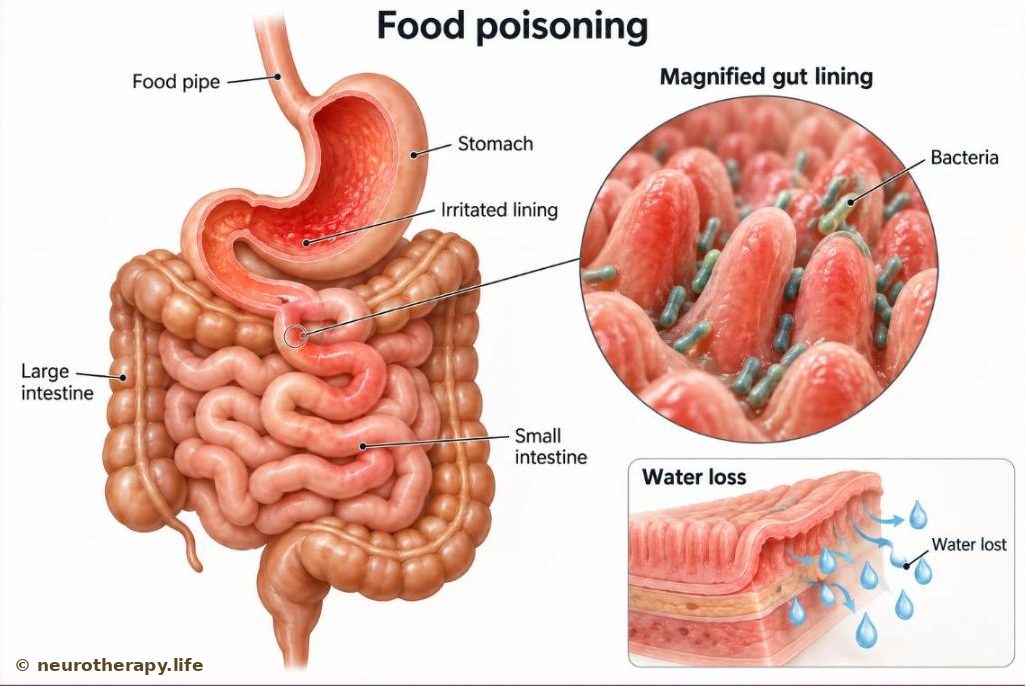
Food poisoning is sickness from eating or drinking something spoiled by germs or toxins. Most people feel better in a day or two — but some signs mean hospital at once.
- About 866 million people — almost 1 in 9 in the world — fall ill each year from contaminated food
- Children under 5 carry 29% of the illness caused by unsafe food
- Signs often start 2 to 6 hours after eating and usually last 12 to 48 hours
Source: World Health Organization (food safety fact sheet); Cleveland Clinic; NHS
What is Food poisoning?
Food poisoning happens when food or water carries germs — bacteria, viruses or parasites — or a harmful chemical. The stomach and intestine react by throwing the food out, through vomiting and loose motions.
Most cases are mild and pass within a few days. The real danger is losing too much water, especially in small children and older people. A few germs and toxins are more serious and can affect the nerves, the kidneys or breathing.
What are the symptoms?
- Nausea and vomiting
- Loose motions (diarrhoea)
- Stomach pain and cramps
- Fever, headache and feeling generally unwell
- Thirst, a dry mouth and little or dark urine — signs of losing water
What causes it, and who is more likely to get it?
Germs
- Bacteria such as Salmonella, E. coli and Campylobacter
- Viruses such as norovirus and hepatitis A
- Parasites in unclean water or food
Chemicals and toxins
- Pesticides left on food
- Metals such as lead, arsenic or mercury
- Toxins made by moulds on stored grain and nuts
How food goes bad
- Vessels and hands not cleaned properly
- Meat, eggs or seafood not cooked through
- Cooked food left warm for hours
- Unclean drinking water
Who gets sicker
- Children under 5 and adults over 65
- Pregnant women
- People with weak immunity or on steroid tablets
How is it found?
Most food poisoning is recognised from the symptoms and from what you ate. Tests are done when it is severe, lasts long or there is blood.
Stool test
A sample of the motion is checked for bacteria or parasites, to find which germ is causing it.
Blood tests
Show infection in the blood and whether the body has lost too much water and salts.
Water check
Are you passing urine? Is the mouth dry? Do you feel dizzy when you stand? These simple questions often matter most.
A neurotherapist first rules out any sign that needs a hospital. Then, with many motions or vomits, the therapist asks about urine, dry mouth and dizziness before anything else — the water matters more than any formula. The therapist also asks to see every tablet you take, including any for blood pressure.
How Neurotherapy (LMNT) sees Food poisoning
LMNT teaching connects food poisoning with the medulla — the lowest part of the brain, where the breathing centre sits — and with acetyl choline, the chemical messenger it needs. If vessels are not cleaned properly after eating, LMNT teaching says, germs such as the botulinum bacteria can breed; their poison can stop the breathing centre from working.
How LMNT reads (15) Medulla
- Medullaholds the breathing centre at the base of the brain
- Acetyl cholinethe messenger the breathing centre, the muscles and the gut need
- (15) Medullathe LMNT point held to make or stimulate acetyl choline
- Breathing and digestionsupported — saliva, gut movement and breathing all use this messenger
LMNT teaching reports that people with food poisoning have been seen to get great benefit from (15) Medulla. For poisoning by toxins — poisonous herbs, bites or the ill effects of medicines — it has other treatments, described on the poisoning page. All of it is given alongside the journey to hospital, never in place of it.
Whether or not the patient gets immediate benefit from our treatment, let no harm reach him through our carelessness — attend to this.
Neurotherapy (LMNT) treatment for Food poisoning, step by step
Emergency signs first
Trouble breathing, swallowing or speaking, blurred vision, blood in vomit or stool, confusion, or no urine — call 108/112 or go to hospital first.
Examine
The therapist checks Liv° and Mu°, counts the motions and vomits, and checks for water loss and blood pressure tablets.
(15) Medulla first
Given seated, on both sides of the neck below the ears. LMNT gives it before any work on the gut and its nerves, because it brings better results there.
Then the gut, by the day's findings
What follows is chosen by the pain points and the number of motions that day — not by the name of the illness.
Points and formulas used
Never do this
- Food poisoning can be an emergency. Trouble breathing, swallowing or speaking, drooping eyelids, blurred or double vision, spreading weakness, blood in vomit or stool, a stiff neck, severe belly pain, confusion, or no urine: call 108/112 or go to hospital at once.
- Never make someone vomit unless a doctor or poison-help line tells you to.
- Neurotherapy (LMNT) is given alongside the journey to hospital, never instead of it. A treatment given while someone carries a child to hospital is one thing; given instead of carrying the child, it is another.
- If the therapist adds (6) Adr for poisoning: never where immunity is already low (septicaemia, cancer, AIDS) and never in high blood pressure. (30) Medulla is never given to heart patients. (6) Adr
- Children get half the adult dose and light treatment only, given by a trained therapist — and a small child with vomiting or loose motions who is not drinking goes to a doctor first.
- Cancer: if the person has cancer, (10) Pan, Thymus, Pit, Lu + Sh, Rt. Ov / Lt. Ov and (30) Medulla are never given — the therapist changes the plan.
- Keep taking the medicines your doctor prescribed. Neurotherapy (LMNT) works alongside your medical care, never instead of it.
Watch

A short self-help demonstration for vomiting, including travel sickness: a finger strokes straight down the Medulla line just beside and below the ear, 30 strokes on the left and 30 on the right — (15) Medulla — with a one-minute gap, repeated two or three times. Talc or a little oil is used so the skin is not rubbed raw.
LMNT teaching lists (8) Medulla — not (15) — for giddiness with nausea and vomiting, and the first point it gives for nausea and vomiting is Gas Only. Vomiting with blood, severe belly pain, a stiff neck or signs of losing water needs a doctor first.
Where (15) Medulla is given — beside and below the ears. The video is about vomiting; with food poisoning, check the emergency signs above first.
From Ayurveda and the kitchen
Test yourself
What research says
- Strong evidence
Botulinum toxin stops nerve endings from releasing acetyl choline, so muscles cannot work. Weakness spreads downward and can stop the breathing muscles. After eating contaminated food, signs usually appear within 12 to 72 hours.
No clinical trial of Neurotherapy (LMNT) in food poisoning has been published yet. Improvements reported by neurotherapists are clinical observations.
For you
Parents of small children
Children under 5 lose water fast. Keep giving small, frequent sips, and see a doctor if the child stops drinking or passes little urine.
Older adults and pregnant women
Food poisoning can hit harder. Do not wait it out for days — see a doctor early.
People with high BP or low immunity
Tell your therapist about every tablet you take. Some LMNT points, such as (6) Adr, are not given to you.
This page explains; it does not diagnose. Neurotherapy (LMNT) works alongside your medical care — keep taking the medicines your doctor prescribed, and see a doctor for any new or severe symptom.