Choosing an abdominal-pain treatment: three teaching cases
Three composite teaching cases show how the abdominal-pain treatments are chosen and corrected: a bar that showed up mid-course, a treatment that only half worked, and a heavy version that tired an older patient.
Overview
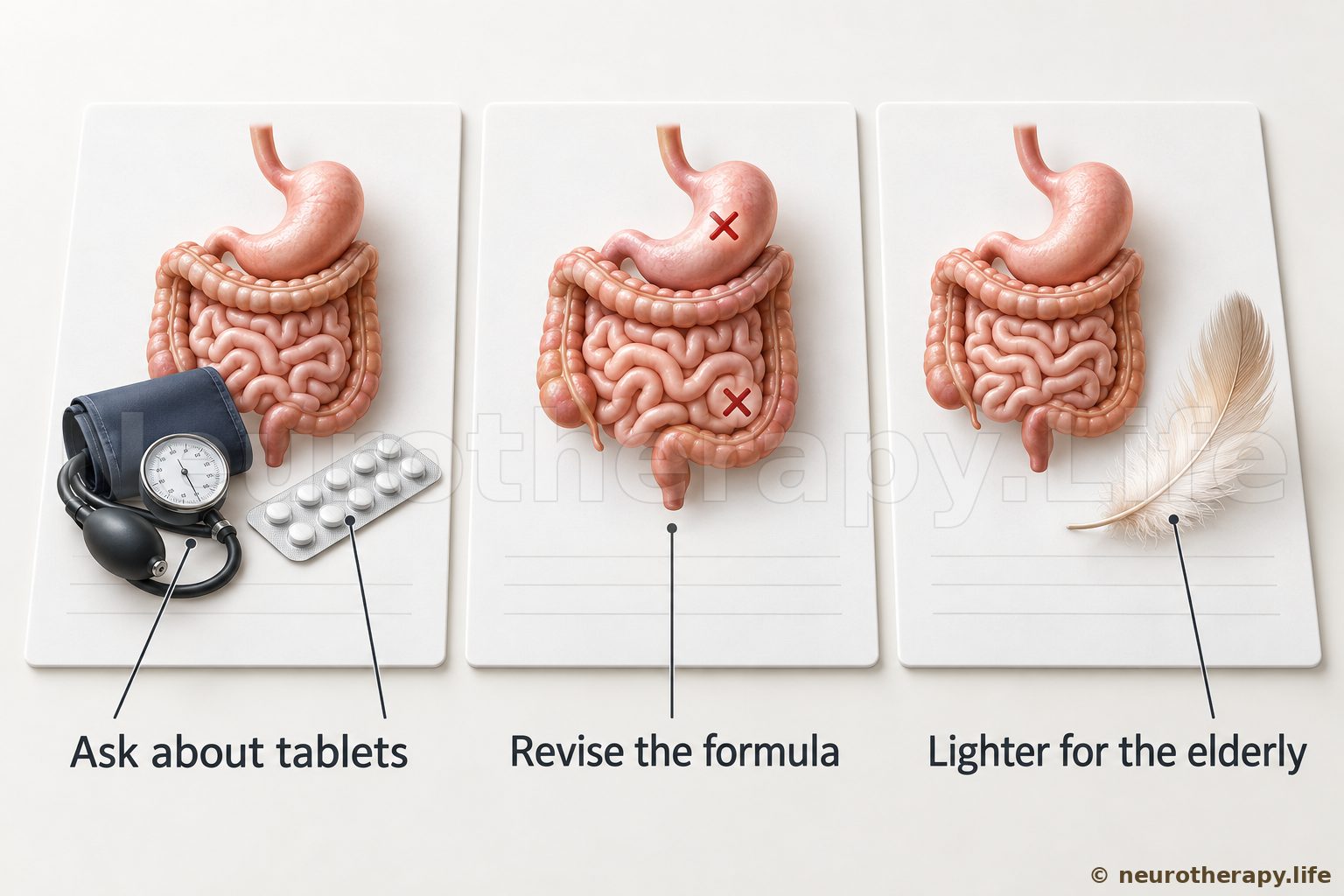
Teaching case one. A bus conductor came with cramping belly pain and many loose motions a day, so the heavier class was chosen. On the second visit he mentioned a blood-pressure tablet he had not counted, because to him the tablet meant his pressure was no longer high. The treatment was stopped where it stood, because (6) Adr is not given in high blood pressure; his doctor was asked for the reading, and the therapy's own treatment for loose motions with high blood pressure, Ulta Normal, was given instead.
The lesson: do not ask whether anyone has said the pressure is high. Ask what tablets the patient takes, and ask to see the strip. When a bar appears mid-course, nothing is invented; the treatment the therapy already writes for that patient is given.
Teaching case two. A tailor with upper-belly pain and a few loose motions a day for a month was given the first version of class A. The pain came down a little and then stayed. The therapist asked what each step was doing, saw that Gal and Spl could feed the inflammation, and gave the revised version without them. Within days the pain eased and the motions became formed. A treatment that half-works is information, and daily grading on the card is what made the plateau visible.
Teaching case three. A retired teacher in her seventies came for 'nothing in particular': a vague belly ache, poor sleep, thin appetite, no loose motions. Class C, Jeevan Dhara, was right, but the heavy version left her tired and quiet. The light version followed, she got up unaided, and over the next weeks the ache went, she walked to the temple again and slept through the night. The light version is not a shortcut; it is the one the therapy prefers.
Key points
- The number of loose motions chooses the class; the bar questions decide whether it may be given.
- Ask what tablets are taken, not only what has been diagnosed.
- A treatment that half-works calls for a change of formula, not more of the same.
- Older patients do better on the light version.
- Every course ends with NAN or FAN once the motions are normal.
Go deeper
Abdominal pain: three kinds, told apart by the loose motions
The three kinds of abdominal pain
APR class B, revised
APR class B, revised
APR class A, revised
APR class A, revised
Ulta Normal
Ulta Normal, for loose motions and high blood pressure
Jeevan Dhara, light version
Jeevan Dhara, the light version
High blood pressure
High blood pressure
Frail and elderly patients (gentle care)
Care for frail and elderly patients
APR: Releasing Pain in the Belly
APR: the abdominal pain group
Read the full guide
This topic is part of: APR: Releasing Pain in the Belly
Safety: when it is held back
- (6) Adr lowers immunity, so it is not given where immunity is already low, such as septicaemia, HIV/AIDS or cancer. It also raises alkali, so it is not given in high blood pressure. (6) Adr
- Blood or mucus in the stool with fever, black tarry stool, sudden or severe belly pain, a hard swollen belly, vomiting that will not stop, or a drowsy patient: see a doctor the same day. These are not treatment questions.
- Diarrhoea harms mainly by the water it takes out. Oral rehydration (sugar-salt solution) comes first, and any treatment is given alongside it, never in its place. Diarrhoea (loose motions)
- Neurotherapy (LMNT) works alongside your medical care. Do not stop or change any medicine on your own; ask the doctor who prescribed it.
Watch

A demonstration of the Ulta Normal formula for loose motions: (8) Pan on both thighs, then Spl before Gal and Mu before Liv — the Normal formula's order reversed to slow the bowel.
The video's counts ((3) Spl, (3) Gal, (5) Mu, (7) Liv) differ from LMNT teaching, which gives (1) Spl, (1) Gal, (1) Mu – 3 points and (1) Liv – 3 points. Ulta Normal is stopped as soon as the stool is formed, and the Normal formula is given for at least one day.

A practical training demo on the Gal (gall bladder) point: how to give 1 Gal, 3 Gal and 1 Point Gal, used to support bile flow and digestion.
This page explains what a Neurotherapy (LMNT) treatment is for; it is not a self-treatment guide and does not diagnose. Neurotherapy (LMNT) works alongside your medical care — keep taking the medicines your doctor prescribed.