(6) Left Swt (the opening side of the adrenal core point)
Also called: Six Left Swt, (6) Lt. Swt, Left Swt
(6) Left Swt is the left-sided form of Swt, the Neurotherapy (LMNT) point for the inner core of the adrenal gland. It is the opening side: it is used to widen a sphincter, valve or passage that has become narrow — as in difficulty breathing in with asthma, or difficulty swallowing. Because adrenaline raises blood sugar, it is not given to diabetic patients.
Overview
What is (6) Left Swt?
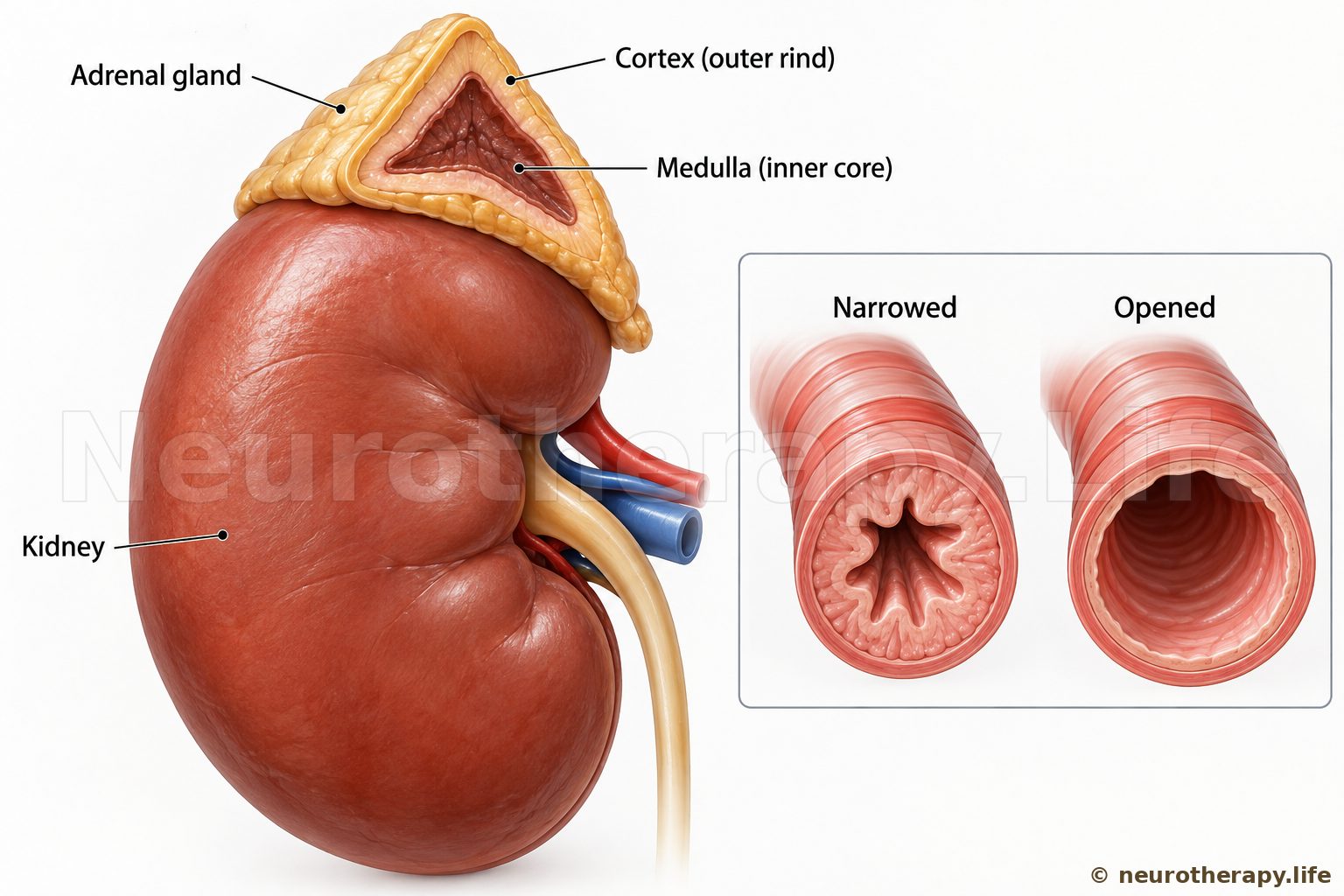
Each adrenal gland sits like a small cap on top of a kidney, and it is really two glands in one wrapper. The outer rind (cortex) makes slow hormones such as cortisol. The inner core (medulla) makes the two fast "fright" hormones: adrenaline (epinephrine) and noradrenaline (norepinephrine). Swt is the point named for this inner core, and for the sweat glands.
In Neurotherapy (LMNT) the side is part of the point. (6) Left Swt and (6) Right Swt are not two sides of one treatment but two opposite treatments. The left one opens — it is held to work through adrenaline, which widens some vessels and airways. The right one closes — it works through noradrenaline.
So a narrowed passage asks for the left side, and a slack one asks for the right. The mechanism chooses the side.
Swt is named for the inner core of the adrenal gland. Its left form is the opening side.
Where it is given
Where is (6) Left Swt given?
PositionLying face down
Body areaBeside the spine on the LEFT, in the middle of the back at about the level where the shoulder blade ends; lying face down
You lie face down with pillows under the chest so the head stays straight. The place is the groove on the left of the spine at about the level of the lower tip of the shoulder blade. The demonstration video (15 Left Medulla, 6 Left Swt) shows it.
How it is given
How is (6) Left Swt given?
How this point is given — the tool, the pressure, the count and the exact movement — is deliberately not described here. A demonstration video for this point is being prepared; until it is on this page, learn the method hands-on from a trained Neurotherapist before giving it. Please do not give any point from a written description alone: a point given in the wrong place or the wrong way can do harm.
The number written before a point's name is not a strength setting. Each numbered form is a separate named treatment with its own method and timing, taught hands-on in the course.
SideLeft only — the opening side
The exact technique is taught hands-on in the Neurotherapy (LMNT) course. See the course →
What it does
What does (6) Left Swt do in the body?
The teaching holds that (6) Left Swt stimulates adrenaline from the adrenal core. Body science confirms that adrenaline relaxes the airways and widens the vessels inside working muscle; the link from a press on the back to that hormone is the therapy's own explanation.
Opens — dilates — any sphincter (ring of muscle), valve or duct that has become narrowed.
For difficulty breathing in, as in asthma.
Where the food pipe has narrowed and swallowing is hard, immediate benefit has been found.
Where a narrowed urinary passage makes urine come with burning and pain in a forceful jet, it gives relief.
It can reduce the lower (diastolic) blood pressure reading.
Organs it reaches
Adrenal glands — The inner core, which makes adrenaline.
One point, split by number and by side, becomes several different treatments.
SWT — The parent point — the adrenal core and the sweat glands.
(6) Right Swt — The closing side — loose motions, bronchitis (difficulty breathing out), swelling from varicose veins, leaking urine. Not in high blood pressure.
(6) Swt — No side — slows the intestine in loose motions.
(3) Swt — The mildest form — smell of sweat or urine, and pimples.
ADR — The neighbouring point for the outer rind (cortex) of the same gland.
Medulla — Left Medulla is paired with Left Swt in the opening line; the Medulla point stimulates the brain, Swt the adrenal core.
What it is used for
What is (6) Left Swt used for?
It is chosen when the finding is a passage that will not open.
Breathing
AsthmaDifficulty breathing in. Note that an asthma card is not empty — this point is given for breathing.
Its closing mirror. The opening line pairs (15) Left Medulla with (6) Left Swt; the closing line pairs the Right forms.
Safety: when it is held back
Diabetes: adrenaline raises blood sugar, so (6) Left Swt is not given to diabetic patients. Diabetes
Heart disease: Swt is blocked in heart disorders — it is given with real physical pressure on the back, and it provokes the adrenal core, from which blood pressure can rise. Angina (chest pain from the heart)
High blood pressure: Swt is on the blocked list for high blood pressure. The closing form, (6) Right Swt, is the one written as forbidden there; any Swt in a high-pressure patient is a decision for a senior therapist. High blood pressure
The enlarged-prostate use carries its own question mark in the teaching and must not be promised to a patient. A narrowed food pipe or painful urine also needs a doctor's diagnosis. How to tell a patient to see a doctor
“When Left Swt is given with Left Medulla, sphincters or arteries will open or dilate; when Right Medulla and Right Swt are given, sphincters or arteries will narrow or constrict.”
— Dr. Lajpatrai Mehra
A teaching case
Teaching case: the man who could not swallow water
A teaching case from a camp: a man came whose food pipe had narrowed over several years, so that even a sip of water took him a long time to swallow. Reasoning that a narrowed passage is to be opened, and the left side opens, he was given Left Medulla with Left Swt; straight afterwards he drank water comfortably. On the next day the nerve of the food pipe was added rather than the first day being simply repeated, and months later he reported no difficulty swallowing.
A composite case written to teach the reasoning — not one patient’s file.
Common questions
Why does it matter which side is written?
Because the left and right forms do opposite things: the left opens a narrowed passage, the right tightens a slack one.
I have asthma and diabetes. Can I have it?
No — adrenaline raises blood sugar, so it is not given in diabetes. Your therapist will choose from the other treatments named for breathing.
Is it the same as an adrenaline injection?
No. Nothing is injected. The therapy holds that the press stimulates the body's own gland; an asthma attack that does not ease still needs emergency medical care.
Surprising facts
1One gland, two organs
The adrenal cortex is steered by hormones from the brain; the medulla is wired straight to the nervous system — its cells are nerve cells that release their message into the blood.
Source: Guyton & Hall, Textbook of Medical Physiology (adrenal medulla).
2Why adrenaline can lower the bottom number
Adrenaline widens the vessels inside working muscle, so the lower (diastolic) reading can fall while the heart beats harder. Noradrenaline mostly narrows vessels and raises both readings.
Source: Guyton & Hall, Textbook of Medical Physiology (effects of epinephrine and norepinephrine).
3It opens the airways
Adrenaline relaxes the smooth muscle of the airways — which is why it is the emergency drug for severe allergic reactions that close the throat and chest.
Source: Guyton & Hall, Textbook of Medical Physiology (beta-2 receptors).
4It raises blood sugar
Adrenaline releases sugar from the liver's store so the body can fight or flee — exactly why the left form is kept away from diabetic patients.
Source: Guyton & Hall, Textbook of Medical Physiology (metabolic effects of epinephrine).
This page explains what a Neurotherapy (LMNT) treatment is for; it is not a self-treatment guide and does not diagnose. Neurotherapy (LMNT) works alongside your medical care — keep taking the medicines your doctor prescribed.
Ready to begin?
Send COURSE for course details, or your name, age and health issue for a consultation.