Reading the stool: the seven stool forms and what they mean
A simple wall chart of seven stool forms lets a patient point instead of describe. Hard forms lean towards the acidic side, loose forms towards the alkaline side, and some colours must go to a doctor.
Overview
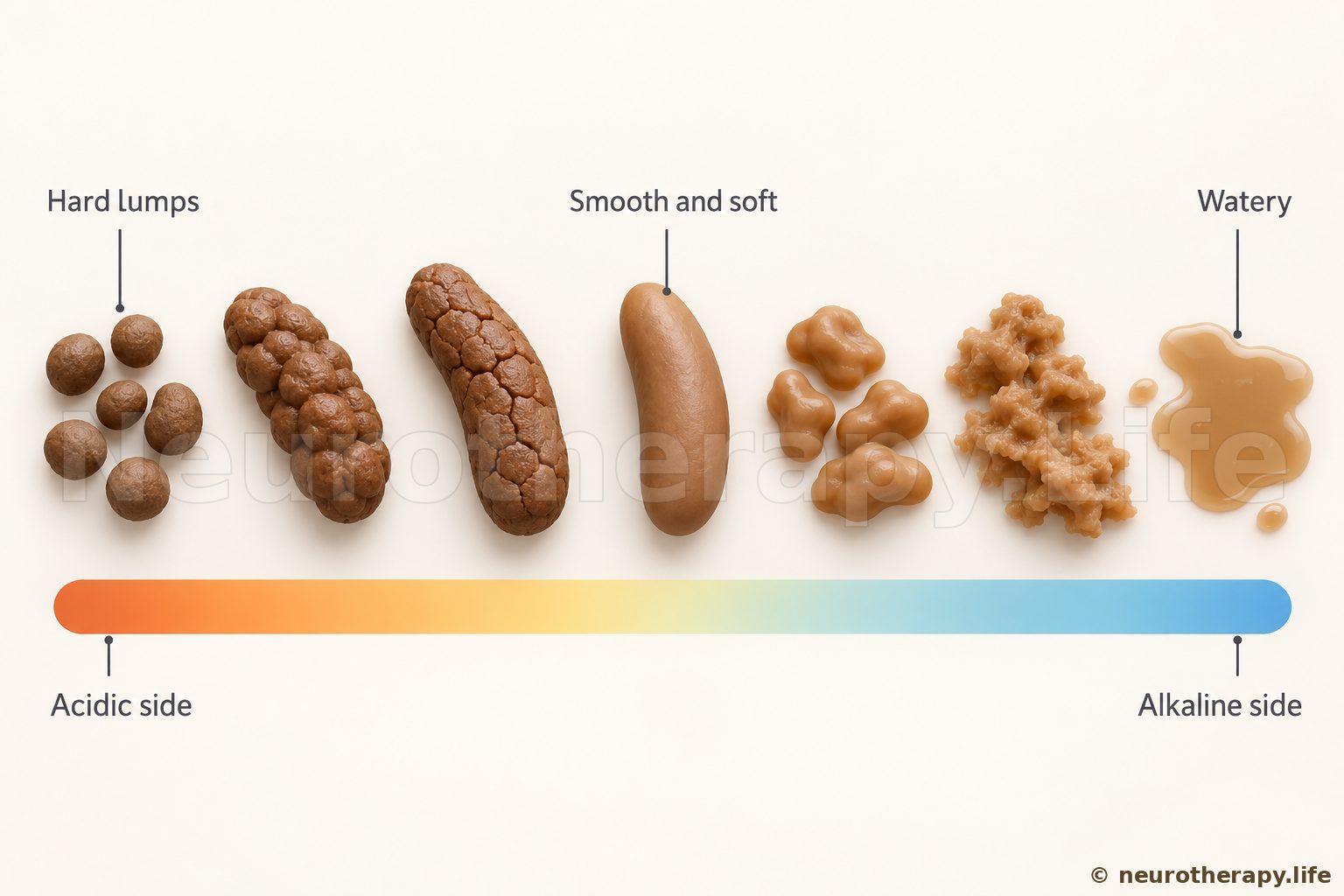
Most patients cannot describe their stool in words and would rather not try. So the chart hangs on the wall like any other chart, and the question becomes a pointing question: which of these seven is yours on most days, and which on a bad day? The gap between the two answers is itself useful.
The seven forms run from separate hard lumps, through a smooth soft sausage shape, to soft blobs, mushy pieces and finally watery stool. The form shows the speed of the journey through the bowel better than the number of visits to the toilet. In Neurotherapy (LMNT), hard forms belong to the acidic side, with tenderness expected at Mu°. Loose forms belong to the alkaline side, with tenderness expected at Liv°.
Colour is read too. Ordinary brown comes from bile pigment and means bile is arriving. Pale, clay-coloured stool means bile is not arriving normally. A floating stool is usually just gas from fibre-rich food, unless it comes with a bulky, pale, greasy look and weight loss.
Four readings are taken together: form, frequency, effort and content. None stands alone. They are read alongside the pain points around the navel, the B12 and folic acid points, and in women the menstrual history.
Key points
- Let the patient point at a chart rather than describe the stool.
- Ask for a good day and a bad day; the swing between them is a finding.
- Hard forms lean acidic; loose forms lean alkaline.
- Record the form as a number so it can be compared next month.
Go deeper
What the Bowel Tells You: Constipation, Stool and Water
What the bowel tells you: the full guide
Constipation
Constipation: when stools stay hard and slow
Diarrhoea (loose motions)
Loose motions: when the journey is too fast
Mu°
Mu°, the point read in the acidic direction
Liv°
Liv°, the point read in the alkaline direction
Bowel
The bowel and how it clears itself
Piles, fissure, fistula and prolapse: one family with one root
Piles and its family of related complaints
Read the full guide
This topic is part of: What the Bowel Tells You: Constipation, Stool and Water
Safety: when it is held back
- Black, tarry stool must never be explained away. Iron tablets can blacken stool harmlessly, but so can bleeding higher up. See a doctor.
- Pale, clay-coloured stool with dark urine or yellow eyes is a matter for a doctor today. Hepatitis
- Blood of any colour in the stool, at any age, goes to a doctor. It is never put down to piles until a doctor has looked. Piles (haemorrhoids) and fissure
- A bulky, pale, greasy, floating stool with weight coming off needs a doctor’s opinion.
This page explains what a Neurotherapy (LMNT) treatment is for; it is not a self-treatment guide and does not diagnose. Neurotherapy (LMNT) works alongside your medical care — keep taking the medicines your doctor prescribed.