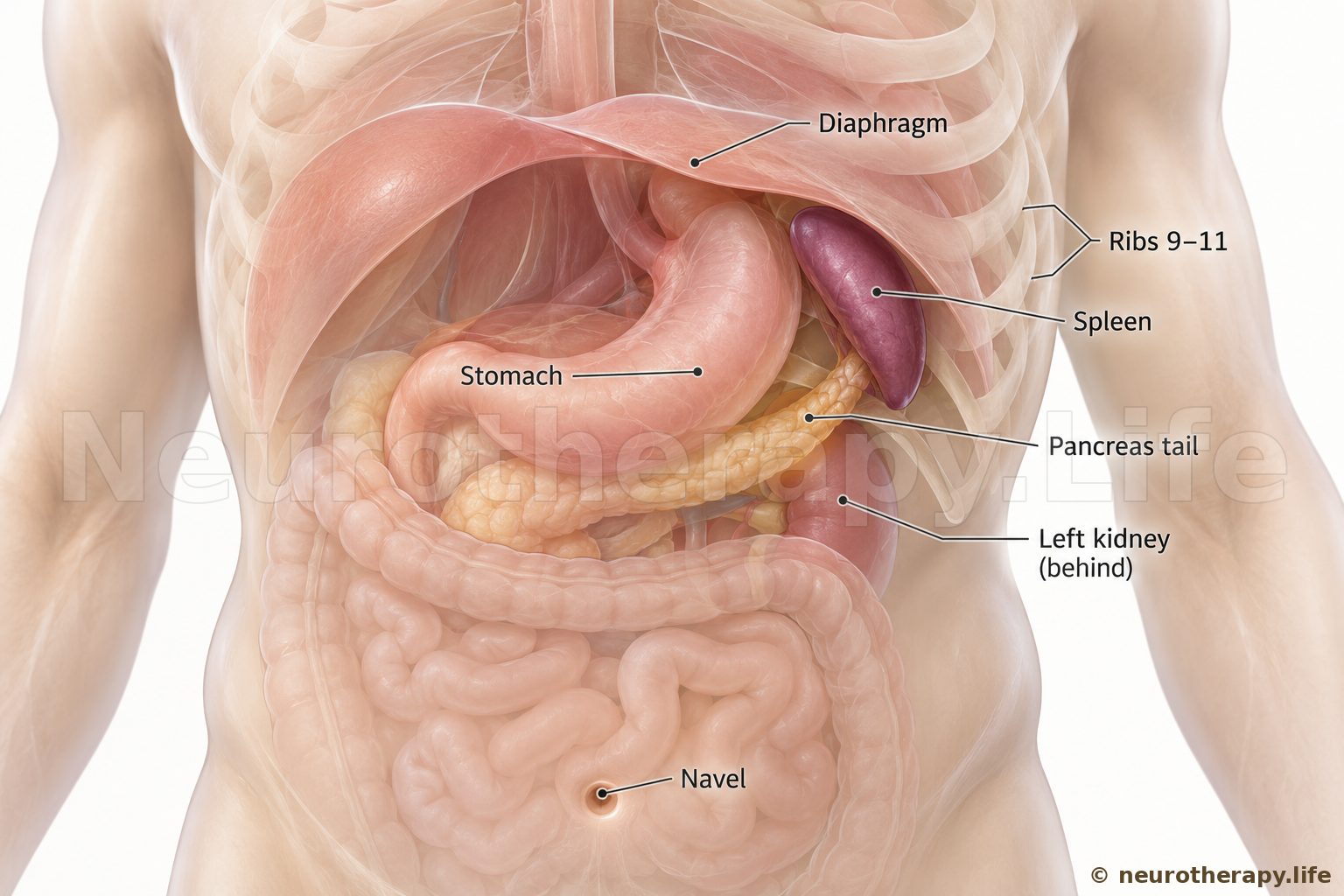
A fist-sized, purple organ tucked high on the left under the ribs that filters your blood, clears out worn-out red cells and helps fight infection. In LMNT the Spl point is read under the left ribs — and Guruji's teaching is careful to say the name is an address, not a claim that you are touching the spleen.
Overview
What is the spleen?
Your spleen is a soft, purplish organ about the size of your fist. It sits in the upper left part of your belly, behind the stomach and under the diaphragm, sheltered by the ninth to eleventh ribs.
It belongs to the lymphatic and immune system. It filters your blood the way a lymph node filters lymph: it removes old and damaged red blood cells and recycles their iron, catches germs in the blood, and makes antibodies. It also keeps a store of platelets and white cells ready for emergencies.
You can live without a spleen, but the body is then less able to fight certain infections. In Guruji's teaching the spleen makes white cells and antibodies — so the Spl point is used in some infections and carefully held back in others, such as allergy, asthma and autoimmune disease.
The spleen hides high on the left, behind the stomach and under the ribs.
Function
What does the spleen do?
The spleen is a filter and a guard post on the blood's highway. It checks the blood that passes through, removes what is worn out or foreign, and raises the alarm when germs appear.
Removes old and damaged red blood cells, which normally live about 120 days.
Recycles their iron, sending it back to the bone marrow to build new red cells.
Catches bacteria in the blood — especially those with a slippery coat that are hard for other defences to grab.
Makes antibodies and houses many lymphocytes (white cells of the immune system).
Holds about a third of the body's platelets, and a reserve of monocytes that can be sent out after an injury.
Before birth, it helps make blood cells.
Blood arrives
The splenic artery, a winding branch from the aorta, brings blood into the spleen at its hilum, the notch where vessels enter.
The white pulp checks for germs
Blood passes sleeves of lymphocytes around the small arteries. Germs meet immune cells here, and antibodies are made.
The red pulp squeezes the red cells
Red cells must squeeze through slits far narrower than themselves. Young, flexible cells bend and pass; old, stiff ones get stuck.
Cleaners break them down
Large cleaner cells (macrophages) swallow the stuck cells and germs, keep the iron, and pass the rest of the pigment on to the liver.
Blood leaves for the liver
Cleaned blood leaves through the splenic vein, which joins the gut's veins to form the portal vein to the liver.
How does the spleen work with other organs?
Blood — The spleen checks the blood, removes worn-out red cells and stores platelets.
Liver — Its vein drains into the liver's portal vein; the two share the work of clearing old red cells, and liver disease can make the spleen swell.
Thymus — Trains the T-cells that later settle in the spleen's white pulp.
Stomach — Its close neighbour in front; small arteries from the spleen's artery supply the top of the stomach.
Pancreas — Its tail reaches the spleen, and the spleen's vessels run along the pancreas.
Lymph and immunity — The spleen is the largest organ of the lymphatic system.
Anatomy
What are the parts of the spleen?
Cut a spleen open and you see two kinds of tissue: a dark red pulp that makes up most of it, and small pale islands of white pulp.
Structure
Capsule — A thin, fibrous outer layer. It is not strong, which is why an injured spleen can bleed heavily.
Hilum — The notch on the inner side where the artery enters and the vein leaves.
Red pulp — Most of the spleen: a spongy mesh of blood spaces and narrow slits where old red cells are filtered out.
White pulp — Small islands of lymphocytes wrapped around the little arteries — the immune part of the spleen.
Marginal zone — The border between red and white pulp, where blood-borne germs are first caught.
Blood vessels
Splenic artery — A winding artery that runs along the top of the pancreas to the spleen.
Splenic vein — Runs behind the pancreas and joins the gut's main vein to form the portal vein to the liver.
Short gastric vessels — Small branches that also supply the top of the stomach.
Cells at work
Macrophages — Large cleaner cells that swallow old red cells and germs.
B and T lymphocytes — B cells make antibodies; T cells direct and support the immune response.
Stored platelets and monocytes — Kept in reserve and released when the body is injured or under stress.
Where is the spleen located?
The spleen lies high in the upper left part of your belly, just under the diaphragm and towards the back, behind the ninth to eleventh ribs. Its long axis follows the tenth rib. The stomach lies in front of it, the left kidney behind and below, the tail of the pancreas at its inner side, and the bend of the large intestine beneath.
A healthy spleen cannot be felt through the belly wall at all. A spleen that a doctor can feel below the left ribs is an enlarged one.
In LMNT the Spl point is under the left rib margin — the mirror of Gal. Guruji's teaching is honest that the spleen is not under the finger there; under it lie the stomach and the bend of the large bowel. The name records that tenderness at that place goes with disorders connected with the spleen. On the back chart, 'pain due to spleen disorder' is shown in the lower back ribs on the left. In treatment, Spl is given on the right thigh.
The spleen is soft, spongy and dark purple-red, shaped a little like a large coffee bean or a clenched fist. Its outer surface is smooth and curved to fit under the diaphragm; its inner surface is shaped by the stomach, kidney and colon pressing against it.
Its upper edge often has one or two notches — which a doctor can sometimes feel when the spleen is enlarged.
How big is the spleen?
Anatomy students learn it by the odd numbers 1, 3, 5, 7, 9, 11: the spleen is roughly 1 inch thick, 3 inches wide and 5 inches long (about 2.5 × 7.5 × 12.5 cm), weighs about 7 ounces (roughly 150–200 g), and lies between the 9th and 11th ribs.
In some illnesses — long-standing malaria, some blood cancers or liver disease — it can swell to more than a kilogram and reach far down into the belly.
Conditions and disorders
What conditions and disorders affect the spleen?
The commonest spleen problem is enlargement (splenomegaly), which is a sign of something else — an infection, a liver problem or a blood disease. An injured spleen can bleed dangerously.
Infection and fever
Fever and viral feverMalaria, typhoid and glandular fever can make the spleen swell.
InfectionsThe spleen catches germs in the blood; LMNT uses Spl in viral fever and similar infections.
Septicaemia (sepsis)Infection in the bloodstream — a special danger for people without a spleen.
HIV/AIDSListed in the teaching among the conditions for which Spl is given.
Blood
AnaemiaAn overactive or enlarged spleen can destroy red cells too fast.
ITP (low platelets)In ITP the spleen removes antibody-coated platelets; removing the spleen is sometimes part of treatment.
Leukaemia (blood cancer)Blood cancers often enlarge the spleen. LMNT does not give Spl in cancer.
Where Spl is held back
Autoimmune disordersNot given in autoimmune disorders, where provoking the immune cells may worsen the disease.
DiabetesThe teaching does not give Spl in diabetes.
AllergyIn cold, allergy and asthma the teaching says Spl does harm.
InflammationGal and Spl are taken out of treatments for an inflamed abdomen.
The bowel next door (as LMNT uses Spl)
ConstipationIn constipation formulas, Spl is given for the part of the large bowel near the spleen — not for the spleen.
Diarrhoea (loose motions)In Ulta Normal, for loose motions, Spl is given before Gal — the Normal order reversed.
What are common signs of a spleen problem?
Often none — an enlarged spleen is frequently found only on examination or a scan
A feeling of fullness, or pain, under the left ribs
Feeling full after only a little food, because the spleen presses on the stomach
Tiredness, pale skin, frequent infections, or easy bruising and bleeding
Pain at the tip of the left shoulder after a blow to the left side — a possible sign of bleeding
After an injury to the left ribs: belly pain, dizziness, a fast pulse or fainting — call 108/112
What tests check the spleen?
Examination — A doctor feels and taps under the left ribs; a spleen that can be felt is enlarged.
Ultrasound — Measures the spleen's size quickly and without radiation.
Blood count and blood smear — Show red cells, white cells and platelets, and how they look under the microscope.
Tests for the cause — For example a malaria test, liver tests or tests for viral infections.
CT or MRI — For a detailed look, especially after an injury.
How are spleen problems treated?
Treating the cause — When the infection, liver problem or blood disease is treated, an enlarged spleen often shrinks back.
Protecting an enlarged spleen — No contact sports or heavy lifting until a doctor says it is safe, because a swollen spleen can tear.
Surgery — The spleen may be removed (splenectomy) after serious injury or in some blood diseases; sometimes only part is removed.
Vaccines and antibiotics after removal — People without a spleen need vaccines against pneumococcus, meningococcus and Hib, a yearly flu shot, and sometimes daily antibiotics.
Neurotherapy (LMNT)
Guruji's teaching reads the spleen chiefly as a maker of white cells and antibodies, and that one idea explains almost every rule about its point. Spl is given in viral fever, septicaemia and similar infections, where more defence is wanted. It is held back where more immune activity would do harm: in cold, allergy and asthma; in diabetes and other autoimmune disorders; nowadays in cancer; and in an inflamed abdomen, where Gal and Spl were taken out of the treatments. The teaching printed these changes openly — 'nowadays' — as rules revised on experience. The Viral Treatment Formula shows the same narrowing across three generations: (3) Spl, then one point of Spl, then Spl only when the Spl point is painful. The second idea is that a point's name is an address, not a description of the parcel. In the Normal and constipation formulas, Spl is given not for the spleen at all but for the left end of the transverse colon and the top of the descending colon, which lie in the same region and share its blood. The point is read under the left ribs and given on the right thigh, in the same stance as Gal. This is support alongside your doctor's care.
Points
Spl — The spleen point: the therapist's left sole down the patient's right thigh, three or four stations from hip to knee, six seconds each. For pain below the left ribs, found in blood disorders and diseases of the spleen.
Lymph — Opens the Viral Treatment Formula — both heels at the groin, for the lymph.
Th. Only — The breastbone rubs of the thymus, which stay in every generation of the viral formula.
Const — Given beside Spl in the left-side constipation work.
Mu — After Spl in the constipation run: the middle part of the descending colon, and lubrication of the intestine.
Lt. Ov. — The last of the left-side run: the lower descending colon, the sigmoid colon and the rectum.
Gal–Spl Ghisai — A soft rubbing at the rim of the pelvis, named after the Gal and Spl codes — for blockage in the lymph nodes and swelling of the legs.
“Whenever there is an obstruction or blockage in the blood circulation of any part of the body, then pain or numbness is felt in that part.”
— Dr. Lajpatrai Mehra
“Neurotherapy (LMNT) treats according to the condition of the body.”
— Dr. Lajpatrai Mehra
“This is exactly how it should be. And this itself is the secret of Neurotherapy (LMNT)'s success.”
— Dr. Lajpatrai Mehra
Never do this
Spl is not given in cold, allergy or asthma, where the teaching says it does harm; not in diabetes or other autoimmune disorders; and nowadays not in cancer. Spl
Gal and Spl are not provoked in an inflamed abdomen: the spleen makes white cells and antibodies, and the inflammation could increase. APR class A, revised
The Viral Treatment Formula is not given in autoimmune disorders, because provoking the lymphocytes may increase the disease. In old diseases, Spl is added only if the Spl point is painful. VTF (Mild)
Spl is given on the thigh and carries no risk to the spleen on that account. But in malaria, typhoid, blood diseases and long-standing liver trouble the spleen swells and becomes fragile: no firm or sustained pressure over the upper left belly, and a firm, tender fullness under the left ribs goes to a doctor the same day. How to tell a patient to see a doctor
With an enlarged spleen, avoid contact sports, heavy lifting and any blow to the left side until your doctor says it is safe.
After a blow to the left ribs or belly: belly pain, pain at the tip of the left shoulder, dizziness, a fast pulse or fainting can mean a torn spleen — call 108/112 at once.
If you have no spleen, or it does not work, treat any fever as urgent and see a doctor the same day. Keep your vaccines up to date and tell every doctor and therapist.
Keep taking prescribed medicines. Neurotherapy (LMNT) works alongside your doctor's care, not in place of it.
Care
How can I keep my spleen healthy?
There is no special food for the spleen. Protecting it mostly means preventing the infections and liver problems that make it swell, and guarding it from injury.
Prevent mosquito bites
Repeated malaria is a common cause of an enlarged spleen in India. Use nets, repellents and screens, and get fevers tested.
Safe water and food
Typhoid and other infections spread through contaminated water and food.
Look after your liver
Long-standing liver disease backs blood up into the spleen and makes it swell. Limit alcohol and keep a healthy weight.
Protect your left side
Wear a seat belt, and use proper padding in contact sports — especially while recovering from glandular fever or malaria.
Keep vaccines up to date
Especially important if your spleen has been removed or does not work well — ask your doctor which ones you need.
Feed your red cells
Iron, folate and vitamin B₁₂ from dal, green vegetables, milk and other foods keep the red cells the spleen checks every day in good shape.
Common questions
Can you live without a spleen?
Yes. The liver and lymph nodes take over many of its jobs. But the body is less able to fight certain bacteria, so people without a spleen need extra vaccines, sometimes daily antibiotics, and must treat any fever as urgent.
What does an enlarged spleen mean?
It is a sign, not a disease. Common causes include infections such as malaria, typhoid or glandular fever; liver disease; and blood diseases, including some blood cancers. In children in India, repeated malaria and inherited blood conditions such as thalassaemia are frequent causes. A doctor needs to find the reason.
Where would I feel spleen pain?
Usually under the left ribs, in the upper left belly, sometimes as a dragging fullness. Bleeding from the spleen can irritate the diaphragm and be felt at the tip of the left shoulder. On LMNT's back chart, spleen pain is shown in the lower back ribs on the left.
Why is the spleen point used for constipation?
Not for the spleen. In Guruji's teaching every point is named after the chief organ of its region, but it raises blood flow in all the organs there. Above and to the left of the navel, besides the spleen, lie the left end of the transverse colon and the top of the descending colon — and that is what Spl is given for in constipation. Read the names as addresses.
Why is Spl held back in allergy, asthma and autoimmune disease?
Because the teaching reads the spleen as a maker of white cells and antibodies. Where the immune system is already over-active — in allergy, asthma or autoimmune disease — provoking it further may add to the trouble. The same reasoning took Spl out of treatments for an inflamed abdomen.
Why is Spl given on the right thigh when the spleen is on the left?
In LMNT, pressure on the right limbs relieves pain on the left of the navel, and the legs are used for pain above the navel. So the Spl area, above and to the left, is reached through the right thigh — the mirror of Gal on the left thigh.
What should I ask my doctor or therapist?
Is my spleen enlarged, and what is causing it?
Which activities or sports should I avoid, and for how long?
Are my blood counts — red cells, white cells and platelets — normal?
If my spleen is removed, which vaccines and medicines will I need?
What should I do if I get a fever?
For my therapist: is the Spl point tender, and is Spl blocked for me — for example because of asthma, allergy, diabetes or an autoimmune condition?
Surprising facts
1Red cells must squeeze through slits far narrower than themselves
A red blood cell is about 7–8 micrometres across, yet in the spleen it must squeeze through slits roughly a micrometre wide. Young, flexible cells fold and slip through; old, stiff ones get stuck and are removed. It is a fitness test every red cell takes again and again.
Source: Mebius RE, Kraal G, Nat Rev Immunol 2005;5:606–616; Pivkin IV et al., PNAS 2016;113:7804–7809 (biomechanics of red cells passing splenic slits)
2Remember it with odd numbers: 1, 3, 5, 7, 9, 11
Medical students learn the spleen with a counting rhyme: 1 inch thick, 3 inches wide, 5 inches long, about 7 ounces in weight, lying between the 9th and 11th ribs. It is a rough guide, but a surprisingly good one.
Source: Moore KL, Dalley AF, Agur AMR. Clinically Oriented Anatomy (spleen: the '1, 3, 5, 7, 9, 11' rule)
3It holds about a third of your platelets
At any moment about one-third of the body's platelets — the tiny cells that plug bleeding — are pooled in the spleen. When the spleen is much enlarged it can hold far more, which is one reason the platelet count can fall.
Source: Aster RH. Pooling of platelets in the spleen: role in the pathogenesis of 'hypersplenic' thrombocytopenia. J Clin Invest 1966;45:645–657
4It keeps an emergency army of white cells
Researchers found that the spleen holds a large reserve of monocytes — a kind of white cell. After a heart attack in experiments, this reserve poured out of the spleen and travelled to the injured heart.
Source: Swirski FK et al. Identification of splenic reservoir monocytes and their deployment to inflammatory sites. Science 2009;325:612–616 (experiments in mice)
5Sea nomads have bigger spleens
The Bajau people of South-East Asia have dived for food for generations. Their spleens are about 50% larger than their land-farming neighbours'. When a diver holds their breath, the spleen squeezes extra oxygen-carrying red cells into the blood — like a built-in scuba tank.
Source: Ilardo MA et al. Physiological and genetic adaptations to diving in sea nomads. Cell 2018;173:569–580
6Many people have a spare spleen
About one person in ten has one or more small extra spleens, called accessory spleens or splenules, usually the size of a pea or marble, near the main one. They are harmless — and can even take over the work if the main spleen is removed.
Source: Gray's Anatomy (41st ed.) — accessory spleens in about 10% of people; StatPearls, 'Anatomy, Abdomen and Pelvis, Spleen'
7Before you were born, your spleen made blood
In the growing baby, blood cells are made first in the liver, spleen and lymph nodes; only later does the bone marrow take over. Guruji's teaching notes the same — that in the womb the liver, spleen and lymph nodes all make some blood.
Source: Guyton & Hall, Medical Physiology (fetal haematopoiesis in liver, spleen and lymph nodes). LMNT: wiki_db 37.32
8You can live well without it — with a few precautions
Thousands of people live full lives after losing their spleen to injury or illness. Because the spleen is so good at catching bacteria with slippery coats, they are given vaccines against pneumococcus, meningococcus and Hib — and are taught to treat every fever as urgent.
Source: US CDC, 'Asplenia and Adult Vaccination'; Mebius & Kraal 2005 (the spleen's role against encapsulated bacteria)
A day in the life of your spleen
~200 billionworn-out red cells cleared by the spleen and liver
~120 daysthe life of a red cell before it is retired
~1/3of the body's platelets held in reserve
~1 µmslits every red cell must squeeze through
1-3-5-7-9-11its size, weight and place, in one rhyme
Yoga
Tāḍāsana — the palm-tree stretch Tāḍāsana
Benefits
Lengthens the whole trunk and opens the ribs and the space under them, with no pressure on the belly.
Improves posture and balance, and encourages deep breathing.
Gentle enough for most people; no pose works on the spleen directly, but regular movement supports healthy circulation.
How to do it
Stand with the feet together and the arms by your sides.
Interlace the fingers and, breathing in, raise the arms overhead, palms facing up.
Rise slowly onto the toes and stretch up. Hold for 3–5 breaths.
Breathing out, lower the heels and the arms. Repeat 3–5 times.
Take care
If balance is poor, keep the heels down or stand near a wall. Skip rising on the toes with dizziness or low blood pressure.
Setu Bandhāsana — the bridge pose Setu Bandhāsana
Benefits
Strengthens the back, buttocks and legs.
Opens the chest and the front of the body without twisting or squeezing the belly.
Encourages deeper breathing.
How to do it
Lie on your back, knees bent, feet flat and hip-width apart, arms by your sides.
Breathing in, press into the feet and slowly lift the hips.
Keep the head and shoulders down and the knees pointing forward. Hold for 3–5 breaths.
Breathing out, lower the back down slowly, one part at a time.
Take care
Avoid with neck problems, recent belly or spine surgery, or in later pregnancy. With an enlarged spleen, keep movements gentle and ask your doctor before starting any exercise.
Calms the breath and the body — a quiet practice that suits almost anyone, even during recovery from illness.
Needs no movement or pressure on the belly, so it is safe with an enlarged spleen.
Slow breathing helps the body shift into its 'rest and repair' mode.
How to do it
Sit comfortably with a straight back.
Close the right nostril with the right thumb and breathe in through the left.
Close the left with the ring finger, open the right, and breathe out.
Breathe in through the right, switch, and breathe out through the left. That is one round.
Continue for 5–10 minutes, slowly and evenly.
Take care
Keep it gentle, with no breath-holding, if you have heart disease or high blood pressure or are pregnant. Stop if you feel dizzy. Do not do it with a blocked nose.
Watch
LMNT Spleen Point Practical Demo by Dr. Diwakar Shukla | How to Give 1, 2 & 3 Spleen in Neurotherapy
A short Hindi practical demo by Dr. Diwakar Shukla of the Spl (spleen) point: the patient lies on the back with a pillow under the thighs, three stations are marked down the side of the thigh starting about three finger-breadths below the groin, and each is pressed for six seconds without long gaps. One pass is (1) Spl; the pass is repeated for (2) and (3) Spl.
Loose Motion / Dast ka Neurotherapy Ilaaj | Ulta Normal Treatment (LMNT)
A demonstration of the Ulta Normal formula for loose motions: (8) Pan on both thighs, then Spl before Gal and Mu before Liv — the Normal formula's order reversed to slow the bowel.
The video's counts ((3) Spl, (3) Gal, (5) Mu, (7) Liv) differ from LMNT teaching, which gives (1) Spl, (1) Gal, (1) Mu – 3 points and (1) Liv – 3 points. Ulta Normal is stopped as soon as the stool is formed, and the Normal formula is given for at least one day.
UDF (Anpacha Khaana) ka Neurotherapy Ilaaj | 40+ Bimariyon ki Jad | LMNT
A step-by-step demo of the full UDF (undigested food) treatment: 15 Medulla, Parkhoo at both hips, Half Kundli, 10 Medulla with 1 Gas Only and 1 Gas 'I', then the Gal, Spleen, Liver and Mucus points and Ajay Normal on the thighs and forearms. It is given to support digestion when food passes through undigested.
Test yourself
Research
Strong evidence
A standard review of how the spleen is built and what it does: filtering old red cells in the red pulp, and mounting immune responses — especially against blood-borne bacteria — in the white pulp.
In experiments in mice, the spleen held a large reserve of monocytes that was sent out after a heart attack to the injured heart — showing the spleen as an emergency store of white cells.
The Bajau 'sea nomads', who have free-dived for generations, have spleens about 50% larger than their neighbours', linked to gene variants — the spleen acting as a store of oxygen-carrying red cells.
This page explains how the body works; it does not diagnose. Neurotherapy (LMNT) works alongside your medical care — keep taking the medicines your doctor prescribed, and see a doctor for any new or severe symptom.
Ready to begin?
Send COURSE for course details, or your name, age and health issue for a consultation.