Leukaemia (blood cancer)
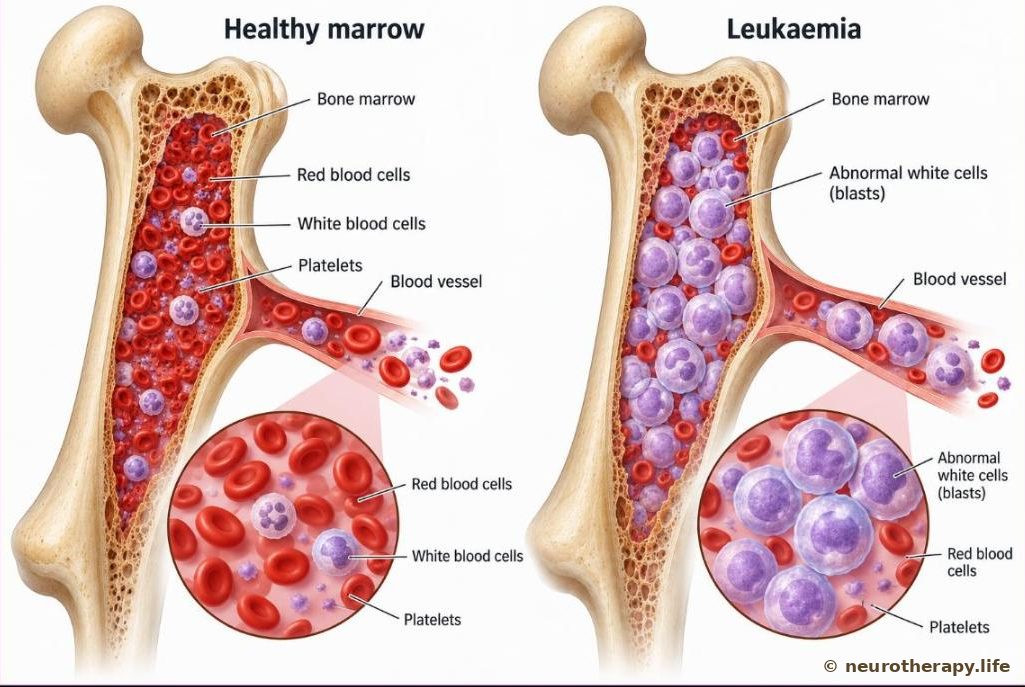
Leukaemia is a cancer of the blood-forming cells in the bone marrow. The marrow makes large numbers of abnormal white cells that crowd out healthy blood cells. It is treated by a blood-cancer specialist (haematologist or oncologist). LMNT does not treat leukaemia — it is offered only as gentle comfort support alongside that treatment.
- Leukaemia is the most common cancer in children
- In adults it is most common after the age of 60
- About 7 out of 10 adults with leukaemia in the US are alive five years after diagnosis
Source: Cleveland Clinic; MedlinePlus
What is Leukaemia (blood cancer)?
Blood cells are made in the bone marrow, the soft tissue inside bones. Red cells carry oxygen, white cells fight infection, and platelets help stop bleeding. In leukaemia, the marrow starts making abnormal white cells that do not work properly and do not die when they should.
These cells crowd out the healthy ones, so the body runs short of red cells, working white cells and platelets. Leukaemia is named by the cell it starts in (lymphocytic or myeloid) and by its speed — acute grows fast, chronic grows slowly. The four main types are ALL, AML, CLL and CML.
What are the symptoms?
- Tiredness that does not go with rest; looking pale or feeling breathless
- Fever, night sweats or infections that keep coming back
- Bruising easily, bleeding gums or frequent nosebleeds
- Tiny red dots under the skin (petechiae)
- Weight loss, bone pain or swollen lymph nodes
- Chronic leukaemia may give no signs at first — found on a blood test
What causes it, and who is more likely to get it?
Changes in blood-forming cells
- Gene changes in a marrow cell make it grow out of control
- Usually no single clear reason can be found
Age
- Risk rises with age, most of all after 60 — yet it is also the commonest cancer of childhood
Other risk factors
- Each type has its own risk factors, which the specialist will explain
How is it found?
Leukaemia is found with blood tests and confirmed with a bone marrow test. Further tests show the exact type, which decides the treatment.
Complete blood count (CBC)
Counts the red cells, white cells and platelets. In leukaemia the white count is often abnormal and the red cells and platelets may be low.
Bone marrow aspiration and biopsy
A small sample of marrow, usually from the hip bone, is checked under a microscope to confirm leukaemia.
Genetic tests, scans and spinal fluid test
These show the exact type and whether the disease has reached other places, such as the spinal fluid.
A neurotherapist reads the latest blood count before every course — especially the platelets and white cells — and asks about fever, bruising and the treatment dates.
How Neurotherapy (LMNT) sees Leukaemia (blood cancer)
In LMNT, leukaemia is a blood cancer, so every rule for cancer applies first: nothing in this therapy treats a cancer, and the whole cancer list of points is never given. On top of that list, leukaemia carries one bar of its own — Gal is not given in leukaemia, blood cancer or any disease that comes from a raised white cell count.
What LMNT teaching names for leukaemia is small and gentle: (1) point Liv × 6 treatments, given through the day an hour apart — the form LMNT uses in serious and long-standing illness. It is support for the body alongside the specialist's treatment, not a treatment for the leukaemia.
Neurotherapy (LMNT) treats according to the condition of the body.
Neurotherapy (LMNT) treatment for Leukaemia (blood cancer), step by step
The specialist stays in charge
Leukaemia is treated by a haematologist or oncologist. Every appointment, blood test and course of treatment is kept; Neurotherapy (LMNT) runs only alongside.
Examine first
The therapist checks the diagnostic points Liv° and Mu°, reads the latest blood count, and asks about fever, bruising and bleeding.
Close the barred points
The whole cancer list is struck out on the card, and Gal with it. Any formula that contains Gal is left out too.
Gentle support
(1) point Liv × 6 treatments, through the day an hour apart, with light pressure — lighter still when the platelets are low.
Points and formulas used
Never do this
- Never given in cancer, leukaemia included: (10) Pan, Thymus, Pit, Lu + Sh, Rt. Ov / Lt. Ov and (30) Medulla. LMNT teaching also bars WD, (10) Medulla, (4) Adr, (6) Adr, (4) Pan and — nowadays — Spl. (6) Adr
- Gal is not given in leukaemia, blood cancer or any disease arising from a raised white cell count. Gal
- With low platelets or during chemotherapy, the body bruises and catches infection easily — pressure stays light. If new bruises appear after a session, stop and show them to your doctor.
- Go to hospital at once for fever or shivering, bleeding that will not stop, blood in the urine, stool or vomit, breathlessness, a sudden severe headache, confusion or drowsiness.
- Never delay, reduce, refuse or stop the treatment your specialist advises.
- Children get half the adult dose and light treatment only, given by a trained therapist.
- Cancer: if the person has cancer, (10) Pan, Thymus, Pit, Lu + Sh, Rt. Ov / Lt. Ov and (30) Medulla are never given — the therapist changes the plan.
- Keep taking the medicines your doctor prescribed. Neurotherapy (LMNT) works alongside your medical care, never instead of it.
From Ayurveda and the kitchen
Test yourself
What research says
- Strong evidence
This review explains how leukaemia cells begin in the bone marrow, travel in the blood and settle in other organs — which is why leukaemia is treated as a whole-body disease by specialists.
No clinical trial of Neurotherapy (LMNT) in leukaemia has been published yet. Improvements in comfort reported by neurotherapists are clinical observations.
For you
Parents of a child with leukaemia
Keep every hospital visit and blood test. Any gentle hands-on care must be light, given by a trained therapist, and known to the child's doctor.
Adults on treatment
Tell your therapist your latest counts and treatment dates, and skip a session on any day of fever.
Anyone with unexplained bruising or constant tiredness
Ask your doctor for a complete blood count. It is a simple test that can find leukaemia early.
This page explains; it does not diagnose. Neurotherapy (LMNT) works alongside your medical care — keep taking the medicines your doctor prescribed, and see a doctor for any new or severe symptom.