Diseases ending in '-itis', polio and the side effects of medicines
A disease name ending in '-itis' means inflammation of an organ or tissue. Neurotherapy (LMNT)'s inflammation treatments grew from this reading, from polio to the side effects of medicines, and led to the finding of (30) Medulla.
Overview
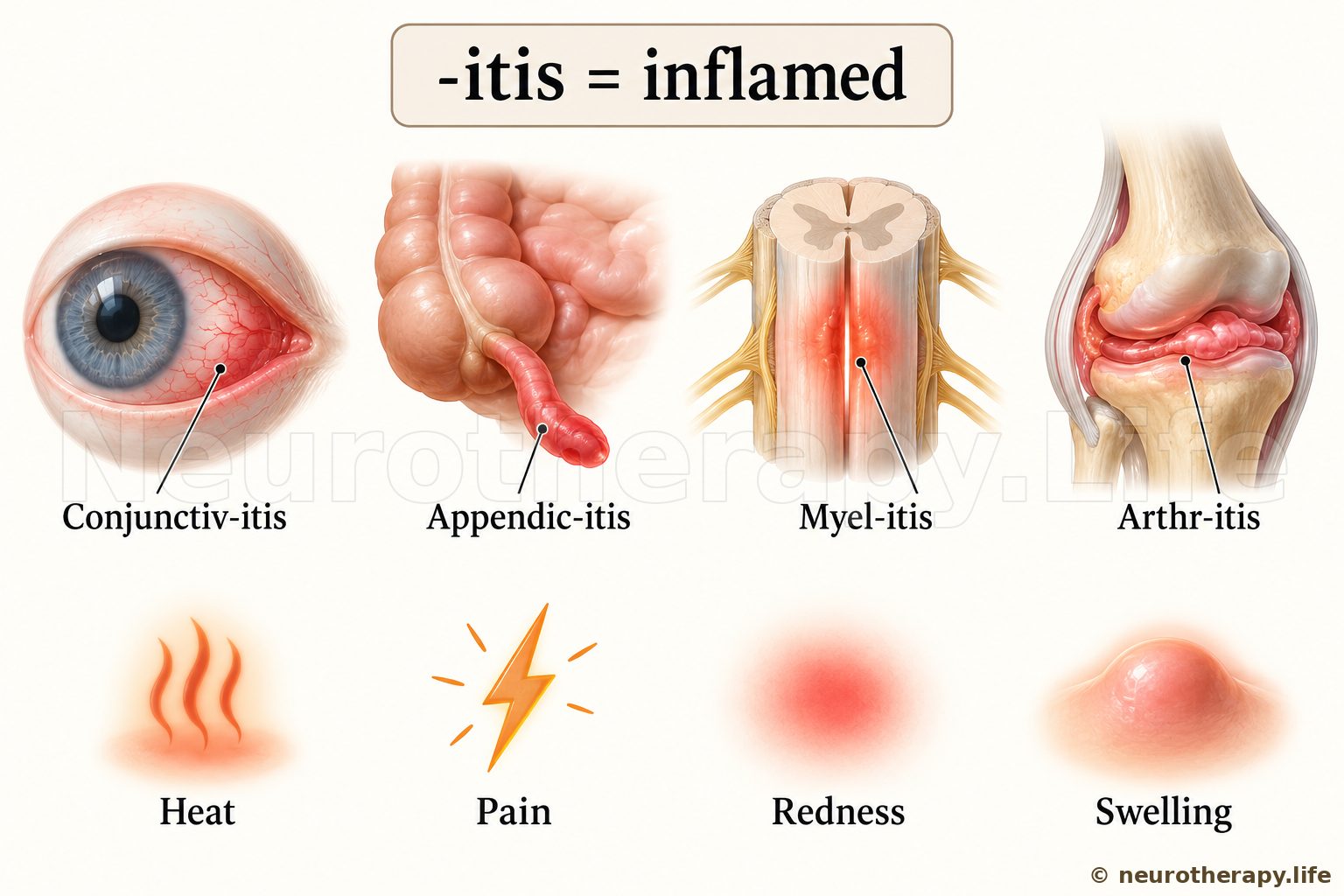
To show inflammation, the ending '-itis' is added to the name of an organ or tissue: appendicitis, conjunctivitis, myelitis, bronchitis, arthritis. On that reading, each is a candidate for the treatment that calms inflammation. The rule also works backwards: when a patient brings a hospital letter with a long unfamiliar word ending in '-itis', you already know what the doctors think is happening inside that organ.
Many polio patients once came to Guruji. Poliomyelitis is itself an inflammation of the spinal cord, so they were given (6) Adr, and they said they felt better. Nothing more was claimed: not that the paralysis was reversed, not that the virus was touched. An inflamed cord was treated as an inflamed cord, and Blood Supply to Legs was given for the leg weakness.
Talking with those patients, a pattern surfaced: many had first had a fever, been given an injection or medicine, and only then developed polio. Could the treatment also ease the ill effects of medicines? A woman whose eyes had watered for months, beginning the morning after an injection for another illness, was given the adrenal treatment and improved at once. It was then tried on many people before it was taught. The decisive question was when it started, not where it hurt.
Years later, while treating swelling from the side effects of medicines, Guruji, then reading about the brain, extended the Medulla treatment, and the swelling all but ended. This became (30) Medulla, thought to work through the prostaglandins. In another teaching case, a woman who refused anyone standing on her was treated seated, at the neck, and a swelling above her heel that she had lived with for twenty years eased. The technique a patient will consent to is the one that gets used.
Key points
- '-itis' at the end of a disease name means inflammation of that organ or tissue.
- Polio was treated as an inflammation of the cord, with no claim to reverse paralysis.
- Ask when a complaint began: it may be a report about a medicine.
- (30) Medulla was found while treating swelling from medicines.
Go deeper
ITF: the Inflammation Treatment Formula
ITF, the inflammation formula
Inflammation
Inflammation
Reactions after treatment
Reactions and side effects of medicines
(6) Adr
(6) Adr, the adrenal treatment
(30) Medulla
(30) Medulla, the prostaglandin treatment
Blood Supply to Legs
Blood Supply to Legs, for leg weakness
Fire and Swelling: Inflammation, Injury and Infection
Fire and swelling
Read the full guide
This topic is part of: Fire and Swelling: Inflammation, Injury and Infection
Safety: when it is held back
- Appendicitis is a surgical emergency. Sudden pain in the lower right belly, fever or vomiting needs a hospital first, the same day. Appendicitis
- A reaction to a medicine with swelling of the face or lips, a rash spreading fast, or difficulty breathing is an emergency: call 108/112. Tell the doctor who prescribed the medicine about any reaction. Reactions after treatment
- (6) Adr lowers immunity, so it is not given where immunity is already low, such as septicaemia, HIV/AIDS or cancer. It also raises alkali, so it is not given in high blood pressure. (6) Adr
- (30) Medulla is not given to patients of heart disease, because it is not known which prostaglandins it stirs, and some of them raise blood pressure. (30) Medulla
- In cancer, (10) Pan, Thymus, Pit, Lu+Sh, Rt. Ov / Lt. Ov and (30) Medulla are never given. Cancer care: Neurotherapy (LMNT) support
- Neurotherapy (LMNT) works alongside your medical care. Do not stop or change any medicine on your own; ask the doctor who prescribed it.
This page explains what a Neurotherapy (LMNT) treatment is for; it is not a self-treatment guide and does not diagnose. Neurotherapy (LMNT) works alongside your medical care — keep taking the medicines your doctor prescribed.