Appendicitis
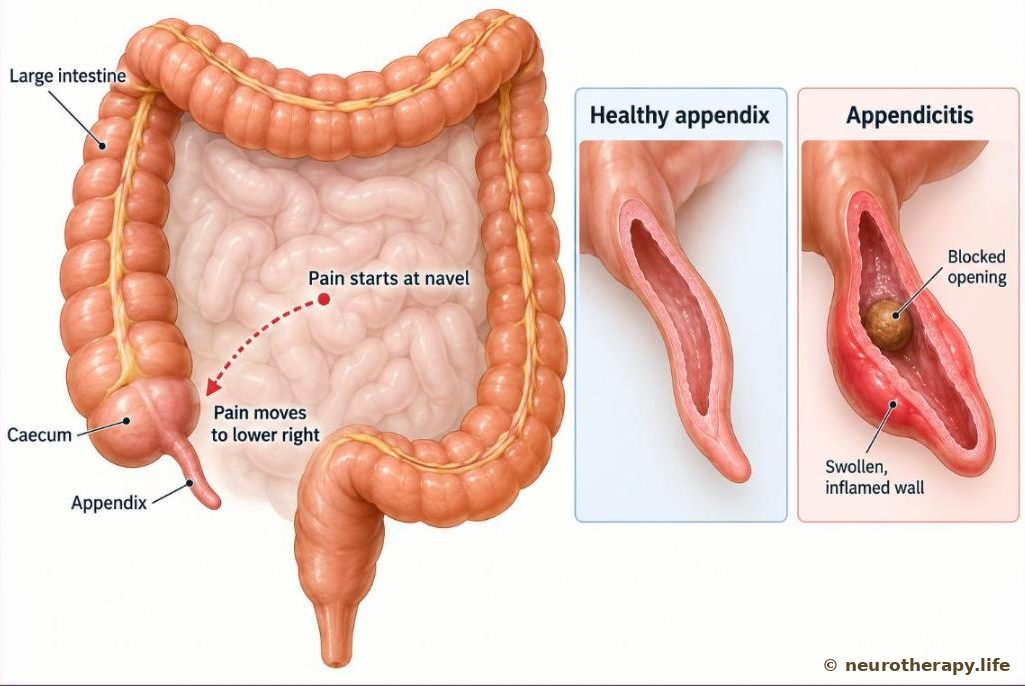
Appendicitis is a swollen, infected appendix — the small tube off the large intestine in the lower right belly. It is an emergency and usually needs an operation: with belly pain moving to the lower right, go to hospital now.
- About 5 in every 100 people get appendicitis at some time in their life
- It is most common between the ages of 10 and 30
- An inflamed appendix can burst within 36 hours of the first symptoms
Source: Cleveland Clinic; MedlinePlus
What is Appendicitis?
The appendix is a small, finger-shaped tube with one closed end, attached where the large intestine begins. When its opening gets blocked — often by a hard piece of stool or by swollen lymph tissue — pressure builds up inside.
The pressure squeezes the blood supply, germs multiply, and the wall starts to die. If it bursts, infection spreads through the belly (peritonitis) — a life-threatening emergency.
What are the symptoms?
- Pain that starts around the navel, then moves to the lower right belly
- Pain that gets worse over hours, and with walking or coughing
- Loss of appetite, nausea and vomiting
- A low fever
- Constipation or loose motions, or not passing gas
- A swollen belly
What causes it, and who is more likely to get it?
A blocked opening
- A hard lump of stool (an appendix stone)
- Swollen lymph tissue, often after an infection
- Rarely, worms or other parasites, or a growth
Other inflammation
Who gets it
- Anyone — but most often people aged 10 to 30
How is it found?
Only about half of people have the classic pattern of pain, so doctors combine an examination with tests.
Belly examination
The doctor presses gently to find where the pain is sharpest, usually low on the right.
Blood tests
A raised white cell count and CRP show the body is fighting inflammation.
Ultrasound or CT scan
Pictures that show a swollen appendix, or whether it has burst.
A neurotherapist who finds belly pain moving to the lower right, with fever or vomiting, sends the person to hospital the same hour. LMNT calls appendicitis a race: the person goes to the doctor, and anything the therapist gives is only alongside that, mostly in recovery after the operation.
How Neurotherapy (LMNT) sees Appendicitis
In LMNT, any disease whose name ends in “-itis” is inflammation, and appendicitis is named with them. The main LMNT treatment for inflammation is (6) Adr × 3 treatments, aimed at the adrenal cortex — the gland that makes cortisol, the body's own hormone for calming inflammation. ITF adds (30) Medulla, aimed at the prostaglandins that make a site red, hot and swollen.
Why the pain starts at the navel
- Appendixgets blocked, stretched and inflamed
- Gut nervessend their complaint into the same segment of the spinal cord as the skin around the navel
- Navelthe cord cannot tell which is complaining, so a vague ache is felt at the navel first
- Belly lininghours later the inflammation reaches the lining next to the appendix
- Lower rightnow the pain is sharp and fixed where the appendix really lies
Guruji's teaching adds the rule that governs everything here: appendicitis is a race. A treatment given while someone carries a child to hospital is one thing; given instead of carrying the child, it is another. LMNT support comes alongside hospital care and in recovery, never in its place.
Whether or not the patient gets immediate benefit from our treatment, let no harm reach him through our carelessness — attend to this.
Neurotherapy (LMNT) treatment for Appendicitis, step by step
Hospital first — it is a race
Belly pain moving to the lower right, getting worse, with fever or vomiting: 108/112 or hospital now. Appendicitis usually needs an operation.
Examine first
The therapist checks Liv° and Mu°, blood pressure, any heart disease, and whether immunity is low — because each of these changes what may be given.
(6) Adr × 3 treatments
LMNT's main treatment for any “-itis”: the adrenal point beside the spine, given on three separate occasions, with rests in between.
ITF over two days
Day one: (30) Medulla once, then (6) Adr twice. Day two: (6) Adr three times, and no Medulla. Appendicitis is one of its named uses.
Points and formulas used
(6) Adr × 3 treatments
Aimed at the adrenal cortex, which makes cortisol — the body's own hormone for calming inflammation.
Works through
Open →Never do this
- Appendicitis is an emergency. Call emergency services (108/112) immediately. LMNT works best alongside your existing medical care — always call emergency services first. Severe or worsening pain in the lower right belly, pain with fever and vomiting, a hard, rigid belly, or pain that suddenly spreads everywhere: hospital at once.
- This is a race: send the person to hospital, and treat only alongside. Neurotherapy (LMNT) is never a reason to wait.
- (6) Adr lowers immunity: never when immunity is already low — septicaemia (infection in the blood, which can follow a burst appendix), cancer, AIDS or HIV. It is not given in high blood pressure. (6) Adr
- Heart patients: (30) Medulla is never given; if needed, (6) Adr is given with the patient seated. (30) Medulla
- Children get half the adult dose and light treatment only, given by a trained therapist — and a child with belly pain and fever or vomiting goes to a doctor first.
- Cancer: if the person has cancer, (10) Pan, Thymus, Pit, Lu + Sh, Rt. Ov / Lt. Ov and (30) Medulla are never given — the therapist changes the plan.
- Keep taking the medicines your doctor prescribed. Neurotherapy (LMNT) works alongside your medical care, never instead of it.
From Ayurveda and the kitchen
Test yourself
What research says
- Strong evidence
A blocked appendix builds up pressure, which cuts its blood supply and lets germs grow until the wall can burst. The pain starts vaguely around the navel, through the gut's nerves, and later settles in the lower right.
Lotfollahzadeh S, Lopez RA, Deppen JG. Appendicitis. StatPearls. 2024.
- Strong evidence
Cortisol is made by the adrenal cortex — the part LMNT's (6) Adr is aimed at — and it calms inflammation by switching on anti-inflammatory proteins and switching off inflammatory signals.
Kaur J, Gandhi J, Sharma S. Physiology, Cortisol. StatPearls. 2025.
No clinical trial of Neurotherapy (LMNT) in appendicitis has been published yet. Improvements reported by neurotherapists are clinical observations.
For you
Parents
Children and teenagers get appendicitis most. A child with belly pain that moves to the right, with fever or vomiting, needs a doctor that day — do not wait for it to pass.
After the operation
Follow your surgeon's advice and keep your check-ups. Tell your therapist about the operation and any fever or redness at the wound before LMNT support begins.
This page explains; it does not diagnose. Neurotherapy (LMNT) works alongside your medical care — keep taking the medicines your doctor prescribed, and see a doctor for any new or severe symptom.