Also called: the polio stance, पोलियो वाला खड़ा होना, Blood supply to legs — for polio
Blood Supply to Legs is a slow, gentle sweep down the back of both thighs, given while the patient lies face down. It is used to increase circulation in the legs in polio, in weakness of the legs, and where the thighs or legs feel numb.
Overview
What is Blood Supply to Legs?
Blood Supply to Legs is a physical point of the low-back and leg group. Guruji's teaching calls it an excellent treatment for polio and for weakness in the legs. It is given to increase the flow of blood in the arteries of the legs of polio patients, and wherever there is numbness in the legs or in the front or back of the thighs. Some paralysis patients also get relief from it.
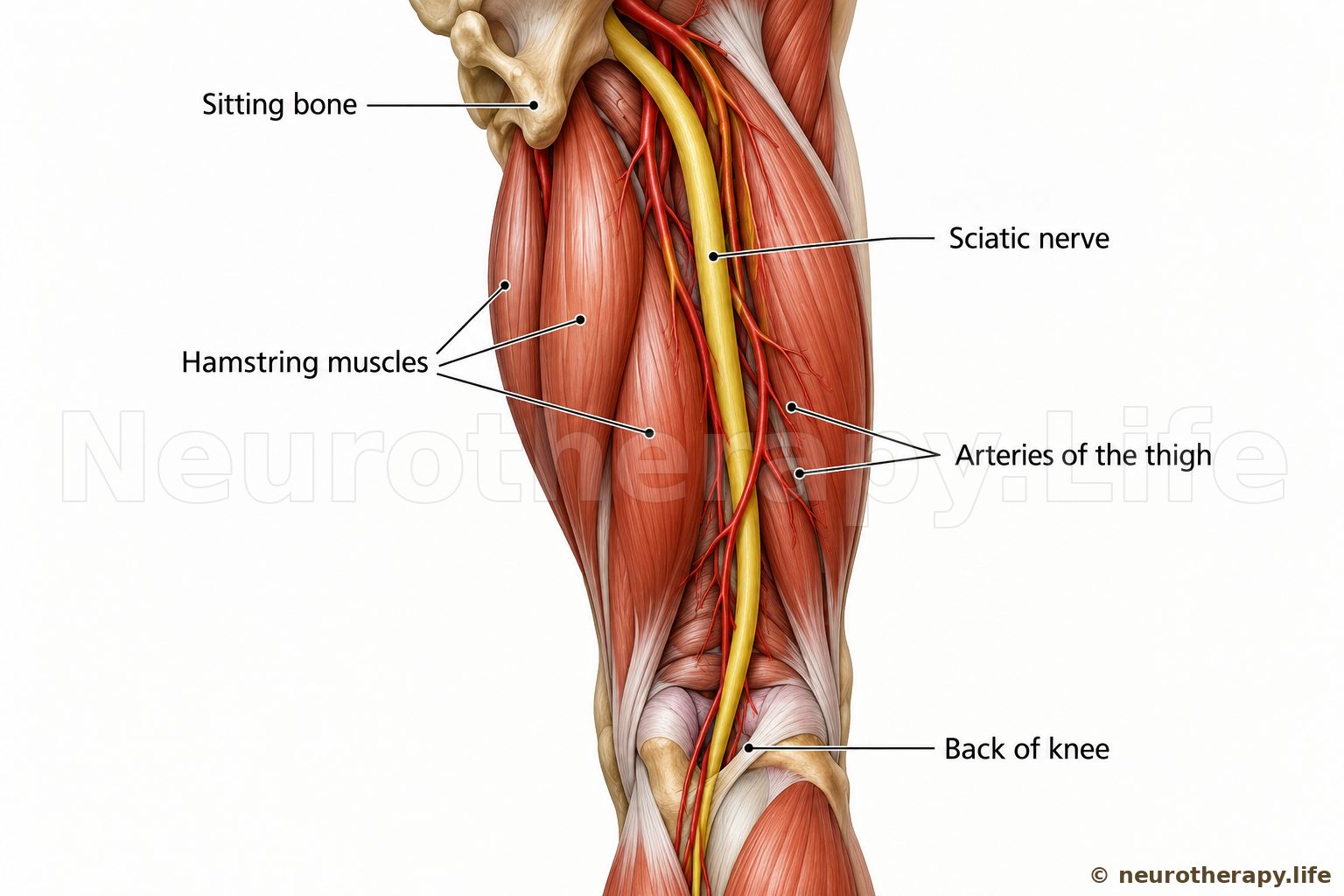
The sweep covers the three big muscles at the back of the thigh — the hamstrings — with the large sciatic nerve running down between them. It is unusual in one way: it is the one treatment of its group given with the therapist facing the patient's feet.
It is honest about its size. No amount of rubbing replaces using a weak muscle — what rebuilds a weak muscle is loading it and practising. What this slow sweep gives is a leg that is less stiff, less sore and more willing to move.
The sweep covers the hamstring muscles at the back of the thigh, with the sciatic nerve between them.
Where it is given
Where is it given?
PositionLying face down
Body areaBack of both thighs, hip to knee
The patient lies face down with pillows under the chest. The legs are kept loose, with the toes turned outward and the heels facing each other. This rolls the thighs slightly outward and softens the muscles at the back of the thigh.
The area is the back of both thighs, from the hip down to the knee. The knee joint itself is not worked.
How it is given
How is it given?
How this point is given — the tool, the pressure, the count and the exact movement — is deliberately not described here. A demonstration video for this point is being prepared; until it is on this page, learn the method hands-on from a trained Neurotherapist before giving it. Please do not give any point from a written description alone: a point given in the wrong place or the wrong way can do harm.
Feels likeA slow, broad, gentle sweep down the thigh
The exact technique is taught hands-on in the Neurotherapy (LMNT) course. See the course →
What it does
What does it do in the body?
The teaching says this treatment increases blood circulation in the nerves and muscles of the leg. What can be shown is simpler: a slow, repeated broad sweep relaxes the back-of-thigh muscles and leaves the leg less stiff and less sore.
Used to increase circulation in the legs of polio patients.
Given where there is numbness in the legs, or in the front or back of the thighs.
Some paralysis patients also report relief.
Organs it reaches
Muscles — The hamstrings at the back of the thigh.
Blood vessels — The arteries that feed the leg muscles.
Spinal cord — Polio damages nerve cells in the spinal cord that run the leg muscles.
Its family
Which points sit beside it?
It belongs to the group of leg treatments given to numb or weak legs, each with its own region.
Numbness in the legsNumbness in the legs, or in the front or back of the thighs.
SciaticaThe sciatic nerve runs down the middle of the area it covers.
Safety: when it is held back
A calf or leg that is swollen, warm and tender on one side only may hide a blood clot. It is not rubbed, not walked on and not moved — the patient is sent to a doctor the same day. Thrombosis (blood clots)
Numbness is the reason for this treatment, and also its danger: a leg that cannot feel cannot report harm. Keep the pressure gentle and look at the skin before and after. Numbness in the legs
The knee joint itself is never stood on. Knee pain
“This is an excellent treatment for polio and for weakness in the legs.”
— Dr. Lajpatrai Mehra
A teaching case
Teaching case: the boy with the thin leg
A teaching case, put together from several patients: a schoolboy came with one leg that had never grown properly after a fever in infancy, and his mother asked whether anything could be done. The therapist told her plainly that the old nerve damage would not be reversed, but that his slow digestion and stiff leg could be helped. His digestion was treated first, and Blood Supply to Legs was given alongside, gently, while he kept up his daily exercises.
A composite case written to teach the reasoning — not one patient’s file.
Common questions
Can this treatment cure polio?
No. Old nerve damage from polio is not reversed by any hand treatment. It is used to support circulation and comfort in the legs, alongside exercise and medical care.
Why must my heels face each other?
That position rolls the thighs out a little and relaxes the muscles at the back of the thigh, so the sweep rides soft muscle instead of a tight one.
Does it hurt?
It should not. It is a gentle slide meant to warm the leg without hurting the skin. Tell the therapist if anything feels sharp or hot.
Surprising facts
1The thickest nerve in the body
The sciatic nerve, which runs down the back of the thigh, is the thickest and longest nerve in the body — close to the width of a thumb near its start.
The polio virus damages the nerve cells in the spinal cord that send orders to the muscles. The leg muscle is healthy at first; it weakens and thins because its orders stop arriving.
Source: WHO fact sheet, Poliomyelitis.
3Muscles help pump blood
When leg muscles contract, they squeeze the veins inside them and push blood back toward the heart. Moving a weak leg matters for circulation as well as strength.
Source: Guyton & Hall Textbook of Medical Physiology (14th ed.), the venous pump.
This page explains what a Neurotherapy (LMNT) treatment is for; it is not a self-treatment guide and does not diagnose. Neurotherapy (LMNT) works alongside your medical care — keep taking the medicines your doctor prescribed.
Ready to begin?
Send COURSE for course details, or your name, age and health issue for a consultation.