The front pain-point chart: the points around the navel and what each one means
In Neurotherapy (LMNT) the examination starts at the belly. This chart shows the tender points around the navel, the code name of each, and the organ or problem it is linked with.
Overview
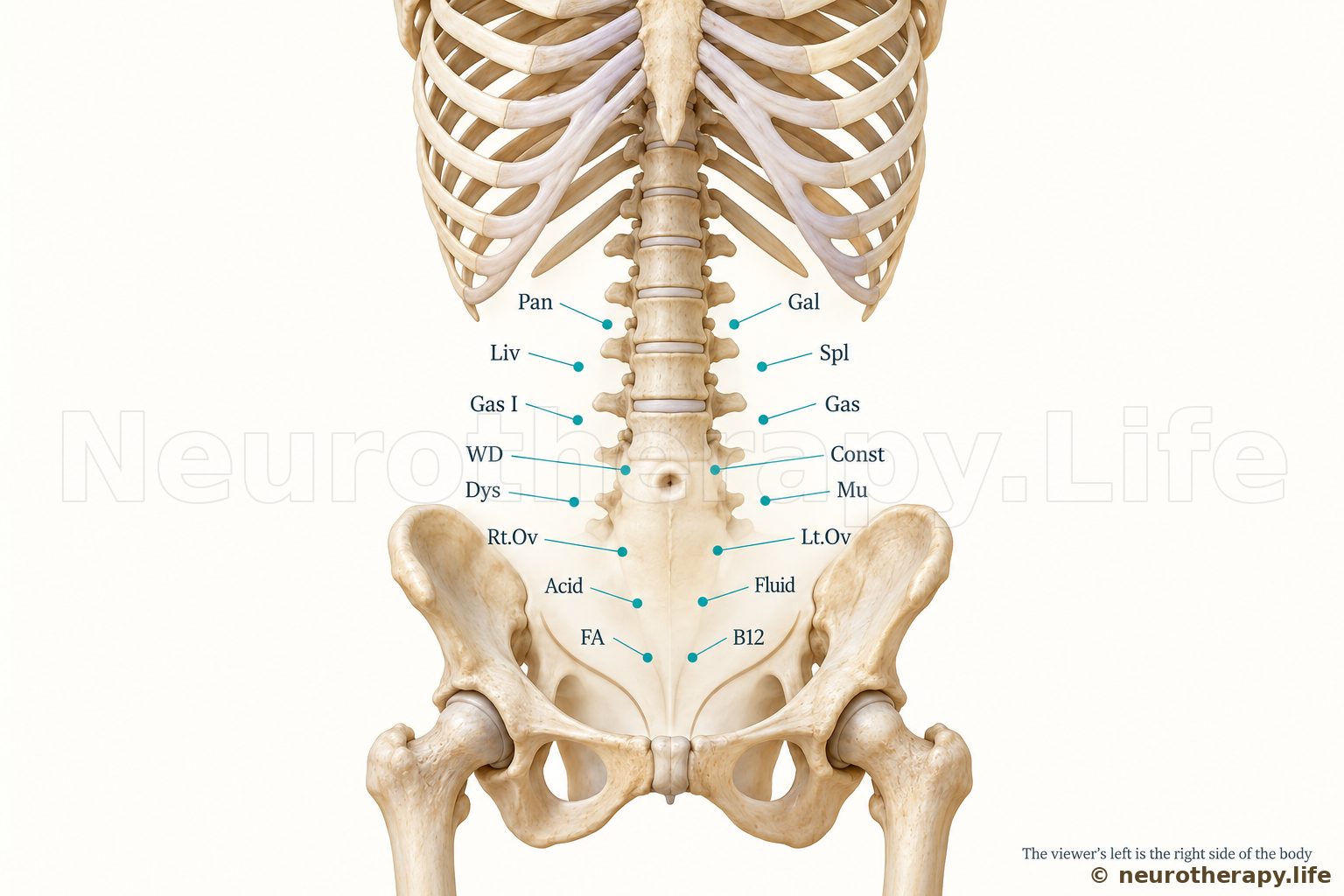
Every Neurotherapy (LMNT) session begins with the belly. The front chart is a simple drawing of the body from the neck to the top of the thighs, with the navel at its centre. Around the navel lie small marked places, each with a short code name. When a trained therapist presses gently and finds pain or stiffness at one of them, it points towards the organ or problem that code stands for.
Most codes are named for an organ. Pan stands for the pancreas, Gal for the gall bladder, Spl for the spleen and Liv for the liver. Mu stands for the wet lining (mucous membrane) of the whole gut, from the lips to the end. Gas stands for the stomach and duodenum (the first stretch of the small intestine), and Gas 'I' for the rest of the small intestine around the navel. WD covers the uterus or the prostate, and Rt.Ov and Lt.Ov the right and left ovary or testis.
Two points are named for a symptom: Const for constipation and Dys for loose motions. Four sit down near the hip bone. Acid and Fluid are named for what they correct: Acid eases the signs of acidosis, and Fluid eases the signs of alkalosis. FA and B₁₂ are linked with a shortage of folic acid and of vitamin B₁₂.
A code name is not an address. The healthy spleen, for example, sits high and far back under the ribs and cannot be felt at all. The Spl point is simply where tenderness is found when the spleen is in trouble. Tenderness at a point is a clue for the therapist, never proof that an organ is damaged.
Key points
- The front chart links tender places around the navel with organs or problems.
- Most codes are named for an organ; Const and Dys for a symptom; Acid and Fluid for what they correct.
- Acid is the point that eases acidosis, not the point that shows it. Reading it the other way gives the wrong one of the pair.
- The chart is drawn from the front, so the patient's right side is on your left.
- A tender point is a clue, not a diagnosis of damage.
Go deeper
Pan
Pan — the pancreas point
Gal
Gal — the gall bladder point
Mu
Mu — the point for the gut's wet lining
Gas 'I'
Gas 'I' — the small intestine point
Acid
Acid — the point that eases acidosis
Navel
The navel, the centre of the examination
The Navel Speaks First: The Map of the Pain Points
Guide: The Navel Speaks First
Read the full guide
This topic is part of: The Navel Speaks First: The Map of the Pain Points
Safety: when it is held back
- A white discharge that is persistent, smelly, blood-stained or itchy, or comes with pelvic pain or fever — and any bleeding after intercourse or after the menopause — needs a doctor who can examine. Neurotherapy (LMNT) goes alongside that care, never instead of it. Leucorrhoea (white discharge)
- Boring pain in the pit of the stomach going through to the back, with vomiting, can mean an inflamed pancreas. Call 108/112 or go to hospital, and allow no pressure on the belly until a doctor has seen the patient. How to tell a patient to see a doctor
- Never tell a patient an organ is ‘blocked’ or damaged because a point was tender. Say instead that the point is linked with how that organ is working, and that it will be worked on.
Watch

An overview of LMNT's diagnostic pain points — the places around the navel that the therapist presses to read the body before choosing a treatment.
This page explains what a Neurotherapy (LMNT) treatment is for; it is not a self-treatment guide and does not diagnose. Neurotherapy (LMNT) works alongside your medical care — keep taking the medicines your doctor prescribed.