Inflammation, injury or infection? Choosing the right formula family
Three families of Neurotherapy (LMNT) formulas answer three different problems: ITF for inflammation, the Injury formula for a blow, and VTF for infection. The therapist first decides which one is in front of them, then checks the safety bar that family carries.
Overview
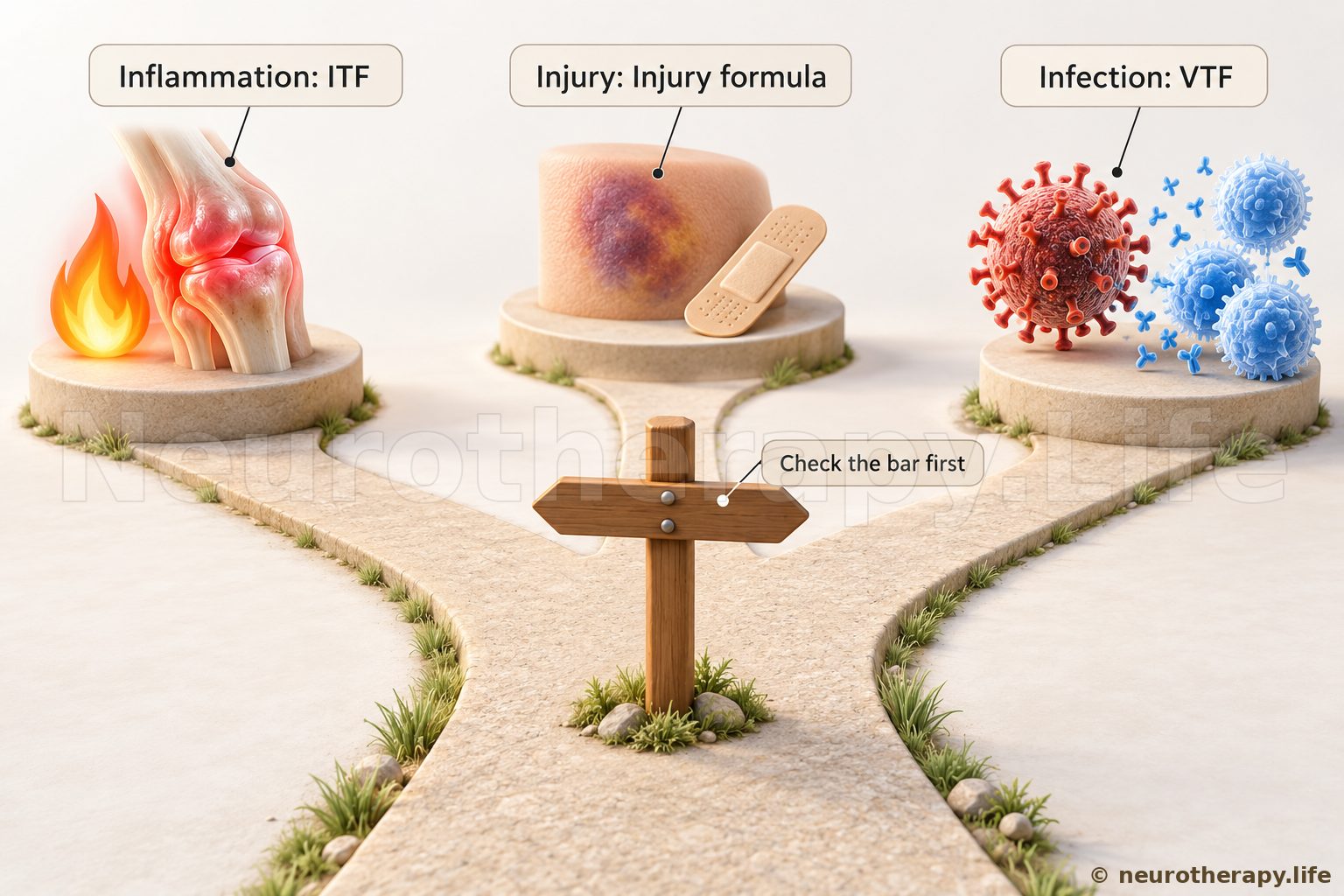
A therapist facing a swollen, painful or feverish patient asks one question before any other: which of three things is this? Infection is something arriving from outside. Inflammation is the body's own defence gone too far, with dead cells collecting at the place. Injury is a blow the body has to rebuild from. These are treated in opposite ways, and one family's formula cannot stand in for another's.
The inflammation family, ITF, fits a sting, a bite or a reaction to a poisonous herb; a complaint that began the day after an injection, a tablet or an operation; polio; and any disease whose name ends in -itis, such as conjunctivitis or appendicitis.
The injury family fits a blow, a bruise, collected blood, a sprain or a torn ligament, and also the marks of old wounds, burns and scalds. The viral family, VTF, fits viral fever, infection of any kind and a body that catches everything. Its Mild form suits someone who wants to stay well, a small child, or a person whose fever has already started.
Some patients show two families at once. A person with cancer and a painful swollen limb seems to need the inflammation family, yet that family contains (6) Adr, which is barred in cancer. The chooser does not settle this; it makes sure the therapist sees it before the hands touch the patient. Such a patient belongs first with their doctor.
Key points
- Infection, inflammation and injury are three different problems.
- Each has its own formula family, and they are not interchangeable.
- A disease ending in -itis points to the inflammation family.
- Every family carries a safety bar that is checked before treatment.
- When two families clash in one patient, the bar wins and the doctor is involved.
Go deeper
ITF
ITF, the inflammation formula
Injury treatment formula
The Injury formula for a blow or sprain
VTF (Mild)
VTF Mild, the everyday viral formula
Inflammation
What inflammation really is
Infections
Infections and the body's defence
Sprain and injury
Sprains, bruises and blows
Lymph and immunity
The lymph system that carries the defence
Fire and Swelling: Inflammation, Injury and Infection
The full guide to inflammation, injury and infection
Read the full guide
This topic is part of: Fire and Swelling: Inflammation, Injury and Infection
Safety: when it is held back
- (6) Adr is never given when immunity is low, as in septicaemia, cancer or AIDS, because it lowers immunity further. (6) Adr
- In heart disease, (30) Medulla is not given, and (6) Adr is given with the patient seated, not lying face down. (30) Medulla
- In an autoimmune disorder, VTF is not given, and the Injury formula is given only with its thymus-free substitution. Autoimmune disorders
- In bronchial asthma, the treatment named is (6) Right Swt; the side is part of the point, so it is never swapped for the left. (6) Right Swt
- Neurotherapy (LMNT) works alongside your medical care. Do not stop or change any medicine on your own; ask the doctor who prescribed it.
Watch
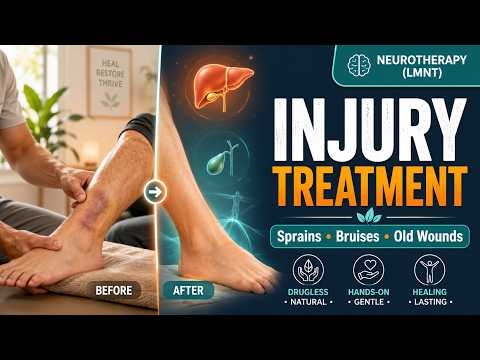
A full Hindi demonstration of the Injury formula: 60 Toe-Finger twists on the third and fourth toes of the left foot, three rounds; then Gal, Liv and Chest Only; then Gal, Liv, Thymus and Chest with the armpits, at four and at eight — a minute's gap between parts, and only as much weight as the patient can bear.
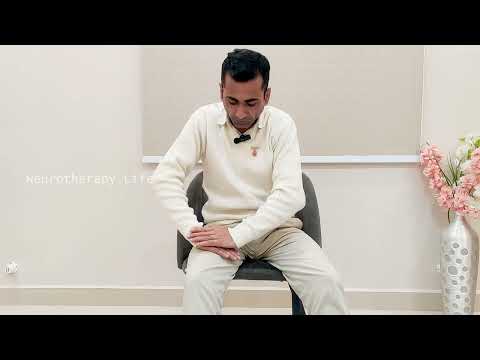
Shows how to give yourself the Spleen (Spl) point, shared for people who fall ill again and again, to support immunity and haemoglobin.
In LMNT teaching Spl is not given in diabetes or other autoimmune disorders, nor in cold, allergy or asthma, and nowadays not in cancer.
This page explains what a Neurotherapy (LMNT) treatment is for; it is not a self-treatment guide and does not diagnose. Neurotherapy (LMNT) works alongside your medical care — keep taking the medicines your doctor prescribed.