1Biggest in childhood
The thymus is most active in early life. It starts to shrink early and keeps losing about 3% of its tissue each year until middle age.
Source: Palmer DB. The effect of age on thymic function. Front Immunol 2013;4:316.
Also called: Thymus Only, (4) Thymus, (8) Thymus, थाइमस ओनली
Th. Only is the Neurotherapy (LMNT) treatment for the thymus alone — a feather-light glide over the breastbone, with no chest work and no armpit. It is used to raise the body's resistance to infection, and it is held back wherever the defence system is already misbehaving.
Th stands for thymus. The thymus is a small, soft gland lying just behind the upper part of the breastbone, above the heart. It is where T cells — white blood cells that recognise and attack germs — grow up and are trained.
The word Only was added on purpose. It shows that only the thymus is to be given — not the chest and not the armpits. That makes Th. Only the smallest member of the chest group, and the building block of Th + Ch.
In the source teaching, (4) Thymus and (8) Thymus are given to increase the body's disease-resisting power by stimulating the lymphocytes of the thymus. It is the thymus work of the viral formulas, which protect the body from infection.
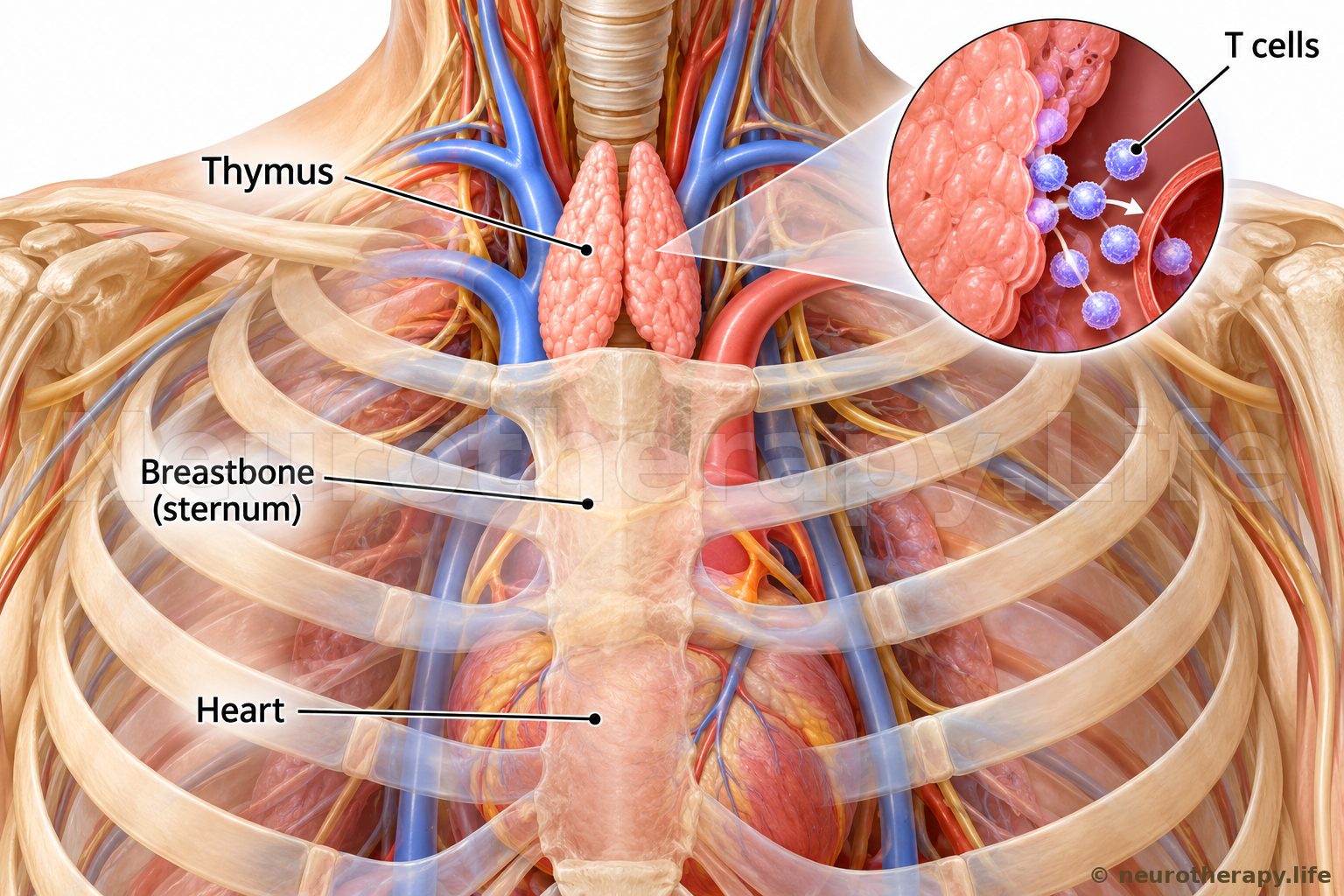
You lie flat on your back with no pillow at all, so that the chest and the shoulders are level.
The work stays on the breastbone in the middle of the chest, travelling from it toward each shoulder in turn. It does not go out over the chest and it does not touch the armpit.
How this point is given — the tool, the pressure, the count and the exact movement — is deliberately not described here. A demonstration video for this point is being prepared; until it is on this page, learn the method hands-on from a trained Neurotherapist before giving it. Please do not give any point from a written description alone: a point given in the wrong place or the wrong way can do harm.
The exact technique is taught hands-on in the Neurotherapy (LMNT) course. See the course →
In the source teaching, the thymus treatment is given for these purposes:
The four chest points are built out of one another, and the word Only tells you which part is given.
Th. Only is used for infection and low immunity, always after checking who must not have it.
The light viral formula, with Lymph and a single Spl point — suitable even for small children
The older, heavier viral formula
The viral formula for long-standing illness
Lymph and Th. Only as one short round
The heparin formula opened by the thymus, for a blow after the wound has dried
The long immune and digestive protocol
No. Th. Only is the breastbone alone. Th + Ch adds the chest and the armpit, and has different uses.
No. It is given with no pressure at all — a light, smooth glide.
The mild viral formula that contains it is described as suitable for small children too, given as light treatment and only when none of the bars apply.
Because in rheumatoid arthritis the body's defences are already attacking its own joints. Stimulating them further could add to the problem.
The thymus is most active in early life. It starts to shrink early and keeps losing about 3% of its tissue each year until middle age.
Source: Palmer DB. The effect of age on thymic function. Front Immunol 2013;4:316.
Most young T cells that enter the thymus never leave it: those that cannot work, or that would attack the body itself, are weeded out inside the gland.
Source: Murphy K, Weaver C. Janeway's Immunobiology, 9th ed. Garland Science, 2016.
The 'T' in T cell stands for thymus, the organ where these cells mature.
Source: Murphy K, Weaver C. Janeway's Immunobiology, 9th ed. Garland Science, 2016.
A review of the thymus over a lifetime: it starts shrinking early, loses about 3% of its tissue a year until middle age and about 1% a year after that, so fewer new T cells are made as we age.
Palmer DB. The effect of age on thymic function. Frontiers in Immunology 2013;4:316.
This page explains what a Neurotherapy (LMNT) treatment is for; it is not a self-treatment guide and does not diagnose. Neurotherapy (LMNT) works alongside your medical care — keep taking the medicines your doctor prescribed.
Send COURSE for course details, or your name, age and health issue for a consultation.