Lymph nodes are the small, bean-shaped 'glands' that swell in your neck when your throat is sore. They make no hormone at all. They are checkpoints: every drop of lymph passes through them on its way home, and inside, your defence cells inspect it and raise an army when they find a germ.
Overview
What are lymph nodes?
Lymph nodes are small, soft, bean-shaped organs that sit along the lymph vessels, like stations on a railway line. You have several hundred of them, in chains and clusters — in the neck, the armpits, the groin, and deep inside the chest and belly.
People call them 'glands', but they are not true glands: they make no hormone. They are filters and meeting places. Lymph drained from the tissues flows through them, and white blood cells inside trap germs, dead cells and abnormal cells before the lymph returns to the blood.
A node that swells is usually a node at work — fighting an infection in the area it drains. But a node that stays large, feels hard or fixed, or comes with fever, night sweats or weight loss needs a doctor, because nodes also catch serious disease early.
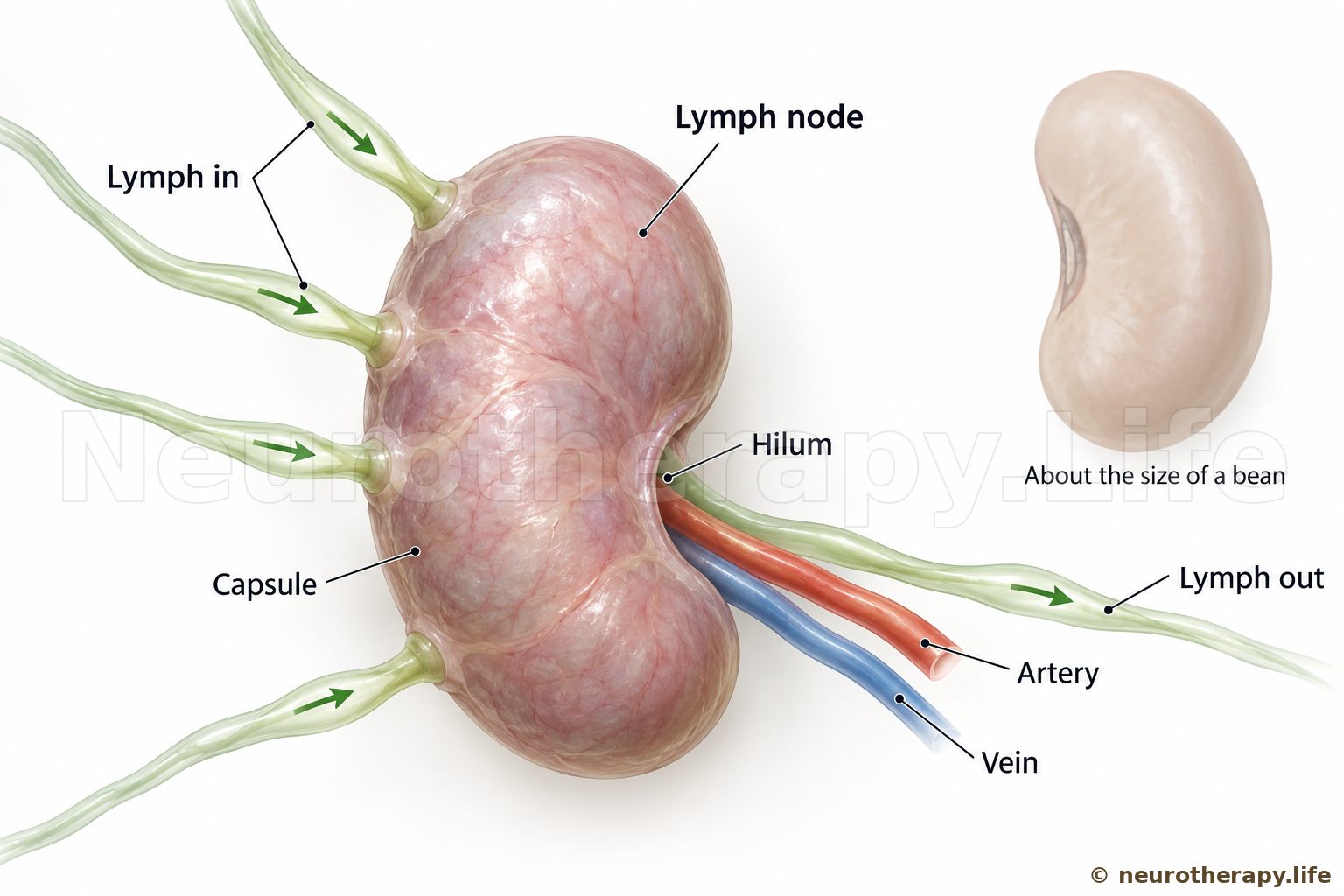
A lymph node: many vessels bring lymph in, one takes the cleaned lymph out. Most are no bigger than a bean.
Function
What do lymph nodes do?
Each node guards one area of the body. Everything that the tissues of that area throw out — fluid, debris, and any germs that got in — reaches the node first. Inside, the body decides whether it has met an enemy and, if so, starts the defence.
Filters lymph, trapping germs, dust, dead cells and cancer cells before the lymph reaches the blood.
Bring germs and defence cells together, so that the right T cells and B cells find the germ they are made to fight.
Grow an army: the chosen cells multiply in the node, and B cells turn into plasma cells that pour out antibodies.
Keep 'memory' cells, so that the same germ is fought faster next time.
Act as an early warning for doctors: a node's size and feel tell them about the area it drains.
Lymph arrives
Several small vessels bring lymph into the node through its rounded outer side.
Slow filtering
The lymph trickles through a sponge-like mesh. 'Eating' cells (macrophages) lining the channels swallow germs and debris.
The germ is shown
Messenger cells carry pieces of the germ to the T cells waiting in the node, like showing a photograph to a crowd of guards.
The army grows
The matching T and B cells multiply fast in the node's follicles. The node fills up and swells, and may ache.
Antibodies go out
Plasma cells release antibodies, and the cleaned lymph, with armed cells, leaves through one vessel at the node's dent.
How do lymph nodes work with other organs?
Lymph and immunity — The nodes are the checkpoints of the whole lymph network; the vessels bring lymph in and carry it onward.
Spleen — The spleen does for the blood what the nodes do for the lymph — it filters it and hosts defence cells.
Thymus — The T cells that wait in the nodes were trained in the thymus.
Blood — Lymphocytes keep moving between the blood and the nodes, patrolling the body.
Skin — A cut, boil or bite on the skin is drained by the nearest nodes — often the first to swell.
Mouth — Infections of the teeth, gums, tonsils and throat drain to the nodes under the jaw and in the neck.
Anatomy
What are the parts of a lymph node?
Each node has a tough outer skin, an outer zone full of B cells, a middle zone of T cells, and an inner zone where antibodies are made and the lymph drains out.
The outside
Capsule — A thin, tough coat of fibrous tissue around the node, with strands running inward to support it.
Afferent lymph vessels — Several small vessels that bring lymph in through the curved outer side.
Hilum — The dent on one side, where the artery and vein enter and leave and the single outgoing lymph vessel exits.
Efferent lymph vessel — The outgoing vessel that carries filtered lymph on to the next node or to the main ducts.
The inside
Cortex and follicles — The outer zone holds round clusters of B cells. When a germ is found, their centres swell into 'germinal centres' where the army is built.
Paracortex — The middle zone, crowded with T cells and the messenger cells that show them pieces of germs.
Medulla — The inner zone, with cords of plasma cells that release antibodies, and channels lined with macrophages.
Sinuses — Slow channels through which the lymph trickles from the edge to the centre, so that nothing escapes inspection.
The main groups
Nodes are named by where they sit and which area they drain.
Neck (cervical) and under the jaw — Drain the scalp, face, mouth, teeth, tonsils and throat.
Above the collarbone (supraclavicular) — Receive lymph from the chest and, on the left, from the belly. A lump here always needs a doctor.
Armpit (axillary) — Drain the arm, hand, breast and chest wall.
Groin (inguinal) — Just below the groin crease; drain the whole leg and foot, the buttock and the lower belly wall.
Deep nodes of the chest and belly — Along the airways, the intestines and the large vessels; found only on scans.
Where are the lymph nodes located?
Lymph nodes lie along the lymph vessels throughout the body, gathered where limbs join the trunk and around the organs. The ones you may be able to feel lie just under the skin: under the jaw and along the sides of the neck, in the armpits, and in the groin just below the crease of the thigh.
Many more lie deep in the chest, around the airways and the heart, and in the belly, in the folds that hold the intestines. Nodes also sit behind the knee and at the inner elbow.
In the groin, a finger's breadth to the inside of the nodes, the leg's main artery, vein and nerve run under little more than skin. That is why LMNT teaching places the therapist's toes on the inner side of the thigh for the Lymph point, and why this area is worked only by a trained hand.
A lymph node is shaped like a small bean or kidney, pinkish-grey, soft and slightly rubbery. It has a rounded side where lymph comes in and a dent (the hilum) where it leaves.
Under the skin a normal node usually cannot be felt. In thin people and in children, small soft nodes that move freely under the finger are often felt in the neck and groin, and are normal. A node that is hard, fixed to the tissues around it, or keeps growing is not.
How big are lymph nodes?
Most lymph nodes are a few millimetres to about 1 cm long — from the size of a grain of rice to a small bean. Doctors generally treat a node over about 1 cm as enlarged; in the groin up to about 1.5 cm can be normal, while at the inner elbow even half a centimetre is noticed.
There are several hundred nodes in all — estimates range from about 450 to 700 — and a good share of them are in the head and neck. During an infection a node can double in size within days and shrink back over the following weeks.
Conditions and disorders
What conditions affect the lymph nodes?
Most swollen nodes are reacting to an infection close by and settle on their own. Less often a node is itself infected, reacts to an immune disease, or is involved in a cancer.
Cancer care: Neurotherapy (LMNT) supportLymphoma starts in the nodes; other cancers can spread to the nodes that drain them — which is why doctors check nodes when staging cancer.
Oedema (swelling in the body)After nodes are removed or damaged, lymph can back up and the limb swells (lymphoedema).
Lipoma and cystNot every lump is a node: soft fatty lumps and cysts can look similar, and a doctor tells them apart.
What are common signs of a lymph node problem?
A lump under the skin of the neck, jaw, armpit or groin
Tenderness or pain in the lump, often with a sore throat, a tooth problem or a wound nearby
Red, warm skin over a node, or a node that feels soft and full of pus
A red streak running up an arm or leg from a wound
A node that is hard, painless, fixed, growing, or still there after two to three weeks
Any lump above the collarbone
Swollen nodes with fever, drenching night sweats or unexplained weight loss
What tests check the lymph nodes?
Physical examination — The doctor feels the node's size, hardness, tenderness and whether it moves, and looks at the area it drains.
Blood tests — A complete blood count, ESR or CRP, and tests for particular infections such as HIV.
Tests for tuberculosis — A skin test or blood test, and a chest X-ray, because TB is a common cause of long-lasting neck nodes in India.
Ultrasound — Shows the node's size, shape and inner pattern, and guides a needle if one is needed.
FNAC (fine-needle test) — A thin needle draws a few cells from the node to be seen under a microscope.
Biopsy — Part or all of a node is removed and examined — the surest way to diagnose lymphoma.
CT or PET scan — Show deep nodes in the chest and belly that cannot be felt.
How are lymph node problems treated?
Watch and wait — A small, tender node with an obvious infection nearby is usually just watched; it settles as the infection clears.
Treating the infection — Antibiotics for a bacterial infection; an abscess in a node may need to be drained.
Full treatment for TB — Tuberculosis of the nodes needs the complete course of TB medicines, usually for six months or more, without breaks.
Treating the underlying disease — For autoimmune disease, HIV or cancer, the node improves as the main disease is treated by the right specialist.
Lymphoedema care — After nodes are removed: compression, gentle specialist drainage massage, exercise and skin care.
Neurotherapy (LMNT)
LMNT teaching describes the lymph nodes exactly as checkpoints — 'they make no hormone' — and works on them through two points: Lymph, at the nodes of the upper thighs, and Armpits, at the nodes under the arms. The teaching uses the groin node as a finding too: if there is a boil, a pimple or an injury on a toe, the node of that thigh is very tender, and it eases when the node is roused. A tender node is therefore also a question — what is draining into it? — and the answer may need a doctor. Where the lymph as a whole seems stuck, the teaching has the Subclavian treatment, with a ring-finger check that decides whether it is the right one.
Points
Lymph — Both heels, touching each other, just below the groin crease; pressed downward and inward for six seconds, as many times as written. The weight is on the heels and the toes lie on the inner side of the thigh — this is what makes it different from Pan.
Armpit — (12) Armpits opens small blockages in the many nodes of the armpit — for bacterial or viral illness, tonsils, sore throat and pain on swallowing, and in children for earache and mild cold and cough.
Th + Ch — Whenever Thymus + Chest is written, the Armpits must be given too — the chest work is not complete without the nodes.
Subclavian — A thumb circuit along the inner collarbone and the edge of the neck, three times round, given to rouse the lymph where it returns to the veins.
Raman — If the Subclavian treatment does not clear the ring-finger pains, the teaching turns to Raman, which it also links with easing knee and back pain.
Check both ring fingers first. Only if both are painful is it given — twice. The finger pains should then go, and with them the folic acid, B₁₂ and Liv°–Mu° pains. If they clear, it was a lymph problem; if not, Raman is next.
(1) Lymph (1) point Spl (1) Th. Only × 6 treatments — the mild viral formula, taught as protective for everyone, even after fever has come, and for small children; not in autoimmune disorders.
The fourteen-part formula for long-standing disease; its Lymph step (part VI), with Thymus and Ton 'T', is lifted out in diabetes and any autoimmune disorder.
“Whenever there is an obstruction or blockage in the blood circulation of any part of the body, then pain or numbness is felt in that part.”
— Dr. Lajpatrai Mehra
“Only they know the pain; you do not.”
— Dr. Lajpatrai Mehra
“I am yet to understand the human body. My knowledge is hardly the tip of the iceberg. Neurotherapy (LMNT) is just in its infancy. There is a long way to go.”
— Dr. Lajpatrai Mehra
Never do this
Emergency: a red streak spreading up a limb from a wound, fast-spreading redness, fever with shivering, or a person who is suddenly very unwell — same-day medical care, or call 108/112. This is infection travelling along the lymph and needs medicine, not pressure. Septicaemia (sepsis)
See a doctor this week for a node that is hard, painless, fixed or growing; one that lasts more than two to three weeks; any lump above the collarbone; or swollen nodes with fever, night sweats or weight loss. Never treat and watch such a lump on the mat. How to tell a patient to see a doctor
Never press over an infected, hot, red or pus-filled node or skin. A tender groin node means something is draining into it: the therapist looks at the whole leg, the foot, between the toes and the nails for the cause. Lymph
Armpits are not given in lymph node cancer, polio, diabetes or any autoimmune disorder. Lymph, Armpits, Thymus and the other immunity points are blocked in autoimmune disorders, arthritis, inflammation, polio, diabetes and kidney disorders. Armpit
No pressure is ever given on the front or the sides of the neck; any neck work stays on the safe lines taught for it and is stopped at once for dizziness, greying of vision or nausea. Subclavian
Cancer: if the person has cancer, (10) Pan, Thymus, Pit, Lu + Sh, Rt. Ov / Lt. Ov and (30) Medulla are never given, pressure is never put over a known tumour or affected node, and no one is advised to delay treatment from the cancer team. Cancer care: Neurotherapy (LMNT) support
Keep taking the medicines your doctor prescribed — above all the full course of TB medicines if a node is tubercular. Neurotherapy (LMNT) works alongside your medical care, never instead of it.
Care
How can I keep my lymph nodes healthy?
Healthy nodes need healthy drainage and fewer doorways for germs.
Look after small wounds
Wash cuts and scratches promptly, keep the feet clean and dry between the toes, and check the feet daily if you have diabetes.
Care for teeth and throat
Brush twice a day and get tooth and gum trouble treated; many neck nodes are simply reacting to the mouth.
Keep moving
Walking and moving the arms keep lymph flowing through the groin and armpit nodes.
Know what is normal for you
Small, soft, movable nodes in the neck are common, especially in children. Note the date if you find a new lump, and see a doctor if it is still there after two to three weeks.
Do not squeeze or cut a lump
Squeezing or applying hot pastes to an unknown lump can spread infection or delay a diagnosis.
Finish your medicines
Complete a course of antibiotics or TB treatment exactly as prescribed, even when the node shrinks early.
Common questions
Why are lymph nodes called 'glands' if they are not glands?
It is an old name that stuck because they look like small glands. A true gland makes a secretion or hormone; lymph nodes make none. They are filters and meeting places for defence cells. LMNT teaching makes the same point: 'they make no hormone; they are checkpoints'.
When should a swollen node worry me?
See a doctor if it lasts more than two to three weeks, keeps growing, is over about 1 cm and hard, painless or fixed, is above the collarbone, or comes with fever, night sweats or weight loss. A small tender node during a cold usually settles on its own.
Is it normal for a child to have lumps in the neck?
Very often, yes. Children catch many throat and ear infections, and small, soft nodes that move under the finger are common in their necks. A node that is large, hard, growing, red and hot, or comes with fever that will not settle, should be seen by a doctor.
Can a vaccine make my armpit nodes swell?
Yes. After a vaccine in the upper arm, the armpit nodes on that side can swell for a few days or weeks. That is the node learning the lesson the vaccine was meant to teach. Mention a recent vaccine if you are having a scan or a breast check.
Can tuberculosis cause neck lumps?
Yes. In India, TB of the neck nodes is a common cause of lumps that last for weeks, sometimes with low fever or weight loss. It needs tests and the full course of TB medicines; it is not something to treat at home.
Why does the gland in my groin hurt when I have a cut on my foot?
The groin nodes drain the whole leg and foot, so germs from the cut reach them first and the node reacts. LMNT teaching uses exactly this: a boil or injury on a toe makes the groin node on that side tender. If a red streak climbs the leg or fever starts, see a doctor the same day.
What should I ask my doctor or therapist?
Which area does this swollen node drain, and is there an infection there?
How long should I wait, and what change should make me come back sooner?
Do I need an ultrasound, an FNAC or a TB test?
Is this a node at all, or a different kind of lump?
If I have had nodes removed, how do I protect that arm or leg?
(To the therapist) Are the Lymph or Armpit points blocked for me, and why?
Surprising facts
1They are not really glands
Everyone calls them 'glands', but lymph nodes make no hormone or juice of any kind. They are filters and meeting rooms for the immune system. The old name simply stuck.
Source: Gray's Anatomy — lymph nodes as secondary lymphoid organs; LMNT source 3.3 ('They make no hormone; they are checkpoints').
2A cut on your toe talks to your groin
The nodes just below the groin crease drain the whole surface of the leg and foot, toes included. So a boil or a cut on a toe can make the groin node on that same side swell and ache. LMNT teaching uses this as a finding that predicts which side will be tender.
Source: Gray's Anatomy — superficial inguinal nodes drain the skin of the lower limb; LMNT source 17.7-1.
3A lump above the left collarbone can speak for the belly
The body's main lymph duct empties at the base of the neck on the left. So a hard node just above the left collarbone can be the first sign of disease deep in the belly. Doctors have known this sign since the 1800s, which is why a lump there is always checked.
Source: Gray's Anatomy — thoracic duct termination; the left supraclavicular (Virchow's) node sign; Gaddey & Riegel, Am Fam Physician 2016.
4Surgeons follow a dye to the first node
In some cancers, doctors inject a harmless dye or tracer near the tumour and watch where it drains. The first node it reaches — the 'sentinel' node — is removed and checked. If it is clear, many more nodes can often be spared.
Source: National Cancer Institute (USA), 'Sentinel Lymph Node Biopsy' fact sheet.
5A swollen node is a busy node
When a germ arrives, the few defence cells that recognise it start copying themselves fast inside the node. The node fills with new cells and swells — often within a day or two — then shrinks back over the following weeks as the fight is won.
Source: NHS, 'Swollen glands'; Girard JP et al., Nat Rev Immunol 2012 (lymphocyte activation in nodes).
6Your defence cells commute
Lymphocytes do not stay in one node. They leave the blood through special vessels inside the nodes, look around, and go back out into the lymph and the blood again — patrolling node after node in search of the one germ they were made for.
Source: Girard JP, Moussion C, Förster R. Nat Rev Immunol 2012;12:762–773 (high endothelial venules and lymphocyte recirculation).
7A vaccine in your arm can swell your armpit
After a vaccine in the upper arm, the armpit nodes on that side sometimes swell for a while. It is a sign the lesson is being learned — and it is worth mentioning if you have a scan or breast check soon after.
Source: CDC (USA), vaccine side-effect guidance (swelling of lymph nodes in the arm where the injection was given).
Yoga
Shoulder rotations Skandha Chakra
Benefits
Moves the shoulder joints and the muscles around the armpits, helping lymph flow through the armpit nodes.
Eases stiffness in the upper back and shoulders from long desk work.
Can be done sitting on a chair.
How to do it
Sit with a straight back, on the floor or a chair.
Place the fingertips of the left hand on the left shoulder and of the right hand on the right shoulder.
Bring the elbows together in front of the chest, then lift them up, open them out and bring them down in a large, slow circle.
Breathe in as the elbows rise, and out as they come down.
Do 5 to 10 circles forward, then the same backward.
Take care
Keep the circles small and pain-free if you have a frozen or injured shoulder. After breast surgery or node removal, ask your doctor or physiotherapist before starting.
Butterfly Titalī Āsana (Baddha Koṇāsana)
Benefits
Gently moves the hip joints and the groin, where the nodes of the legs sit.
Loosens the inner thighs after long sitting.
Easy to learn and suitable for most ages.
How to do it
Sit with the legs stretched out, then bend the knees and bring the soles of the feet together.
Draw the heels in only as far as is comfortable and hold the feet with both hands.
Keep the back straight and gently move the knees up and down, like a butterfly's wings.
Continue for 30 to 60 seconds, breathing normally.
Stretch the legs out and shake them loose to finish.
Take care
Never press the knees down by force. Avoid it with a groin or knee injury, recent hip surgery, or a painful, swollen groin node — that node needs a doctor, not a stretch.
Ankle bending Goolf Naman
Benefits
Each movement tightens and relaxes the calf, pumping lymph and blood up the leg.
Useful for people who sit or lie for long hours, and can be done in bed.
Warms up the ankles before walking.
How to do it
Sit with both legs straight in front of you and lean back a little on your hands.
Slowly point both feet forward, away from you, as far as is comfortable.
Then pull them back towards you, feeling the stretch in the calves.
Breathe in as you pull back, out as you point forward.
Repeat 10 times; add slow ankle circles if you like.
Take care
Move slowly and stop if there is pain or cramp. A calf that is suddenly swollen, hot and painful may have a clot — see a doctor at once and do not exercise it.
Test yourself
Research
Strong evidence
A review for family doctors explains how to judge a swollen node: most are harmless and linked to a nearby infection, but size over about 1 cm, hardness, a node above the collarbone, older age and symptoms such as weight loss raise the need for tests.
This review describes how lymphocytes leave the blood through special vessels inside lymph nodes and move through them in search of germs, then leave by the lymph — the daily patrol that makes nodes the immune system's meeting places.
This page explains how the body works; it does not diagnose. Neurotherapy (LMNT) works alongside your medical care — keep taking the medicines your doctor prescribed, and see a doctor for any new or severe symptom.
Ready to begin?
Send COURSE for course details, or your name, age and health issue for a consultation.