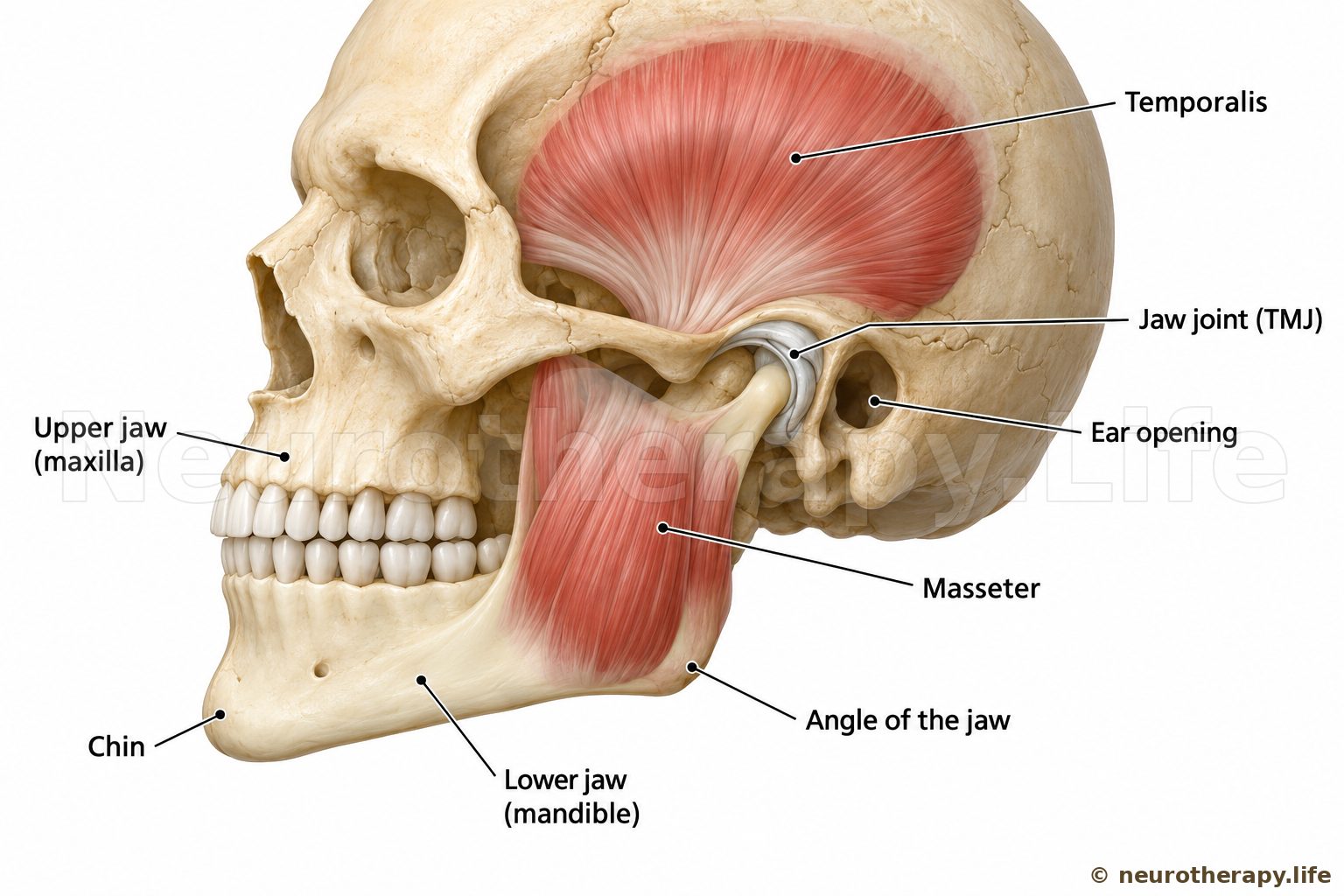
Your jaw is two bones: the fixed upper jaw and the lower jaw, the only bone of the skull that moves. It hinges and slides at two small joints just in front of your ears, driven by some of the strongest muscles in the body for their size, so that you can bite, chew, speak, swallow and yawn — and chewing well is where digestion begins.
Overview
What is the jaw?
The upper jaw (maxilla) is fixed to the skull and holds the upper teeth. The lower jaw (mandible) is a strong, horseshoe-shaped bone that holds the lower teeth and moves at the jaw joints — the temporomandibular joints, or TMJs — one just in front of each ear.
Every bite, every word and every swallow needs the jaw. Powerful muscles close it, smaller ones open it and move it side to side, and a nerve from the brainstem — the trigeminal nerve — runs both the chewing muscles and the feeling in the teeth.
Jaw joint and chewing-muscle problems (temporomandibular disorders) are common — studies suggest nearly a third of adults have some sign of them. Most are mild and settle with simple care. Toothache, clenching and grinding are also frequent reasons for jaw pain, and jaw pain on effort can even come from the heart.
The lower jaw is the only moving bone of the skull; it swings at the joint just in front of each ear.
Function
What does the jaw do?
The jaw is a lever built for force and for fine control at the same time — strong enough to crush a nut, precise enough to shape every sound of speech.
Bites and chews food, mixing it with saliva so that digestion starts in the mouth.
Shapes speech together with the lips and tongue.
Helps swallowing: the jaw closes and steadies before each swallow.
Holds the teeth — 32 in an adult, 16 in each jaw.
Anchors the tongue, which helps keep the airway open.
Gives the face its lower shape and supports the lips and cheeks.
How does the jaw work with other organs?
Mouth — The jaws carry the teeth and frame the mouth; together they begin digestion.
Ears — The jaw joint sits right in front of the ear canal, so jaw pain is often felt as earache.
Cranial nerves — The fifth cranial nerve (trigeminal) drives the chewing muscles and carries feeling from the teeth; the seventh (facial) moves the face.
Sinuses — The large sinus above the upper back teeth sits close to their roots, so sinus trouble can feel like toothache.
Neck — Jaw and neck muscles work as a team in chewing, swallowing and holding the head.
Heart — Heart pain can be felt in the jaw — so jaw pain on effort is checked by a doctor.
Digestive system — Chewing is the first step of digestion; saliva begins breaking down starch.
Two jawbones and their teeth, a pair of jaw joints, the chewing muscles, and the nerves and glands around them.
Bones and teeth
Lower jaw (mandible) — The largest and strongest bone of the face: a curved body carrying the teeth, a vertical branch on each side, the angle below the ear, and the rounded head that sits in the joint.
Upper jaw (maxilla) — A pair of bones joined in the middle that hold the upper teeth, form most of the roof of the mouth and the floor of the eye sockets, and contain the largest sinuses.
Teeth — Children have 20 milk teeth; adults have 32 — incisors to cut, canines to tear, premolars and molars to grind.
Gums and tooth sockets — Each tooth sits in a socket of jawbone, held by a thin ligament and covered at the neck by the gum.
The jaw joint (TMJ)
Two joints that must always work together, one in front of each ear.
Condyle and socket — The rounded head of the lower jaw sits in a shallow socket of the skull's temporal bone.
Articular disc — A small oval cushion of tough cartilage between the two bones; it divides the joint into two spaces, so it can both hinge and glide.
Ligaments and capsule — A loose sleeve and supporting bands that limit how far the jaw can move.
Chewing muscles
Masseter — The thick muscle over the angle of the jaw that you feel bulge when you clench; the main closing muscle.
Temporalis — A fan-shaped muscle over the temple that also closes the jaw; you can feel it move above the ear as you chew.
Pterygoid muscles — Two pairs of deep muscles inside the jaw that pull it forward, open it and grind from side to side.
Openers under the chin — Small muscles below the jaw, helped by gravity, open the mouth.
Nerves and glands
Trigeminal nerve (cranial nerve V) — Its lower branch moves the chewing muscles and carries feeling from the lower teeth, gums and chin; its middle branch serves the upper teeth.
Facial nerve (cranial nerve VII) — Passes through the parotid gland and moves the muscles of expression.
Salivary glands — The parotid wraps around the back of the jaw in front of the ear; the submandibular lies under the jaw; the sublingual under the tongue.
Where is the jaw?
The jaws form the lower third of the face. The upper jaw lies below the eyes and nose; the lower jaw forms the chin and runs back on each side to the jaw joint, which you can feel moving just in front of the ear if you open and close your mouth with a fingertip there.
Its neighbours are close: the ear canal right behind the joint, the parotid gland over the angle, the sinuses above the upper teeth, the tongue and floor of the mouth inside the lower jaw, and the top of the neck below it.
The lower jaw is shaped like a horseshoe seen from above, with an upright branch at each end rising to the joint. From the side you can see its angle below the ear and the point of the chin in front.
The jaw changes through life. In a newborn the lower jaw is still in two halves; teeth reshape it in childhood; and after teeth are lost, the ridge of bone that held them slowly shrinks, which is why a face without teeth or dentures looks shorter.
How big and how strong is the jaw?
The lower jaw is the largest and strongest bone of the face. Most adults can open the mouth wide enough to fit about three fingers, stacked, between the upper and lower front teeth — roughly 4 to 5 cm.
Biting force is greatest at the back teeth, closest to the hinge, and in healthy adults it is commonly measured at several hundred newtons — enough to press with the weight of tens of kilograms.
Conditions and disorders
What conditions and disorders affect the jaw?
Jaw pain most often comes from the teeth and gums or from the jaw joint and its muscles. It can also come from the nerves of the face, from the sinuses, from an injury — and occasionally from the heart.
Pain in front of the ear, in the cheek or at the temple, worse when chewing
Clicking, popping or grating when you open the mouth
Difficulty opening the mouth fully, or the jaw catching or locking
Aching jaw or headache on waking, or worn teeth — signs of night-time grinding
Toothache, bleeding or swollen gums
Emergency signs: swelling of the face or under the jaw with fever, difficulty swallowing or breathing; or jaw pain with chest discomfort
What tests check the jaw?
Dental examination — The dentist checks the teeth, gums and bite, and looks for decay, infection or grinding wear.
Jaw joint and muscle examination — Measuring how wide the mouth opens, listening for clicks and pressing the chewing muscles for tender spots.
Dental X-rays (OPG) — A panoramic X-ray shows all the teeth, the roots and both jawbones in one picture.
CT or MRI — CT shows the bone of the joint and fractures; MRI shows the disc and soft tissue.
ECG — If jaw pain comes on with effort or with chest symptoms, the heart is checked first.
How are jaw problems treated?
Treating the teeth and gums — Fillings, root treatment, gum care or removal of a tooth deal with the cause of most toothache.
Rest for the jaw — Soft food for a while, small bites, no gum chewing, and avoiding very wide yawns.
Warmth and gentle exercises — Warm packs and simple jaw-opening exercises taught by a dentist or physiotherapist.
Night guard — A custom mouth guard protects the teeth from grinding and can ease the jaw muscles.
Managing stress and habits — Noticing and stopping daytime clenching; help with stress and sleep.
Medicines and procedures — Short courses of pain relief; a dislocated jaw is put back by a doctor; surgery is rarely needed.
Neurotherapy (LMNT)
The LMNT sources say little about the jaw itself, and what they say is modest. Jaw Points and Teeth Points are offered for pain of the teeth and gums — as comfort while a dentist is being arranged, never as a cure for decay or infection. In the teaching's table of the face and mouth, (5) Medulla, given at the nape, is credited with problems of the chewing muscles, the teeth, the gums and the lips, and with a jaw that turns to one side and cannot chew; (7) Medulla with problems of the upper or lower jaw and with the muscles of the face. The daily rules add one piece of advice for everybody: chew well, so that more saliva comes. This works alongside dental and medical care, never instead of it.
Points
Jaw Points — Pressed and released on both cheeks at a marked point near the jawbone; for pains of the teeth and gums. It sits on the thick closing muscle — the commonest site of clenching pain.
Teeth Points — Taught to the patient: above the ear and below the eye for the upper teeth, below the chin and jaw for the lower teeth, on the side that hurts, on and off through the day.
Ptyalin — Light palms at four stations — cheeks, below the jaw twice, in front of the jaw — to stimulate the salivary glands and increase saliva.
Medulla — (5) Medulla for the chewing muscles, teeth, gums and a jaw that turns to one side; (7) Medulla for the upper and lower jaw and the muscles of the face.
Bell's Palsy — Both thumbs draw the face from the working side across to the other — used when one side of the face has dropped.
Guruji says
“The patient has to try it for himself and see. Every single thing will not have the same effect on every person.”
— Dr. Lajpatrai Mehra
“Neurotherapy (LMNT) treats according to the condition of the body.”
— Dr. Lajpatrai Mehra
Never do this
Emergency: jaw pain with chest pain or pressure, sweating, breathlessness or faintness — or jaw ache that comes on with effort — call 108/112. It may be the heart. Heart attack (myocardial infarction)
A toothache is a symptom with a cause. See a dentist the same day for swelling of the face or under the jaw, fever, a jaw that will not open fully, difficulty swallowing, or swelling under the tongue. Toothache (tooth, gum and jaw pain)
Jaw Points and Teeth Points are comfort while the dentist is arranged — never a reason to delay treatment of decay or infection. Jaw Points
Ptyalin is given with light pressure only. It is never given over a hot, swollen, painful gland — a swollen face at the jaw hinge with fever needs a doctor the same day — and a lump in front of the ear or under the jaw is assessed, never massaged. Ptyalin
A jaw stuck open after a yawn or a blow, or teeth that suddenly no longer meet after an injury, needs a doctor — do not force it. Sprain and injury
Keep the nails short and off the face; the skin over the jaw is thin, and older skin more so.
In heart patients, only (10) Left Medulla is given from the tenth lane — the standing rule of the Medulla family. (10) Medulla
Cancer: if the person has cancer, (10) Pan, Thymus, Pit, Lu + Sh, Rt. Ov / Lt. Ov and (30) Medulla are never given — the therapist changes the plan.
Keep taking the medicines your doctor or dentist prescribed. Neurotherapy (LMNT) works alongside your medical care, never instead of it.
Care
How can I keep my jaw healthy?
Healthy teeth, relaxed muscles and good chewing habits protect the jaw.
Chew well
Guruji's daily rules ask for food to be chewed well so that more saliva comes. Try it: a plain piece of chapati chewed thirty times turns sweet as saliva begins to digest the starch.
Lips together, teeth apart
At rest the teeth should not touch. Let the tongue rest lightly on the roof of the mouth and the jaw hang loose; notice and stop daytime clenching.
See a dentist regularly
Brush twice a day, clean between the teeth, and have a check-up at least once a year. Get loose or ill-fitting dentures adjusted.
Say no to gutka, supari and tobacco
Chewing areca nut can slowly stiffen the lining of the mouth until the jaw cannot open, and it raises the risk of mouth cancer.
Go easy on the joint
Avoid chewing pens, ice or very hard nuts, cut food into smaller pieces, and support the chin when you yawn.
Mind your posture
A head held forward over a screen strains both the neck and the jaw muscles.
Common questions
Why does my jaw click?
A click usually means the small disc inside the joint is slipping slightly out of place and back as you open. A painless click with normal opening is common and often needs no treatment. See a dentist if it hurts, if the jaw catches or locks, or if you cannot open fully.
Can jaw pain come from the heart?
Yes. Heart pain can be felt in the jaw, especially the lower jaw, often with chest, arm or back discomfort. Jaw ache that comes on with walking or climbing and eases with rest, or comes with sweating or breathlessness, needs urgent medical attention — call 108/112.
Why does my ear hurt when the problem is in my jaw?
The jaw joint sits right in front of the ear canal, and they share nerve supply. Pain from the joint or its muscles is often felt as earache, even when the ear itself is healthy.
Is grinding my teeth at night harmful?
It can wear down the teeth and leave the jaw muscles aching in the morning. A dentist can confirm it and make a night guard. Stress, poor sleep and some medicines can make it worse.
My jaw got stuck open after a big yawn. What should I do?
The jaw may have slipped forward out of its joint (dislocated). Do not force it; go to a doctor or emergency department, where it can be eased back safely. Afterwards, support your chin when yawning.
Can pressing points cure my toothache?
No. Decay, an inflamed nerve or an abscess needs a dentist. LMNT offers Jaw Points and Teeth Points only as comfort while the dentist is being arranged, and says so plainly to the patient.
What should I ask my doctor, dentist or therapist?
Is my pain coming from a tooth, the gum, the jaw joint or the muscles?
Do I grind or clench my teeth, and would a night guard help?
Which jaw exercises are safe for me?
Which signs mean I should come back the same day?
Could my jaw pain be linked to my heart, sinuses or ears?
(To the therapist) Which points are you giving for my jaw, and which are blocked for me?
Surprising facts
1The only moving bone of your skull
The skull is made of more than twenty bones locked together, but only one of them moves: the lower jaw. (The tiny bones inside the ear move too, but they sit within the skull rather than forming part of it.)
Source: Gray's Anatomy (42nd ed.) — the skull; the mandible as the only freely movable skull bone.
2A hinge that also slides
Most hinge joints only swing. The jaw joint has a small cushion of cartilage inside it that splits it into two spaces, so it can swing and also glide forward. You can feel the glide just in front of your ear when you open your mouth wide.
Source: Gray's Anatomy (42nd ed.) — the temporomandibular joint and its articular disc.
3One of the strongest muscles for its size
The masseter, the thick muscle you feel bulge at the angle of your jaw when you clench, is often called the strongest muscle in the body for its size. Together, the closing muscles can press the back teeth with a force of several hundred newtons.
Source: Gray's Anatomy (42nd ed.) — muscles of mastication; bite force: Bakke M, Semin Orthod 2006;12(2):120–126. 'Strongest for its size' is a common description, not a formal measurement.
4Your back teeth bite hardest
The jaw is a lever with its hinge at the ear. The closer a tooth sits to the hinge, the more force the muscles can deliver through it — which is why we crack nuts with the back teeth, not the front ones.
Source: Bakke M, Semin Orthod 2006;12(2):120–126 (bite force is greatest in the molar region); basic lever mechanics.
5A baby's lower jaw starts in two halves
At birth, the two halves of the lower jaw are joined at the chin only by tough fibrous tissue. They fuse into one solid bone during the first year of life.
Source: Gray's Anatomy (42nd ed.) — development of the mandible (symphysis menti fuses in the first year).
6Jaw pain can be a heart signal
Pain signals from a heart short of blood enter the spinal cord alongside signals from other parts of the body, and the brain can misplace them. Some people feel angina or a heart attack mainly in the jaw — so jaw pain on effort is never assumed to be a tooth.
Source: Foreman RD, Qin C. Cleveland Clinic Journal of Medicine 2009;76(Suppl 2):S75–S79 (referred cardiac pain); see the heart page.
7Supari can lock the jaw
Long-term chewing of areca nut (supari, gutka, paan masala) can cause oral submucous fibrosis: the lining of the mouth slowly turns stiff and scarred until the jaw can open only a finger's width. The condition can also turn into mouth cancer.
Source: IARC Monographs on the Evaluation of Carcinogenic Risks to Humans, Vol. 85: Betel-quid and Areca-nut Chewing (2004) — areca nut causes oral submucous fibrosis and oral cancer.
8Chewing turns chapati sweet
Chew a plain piece of chapati thirty times without swallowing and it starts to taste sweet. Saliva contains an enzyme (ptyalin, or salivary amylase) that chops starch into sugars. Guruji's teaching uses this very test so that a patient can prove the rule 'chew well' on her own tongue.
Source: Guyton & Hall, Medical Physiology — salivary α-amylase (ptyalin) digests starch. LMNT: db section 39.4.
Yoga
Siṃhāsana — the lion Siṃhāsana
Benefits
Stretches the muscles of the jaw, face, tongue and throat.
Releases tension held in a clenched jaw.
A playful breath that also relaxes the face.
How to do it
Sit on your heels (or on a chair) with the hands on the knees.
Breathe in through the nose.
Open the mouth as wide as is comfortable, stretch the tongue out towards the chin and spread the fingers.
Breathe out slowly through the mouth with a soft 'haa' sound.
Close the mouth, relax, and repeat 3 to 5 times.
Take care
Open only as wide as is comfortable — never to the point of pain or clicking. Skip it if your jaw has ever dislocated or locked, or while jaw pain is acute. Sit on a chair if kneeling hurts your knees.
Bhrāmarī — the humming bee breath Bhrāmarī Prāṇāyāma
Benefits
Keeping the teeth apart and the jaw loose while humming relaxes the chewing muscles.
The long, humming out-breath calms the mind — useful for people who clench under stress.
Gentle enough to do in bed before sleep.
How to do it
Sit comfortably with the spine upright and the eyes closed.
Close the lips but keep the teeth slightly apart; let the jaw hang loose.
Rest the index fingers gently on the small flaps in front of the ears.
Breathe in through the nose; breathing out, make a soft, steady humming sound like a bee.
Repeat 5 to 7 times, then sit quietly for a minute.
Take care
Never press hard on the ears, and do not do it lying flat with an ear infection. Stop if you feel dizzy. Keep the hum gentle; there is no need to force the breath.
Test yourself
Research
Strong evidence
A review pooling studies from many countries estimated that about 31% of adults and older people, and about 11% of children and teenagers, have a temporomandibular disorder. Displacement of the small disc inside the jaw joint was the most common type.
An international group of experts set out simple, tested criteria for diagnosing jaw joint and chewing-muscle disorders by history and examination — how wide the mouth opens, clicking, and tenderness of the chewing muscles — so that most cases can be recognised without scans.
This page explains how the body works; it does not diagnose. Neurotherapy (LMNT) works alongside your medical care — keep taking the medicines your doctor prescribed, and see a doctor for any new or severe symptom.
Ready to begin?
Send COURSE for course details, or your name, age and health issue for a consultation.