Also called: Ptyalin treatment, Ptyalin point, टाइलिन उपचार
Ptyalin is a gentle seated Neurotherapy (LMNT) treatment for the salivary glands, given with both palms on the cheeks and along the jaws. It is named for ptyalin, the starch-digesting enzyme in saliva, and it is used to increase the flow of saliva and support digestion from its very first step in the mouth.
Overview
What is the Ptyalin treatment?
Ptyalin is the old name for salivary amylase — an enzyme (a protein that breaks food down) in saliva. It starts cutting starch from rice, roti and potato into sugar while you are still chewing.
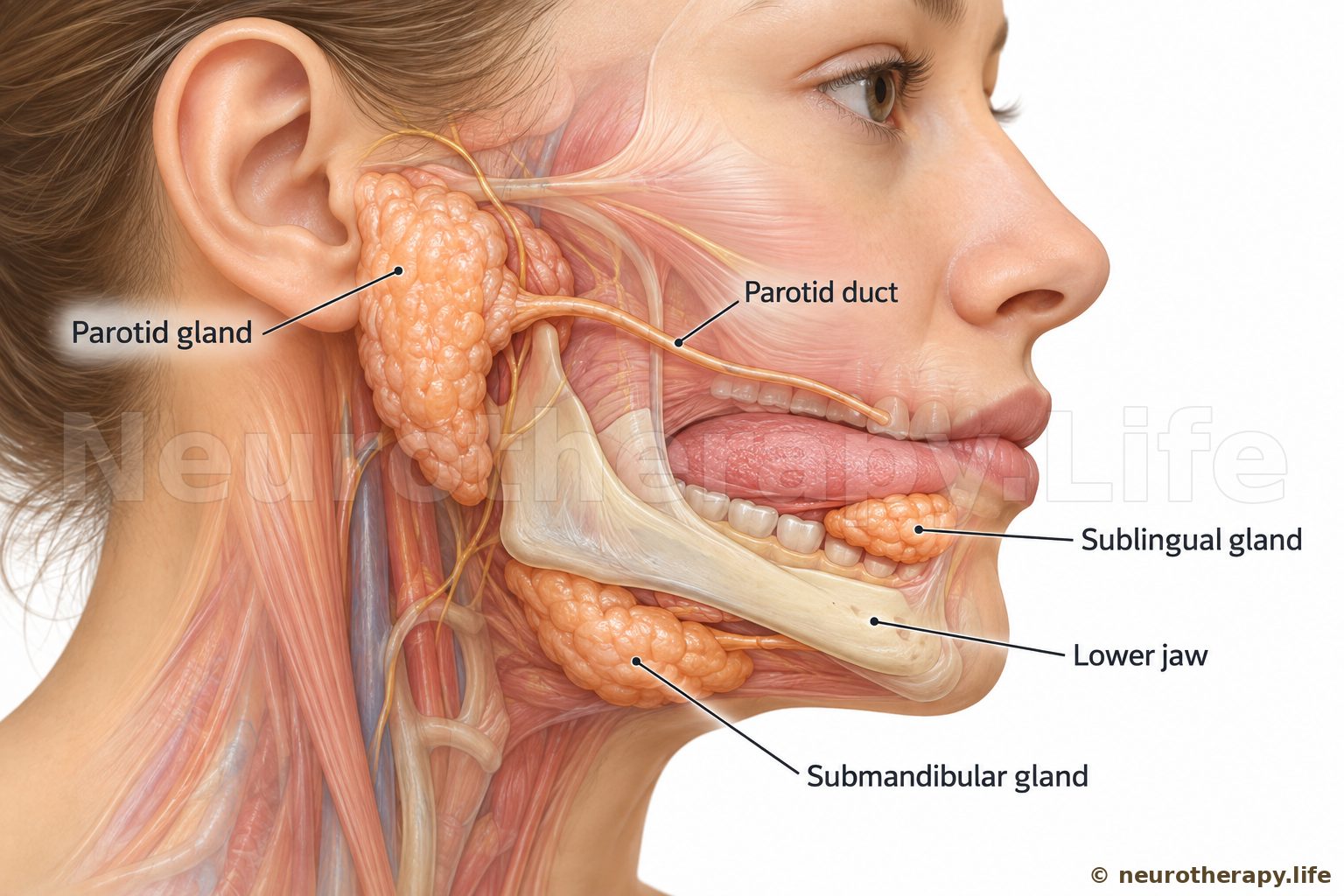
Saliva comes from three pairs of glands: the parotid glands in front of the ears, the submandibular glands under the jaw, and the sublingual glands under the tongue. The Ptyalin treatment is aimed at all three, and at increasing the production of saliva.
Unlike most gland points, this one is given right over the glands it is named for. That is exactly why its one rule is lightness: everything here lies close to the surface and is delicate.
Three pairs of glands make saliva. The Ptyalin treatment is given over them, with light palms.
Where it is given
Where is Ptyalin given?
PositionSitting
Body areaBoth cheeks, below the jaws and in front of the jaws, both sides together
You sit on a chair. The therapist places both palms on your face and jaw, on both sides at once, at four places: the cheeks, below the jaw near its angle, further below the jaw, and on the muscles in front of the jaws.
The cheek place sits over the parotid gland; the places under the jaw sit over the submandibular and sublingual glands. Nothing presses the front of the throat.
How it is given
How is Ptyalin given?
How this point is given — the tool, the pressure, the count and the exact movement — is deliberately not described here. A demonstration video for this point is being prepared; until it is on this page, learn the method hands-on from a trained Neurotherapist before giving it. Please do not give any point from a written description alone: a point given in the wrong place or the wrong way can do harm.
The number written before a point's name is not a strength setting. Each numbered form is a separate named treatment with its own method and timing, taught hands-on in the course.
Feels likeSoft movement of the cheeks and jaw, often with more saliva
The exact technique is taught hands-on in the Neurotherapy (LMNT) course. See the course →
What it does
What does Ptyalin do?
Teaching names each place for the gland beneath it, and gives the whole treatment one purpose: more saliva.
At the cheeks — to stimulate the parotid glands, the main source of ptyalin.
Below the jaw — to stimulate the submandibular glands.
Further below the jaw — to stimulate the sublingual glands beneath the tongue.
In front of the jaws — this too increases the production of saliva.
Inside the Complement System formula, it is the stage written 'for saliva — for the digestive system'.
Organs it reaches
Mouth — Saliva moistens food, protects the teeth and begins starch digestion.
Stomach — Well-chewed, moist food reaches the stomach ready for the next stage.
Cranial nerves — Saliva is switched on by cranial nerves — the parotid by the ninth.
Its family
Which treatments sit beside Ptyalin?
Ptyalin is one of the seated treatments of the neck, jaw and base of the skull. Saliva can also be addressed through the Medulla forms, by a different route.
Necklace — Given along the edge of the skull bone — taught beside Ptyalin.
Neck Clockwise — The third treatment of the same seated group.
Ton 'P' — Also worked on the cheek, but for the parotid's role in immunity, not for saliva.
Medulla — Certain Medulla forms are written for a dry mouth and for saliva.
(4) Medulla — Named for dryness of the mouth when ptyalin is not formed at mealtimes.
What it is used for
What is Ptyalin used for?
Its stated purpose is narrow and plain: to increase saliva.
One of its stages — 'for saliva, for the digestive system'.
Safety: when it is held back
A lump is never treated. A swelling in front of the ear or under the jaw that has been there for weeks is assessed by a doctor, not massaged. Lipoma and cyst
Not at all in an acutely swollen, hot, painful gland. A face tender and swollen at the jaw hinge, with fever, needs medical assessment the same day. Fever and viral fever
Light means light: flat palms, never fingertips, never a grip, and the nails off the face — the skin here is thin, older skin more so.
No pressure falls on the front or sides of the neck in any seated treatment. Neck
No. It is light palm work at set places over the salivary glands, aimed at more saliva — not a massage of the cheeks.
I have a lump under my jaw. Can I have Ptyalin?
Not over the lump. Please have it seen by a doctor first. A lump in a salivary gland is never treated with this point.
Does saliva really help digestion?
Yes, it starts it. Ptyalin begins breaking starch while you chew, and saliva makes food moist and easy to swallow. The stomach's acid soon stops ptyalin, and the rest of starch digestion happens in the small intestine.
Surprising facts
1Roti turns sweet in your mouth
Chew plain roti slowly and hold it: after about a minute it tastes faintly sweet. That is ptyalin cutting starch into sugar before you swallow.
Source: Guyton & Hall, Textbook of Medical Physiology, digestion of carbohydrates by salivary amylase.
2Litres of saliva every day
An adult makes roughly one to one and a half litres of saliva a day, most of it at mealtimes.
Source: Guyton & Hall, Textbook of Medical Physiology, secretion of saliva.
3The nerve is not the one that runs through it
The nerve that moves the face runs right through the parotid gland, yet the gland's saliva is switched on by a different one — the ninth cranial nerve.
Source: Gray's Anatomy, 41st edition, the parotid gland and its nerve supply.
This page explains what a Neurotherapy (LMNT) treatment is for; it is not a self-treatment guide and does not diagnose. Neurotherapy (LMNT) works alongside your medical care — keep taking the medicines your doctor prescribed.
Ready to begin?
Send COURSE for course details, or your name, age and health issue for a consultation.