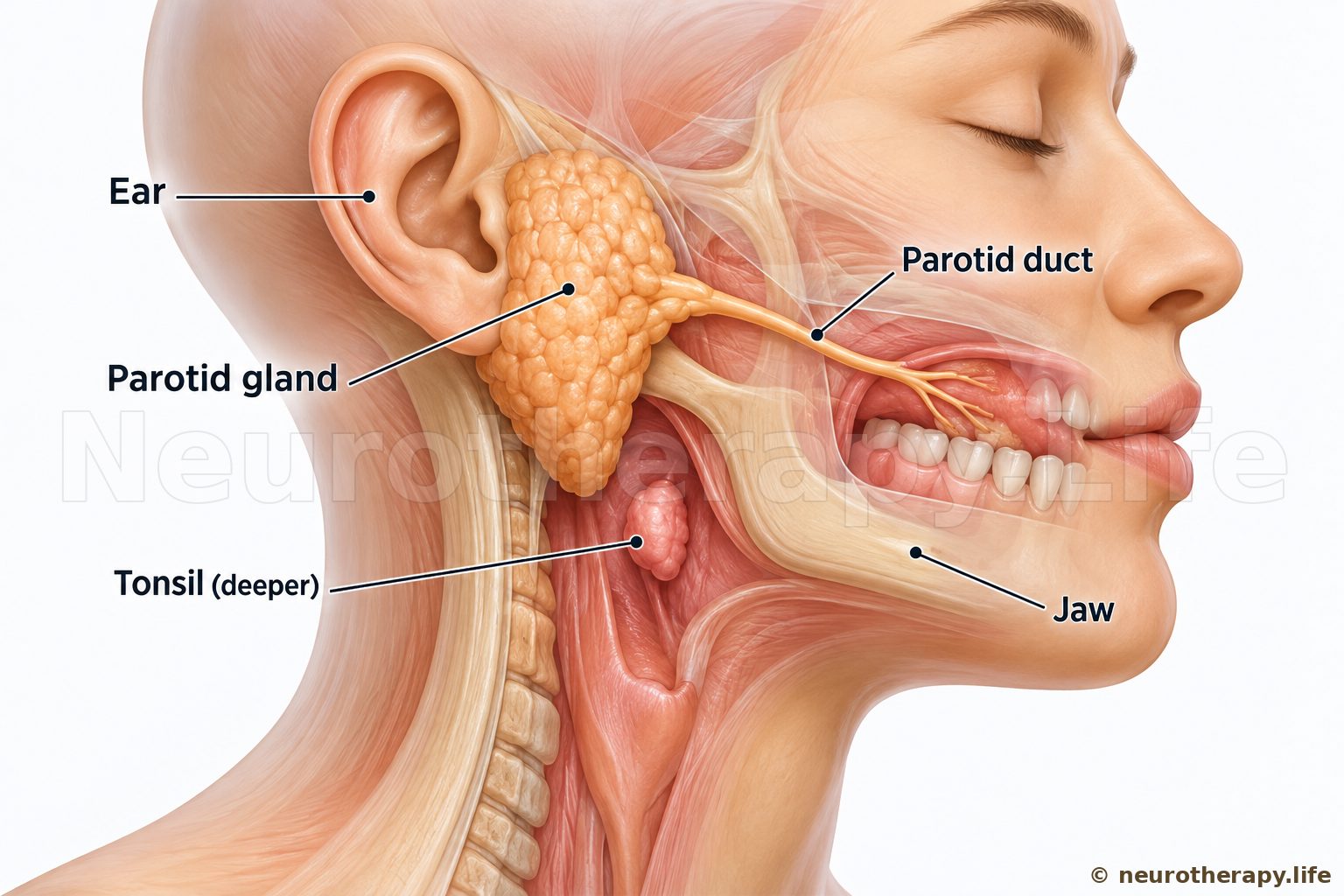
1The biggest saliva glands
The parotids are the largest of the three pairs of major saliva glands. Their duct opens inside the cheek, opposite the upper second molar tooth.
Source: Standring S (ed). Gray's Anatomy, 41st ed. Elsevier, 2016.
Also called: Ton P, Parotid point, टॉन पी
Ton 'P' is a Neurotherapy (LMNT) rubbing treatment over the cheek and the side of the neck that stimulates the parotid glands, the large saliva glands beside the cheeks. It is used for infection in the mouth and throat and for prolapse of the uterus — and it is never given to a woman who wishes to become a mother.
The 'P' stands for parotid. The parotid glands are the largest saliva glands in the body. One sits on each side of the face, just in front of and below the ear, over the back of the jaw. They are the glands that swell in mumps.
In the source teaching, stimulating the parotid glands helps them fight any virus or bacteria in the mouth or throat — so Ton 'P' is given where there is infection. It is also called unmatched for setting a prolapsed uterus back in its place.
Ton 'P' has a twin, Ton 'T', for the tonsils. Both are the same three rubs at the same three places; only the counts differ. That is why the letter must always be read — a card that says only 'Ton' has told you nothing.
No fixed position is written; you only need to be placed so that the face and the side of the neck can be reached comfortably, usually sitting.
The work covers three places on each side: the cheek in front of the ear down toward the neck; below the cheek, from the chin toward behind and below the ear; and the side of the neck where it meets the shoulder. Nothing presses the front of the throat.
How this point is given — the tool, the pressure, the count and the exact movement — is deliberately not described here. A demonstration video for this point is being prepared; until it is on this page, learn the method hands-on from a trained Neurotherapist before giving it. Please do not give any point from a written description alone: a point given in the wrong place or the wrong way can do harm.
The exact technique is taught hands-on in the Neurotherapy (LMNT) course. See the course →
In the source teaching, Ton 'P':
Its twin, and the other immunity points it is grouped with.
After the question 'are you hoping for a child?' has been asked, and the bars checked:
The original, heavy viral formula; the later mild form left Ton 'P' out
“The research is still to be done.”
Because in mumps, when the parotid glands swell, some young men lose the ability to father children. From that, it is thought the parotids have some link with the reproductive organs, so the therapy chose caution in exactly the people who could be harmed.
No. It is not proven to prevent pregnancy and must never be relied on for that. A woman who wants contraception should get proper advice from a doctor.
Same three places, same strokes — only the counts differ. Ton 'P' is for the parotid glands; Ton 'T' is for the tonsils and must be followed at once by the Sangam points.
Yes, one: whether you are hoping for a child, now or later. It is asked privately and plainly, before Ton 'P' is ever written on a card.
The parotids are the largest of the three pairs of major saliva glands. Their duct opens inside the cheek, opposite the upper second molar tooth.
Source: Standring S (ed). Gray's Anatomy, 41st ed. Elsevier, 2016.
Swelling of the parotids is the most common sign of mumps, seen in over 70% of infections.
Source: Rausch-Phung EA et al. Mumps. StatPearls (NCBI), 2024.
About one in five men who catch mumps after puberty develop a painful swelling of the testes, and fertility can be reduced in some of them — rarely in boys before puberty.
Source: Rausch-Phung EA et al. Mumps. StatPearls (NCBI), 2024.
A clinical reference on mumps: parotid swelling occurs in over 70% of infections, about one in five men infected after puberty develop testicular inflammation, and reduced fertility can follow in some of them. This is the medical background to the caution about Ton 'P'.
Rausch-Phung EA, Davison P, Morris J. Mumps. StatPearls. NCBI, updated 2024.
This page explains what a Neurotherapy (LMNT) treatment is for; it is not a self-treatment guide and does not diagnose. Neurotherapy (LMNT) works alongside your medical care — keep taking the medicines your doctor prescribed.
Send COURSE for course details, or your name, age and health issue for a consultation.