Teenage years (care for teenagers)
The teenage years are when the body grows fast and the sex hormones switch on. In LMNT, this stage has its own set of bars — points that are not given while a young person is still growing, because some of them could make the growth plates close early.
- Puberty usually starts between 8 and 13 in girls, and between 9 and 14 in boys
- The growth spurt peaks around 11½ in girls and around 13½ in boys
- Growth slows around 16 in girls and around 18 in boys
- Puberty usually lasts two to five years
Source: Cleveland Clinic (puberty); MedlinePlus (adolescent development)
What is Teenage years (care for teenagers)?
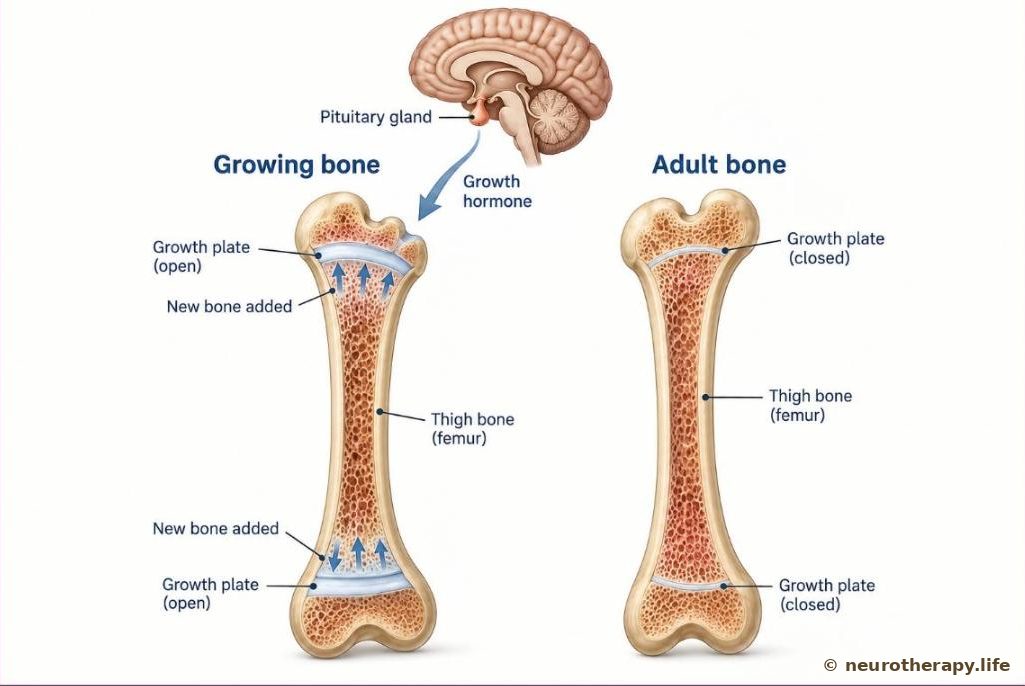
Puberty begins in the brain. The hypothalamus signals the pituitary gland, which tells the ovaries or testes to make sex hormones — mainly oestrogen in girls and testosterone in boys. These hormones bring the changes of the teenage years.
Height grows at the growth plates — soft bands near the ends of the long bones. Towards the end of puberty these plates seal. Once a growth plate has closed, the bone has finished lengthening, and it does not open again.
What are the symptoms?
- A fast growth spurt in height
- Body changes brought by the sex hormones; in girls, periods begin
- Voice change in boys
- Pimples and oily skin
- Stronger feelings, new independence, and friends becoming more important
What causes it, and who is more likely to get it?
What drives the changes
How is it found?
The teenage years are not an illness. A doctor should see a teenager whose puberty starts very early (before 8 in girls or before 9 in boys) or has not begun late on (no breast development in a girl by 13, or no genital development in a boy by 14), or who is not growing.
Height and weight on a growth chart
Measured over months, it shows whether growth is on track for age.
Bone age X-ray of the hand
Shows how open the growth plates still are.
Hormone blood tests
Asked for by the doctor when puberty comes very early or very late.
Before planning anything for a teenager, a neurotherapist asks the exact age, and whether height is a concern or is being treated. Then the blocked points for the teenage years are written on the card, boxed, before the first treatment — so that neither the therapist nor anyone else gives them by mistake. For Ton 'P', one more question is asked of any young woman who could answer yes: "Do you want a child — now, or later?"
How Neurotherapy (LMNT) sees Teenage years (care for teenagers)
In LMNT, the teenage years are a stage with bars, not a disease with a formula. Guruji's teaching blocks five points in the teenage years: Lt. Ov., Rt. Ov., WD, Ton 'P' and Ton 'T'. No substitute is named for any of the five, and none is to be invented. Where a teenager needs help with height, LMNT's plan for low height is followed.
Why the ovary points wait
- Lt. Ov. / Rt. Ov.stimulate oestrogen and progesterone
- Hormones risethese hormones push the growth plates to close
- Plates close earlythe long bones stop lengthening before their time
- Height stopsand a closed plate does not open again
The Ton bar has a different root, and LMNT says so honestly. In mumps the glands at the side of the cheek swell, and in some boys the testes are harmed and they cannot later become fathers. From this it is thought — not proven — that Ton 'P' and Ton 'T' have some relation with fertility. So they are withheld from young people, especially young women up to the age of bearing children. LMNT also says plainly: Ton 'P' is not a contraceptive, it is not proven either way, and research is still to be done.
The research is still to be done.
Neurotherapy (LMNT) treatment for Teenage years (care for teenagers), step by step
Examine first — and block first
The therapist checks Liv° and Mu°, asks the exact age and whether height is a concern, and writes the teenage-year bars on the card, boxed, before any plan is made.
Leave out the five points
Lt. Ov., Rt. Ov., WD, Ton 'P' and Ton 'T' are not given in the teenage years. No substitute is given in their place.
The right Pan, and care with Medulla
For a young person who is short, (2) Pan is not given — it stops growth hormone; (4) Pan or (10) Pan is given instead. (6) Medulla is not given to boys and girls of 13 to 20 who are being treated to increase height, unless there is a special need.
For height, follow the low-height plan
Where height is the concern, the LMNT plan for low height is used, with the doctor's growth chart and bone age report in hand.
Points and formulas used
Never do this
- Never in the teenage years: Lt. Ov., Rt. Ov., WD, Ton 'P' and Ton 'T'. No substitute is named for any of the five, and none is to be invented. WD
- (2) Pan is not given to a young person who is short — it stops growth hormone. (6) Medulla is not given between 13 and 20 to those being treated to increase height, unless there is a special need. (2) Pan
- Ton 'P' is not given to any woman who wants children, now or later. It is not a contraceptive — it is not proven either way, and research is still to be done. Ton 'P'
- See a doctor for puberty that starts very early or very late, a teenager who has stopped growing, or very heavy or painful periods. If a teenager talks of hurting themselves, get help at once — in India, call Tele-MANAS 14416, or 108/112 in an emergency.
- Treatment only by a trained therapist, with a parent or guardian informed and present for a minor.
- Cancer: if the person has cancer, (10) Pan, Thymus, Pit, Lu + Sh, Rt. Ov / Lt. Ov and (30) Medulla are never given — the therapist changes the plan.
- Keep taking the medicines your doctor prescribed. Neurotherapy (LMNT) works alongside your medical care, never instead of it.
From Ayurveda and the kitchen
Test yourself
What research says
- Emerging evidence
In young rabbits given oestrogen, the growth plates aged faster and fused earlier. The study suggests that oestrogen closes the growth plate by speeding up its natural ageing — the same body link on which LMNT's teenage bar on the ovary points rests.
No clinical trial of Neurotherapy (LMNT) in the teenage years has been published yet. Improvements reported by neurotherapists are clinical observations.
For you
Parents
Tell the therapist your child's exact age and whether height is a worry. Ask to see the blocked points written on the card.
Teenagers
The changes of these years are normal and come at different times for different people. Ask a doctor or a trusted adult about anything that worries you.
Young women
If you may want a child now or later, say so — Ton 'P' is then not given.
This page explains; it does not diagnose. Neurotherapy (LMNT) works alongside your medical care — keep taking the medicines your doctor prescribed, and see a doctor for any new or severe symptom.