(10) Pan is the form of the Pan point aimed at insulin. It is given to diabetic patients to help keep the sugar level steady — always alongside their doctor's treatment — and is also used for joint pain of many years, cataract and eye disease, and cracked skin.
Overview
What is (10) Pan?
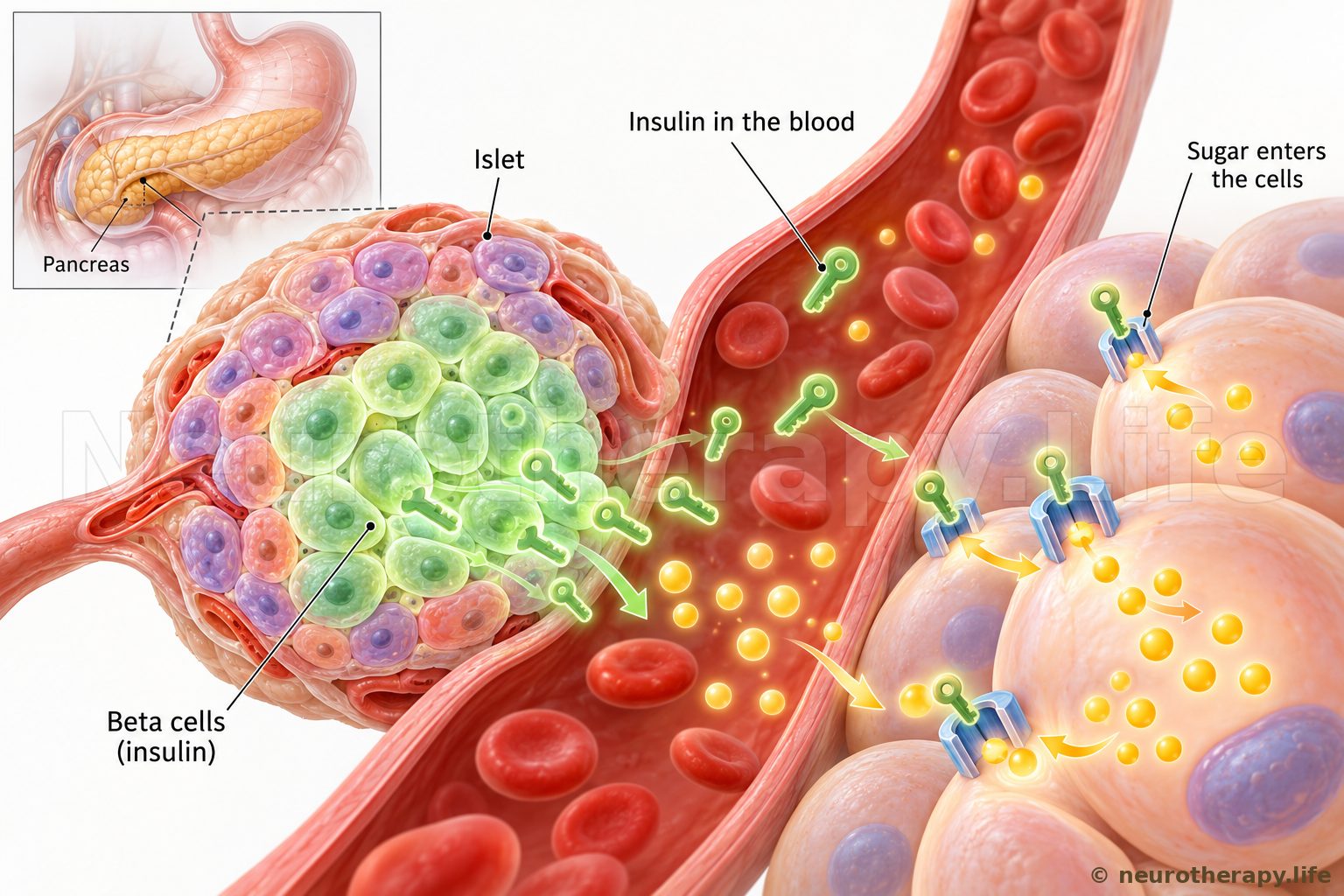
Pan is short for pancreas, the gland behind the stomach. Scattered through it are tiny islands of cells, and the most common cells in them, the beta cells, make insulin.
Insulin is the hormone that lets sugar out of the blood and into the cells, where it is used for energy. In the therapy's teaching, insulin also carries proteins into the tissues — and that is the reason given for (10) Pan's use in old joint pain.
(10) Pan is the Pan a diabetic patient receives. Where (4) Pan is blocked because it raises sugar, (10) Pan is given in its place. It is also one of the two forms that may replace (2) Pan for a child being treated for height.
Insulin lets sugar into the cells — the hormone (10) Pan is aimed at.
Where it is given
Where is (10) Pan given?
PositionLying on the back
Body areaFront of both thighs, middle of each thigh, just below the thigh–hip crease
You lie flat on your back, with one pillow under both thighs and nothing under the head or the waist. (10) Pan is given on the front of both thighs together, in the middle of each thigh, just below the crease where the thigh meets the hip.
This is exactly the same spot as every other form of Pan. The place does not change from one number to the next — only the treatment does. The middle of the thigh is chosen on purpose: further inward lies the groin, where the main artery, vein and nerve of the leg run close under the skin.
Why the thigh, when the pancreas lies deep in the belly? The Neurotherapy (LMNT) map works by a crossing rule: pressure on the legs answers pains above the navel. The point is named for what it is meant to move, not for the place it is given on.
How it is given
How is (10) Pan given?
How this point is given — the tool, the pressure, the count and the exact movement — is deliberately not described here. A demonstration video for this point is being prepared; until it is on this page, learn the method hands-on from a trained Neurotherapist before giving it. Please do not give any point from a written description alone: a point given in the wrong place or the wrong way can do harm.
The number written before a point's name is not a strength setting. Each numbered form is a separate named treatment with its own method and timing, taught hands-on in the course.
The number before itNames the treatment; it is not a strength setting
The exact technique is taught hands-on in the Neurotherapy (LMNT) course. See the course →
What it does
What does (10) Pan do in the body?
In Neurotherapy (LMNT) teaching, (10) Pan stimulates insulin. Body science confirms what insulin does; how a press on the thigh reaches the gland is the therapy's own explanation, offered from clinical experience. Some uses are marked in the teaching itself with a question mark — not yet settled — and are shown that way here.
Given to diabetic patients to help maintain the body's sugar level.
For joint pain of many years' standing, where patients have reported quick relief — the teaching links it to insulin carrying proteins into the cells.
For cataract and eye disease.
In heart disease or obesity, to reduce triglycerides (a blood fat) — chiefly where the trouble arises from a slow thyroid.
For the skin: to clear dead skin, to protect against bacteria, and for cracked skin of the hands and feet.
With (2) Pan, to increase urine in kidney failure, uraemia and nephrotic syndrome.
Marked unsettled (?) in the teaching: raising the white cell count, and help for a cerebral palsy child whose mother had high blood pressure in pregnancy.
Skin — Named for dead skin and cracked hands and feet.
Its family
What are the other forms of Pan?
Every number of Pan is given at the same place, and each is its own treatment with its own uses and its own cautions. A caution written against one number does not travel to the others — but the general Pan cautions apply to all.
Pan — The parent Pan point — the pancreas point and its five numbered forms.
(2) Pan — Somatostatin — to check what is overactive and unwanted growth. Not for children treated for height.
(4) Pan — Glucagon — for weakness from low sugar; appetite and height in small children. Not in diabetes or cancer.
(8) Pan — Digestive enzymes and bicarbonate — the everyday form that opens the Normal and Heparin formulas.
(18) Pan — The highest number — to reduce prolactin in women; cataract and eye disease; opens F. Heparin.
What it is used for
What is (10) Pan used for?
(10) Pan is chosen from the patient's findings, after the blocked list has been checked. In diabetes it always works alongside the doctor's treatment.
Sugar and blood fats
DiabetesGiven in place of (4) Pan to help keep the sugar steady.
High cholesterolTo reduce triglycerides, chiefly where a slow thyroid lies behind them.
ObesityNamed with heart disease for the triglyceride use.
HypothyroidismWhere diabetes or heart disease arises from a slow thyroid.
The heart treatment in four parts — (10) Pan sits in its first part, with the neck and thyroid work.
Safety: when it is held back
Blocking comes first. Before any treatment, the points not to be given for the patient's disease are marked on the diagnosis card. Where a caution and a use both apply, the caution wins. Conditions that block certain points: the six families
Cancer: (10) Pan is never given in cancer. Nothing in this therapy treats cancer; it is support alongside the oncologist. Cancer care: Neurotherapy (LMNT) support
Diabetes: keep taking your medicines and keep checking your sugar. If it starts to fall, tell your doctor — the doctor, not the therapist, changes the dose. Diabetes
Diabetic feet: look at the feet before every session. Where feeling has gone, the patient cannot report that pressure is too much; a wound on the foot goes to a doctor. Gangrene
“By Pan we stimulate the pancreas. Stimulating in different numbers produces different effects.”
— Dr. Lajpatrai Mehra
Common questions
Can (10) Pan replace my diabetes tablets or insulin?
No. It is given alongside your treatment. Never stop or reduce your medicines yourself; if your sugar falls, your doctor decides what to change.
Why is (10) Pan used for joint pain?
The teaching says one job of insulin is to carry proteins into the tissues, and that old joint pain comes when proteins do not reach inside the cells. Patients with joint pain of many years have reported quick relief.
Why do some uses have a question mark?
Because the teaching itself marks them as not yet settled. We keep those marks so you know which claims are firm and which are still being watched.
Is (10) Pan stronger than (8) Pan?
No — it is a different treatment. (8) Pan is for digestion; (10) Pan is for insulin. The number selects, it does not measure.
Surprising facts
1Beta cells are the majority
In a human islet, insulin-making beta cells are the most common cell type, though the islets themselves are only 1 to 2% of the pancreas.
Source: Röder PV et al., Pancreatic regulation of glucose homeostasis, Exp Mol Med 2016;48:e219.
2Insulin also builds
Insulin does more than lower sugar: it helps cells take up amino acids, the building blocks of protein, and slows protein breakdown.
Source: Guyton & Hall, Textbook of Medical Physiology (insulin promotes protein synthesis and storage).
3A Nobel Prize for one hormone
Insulin was isolated in Toronto in 1921, and the discovery won the Nobel Prize in 1923.
Source: NobelPrize.org, The Nobel Prize in Physiology or Medicine 1923 (Banting and Macleod).
4Sugar clouds the lens
People with diabetes tend to develop cataract earlier, because high sugar changes the clear proteins of the eye's lens.
Source: Standard ophthalmology teaching on diabetic cataract (e.g. American Academy of Ophthalmology).
Test yourself
Research
Strong evidence
A review of how the pancreas controls blood sugar: insulin from the beta cells lowers it, glucagon raises it, and the islets that make both are only 1–2% of the organ.
This page explains what a Neurotherapy (LMNT) treatment is for; it is not a self-treatment guide and does not diagnose. Neurotherapy (LMNT) works alongside your medical care — keep taking the medicines your doctor prescribed.
Ready to begin?
Send COURSE for course details, or your name, age and health issue for a consultation.