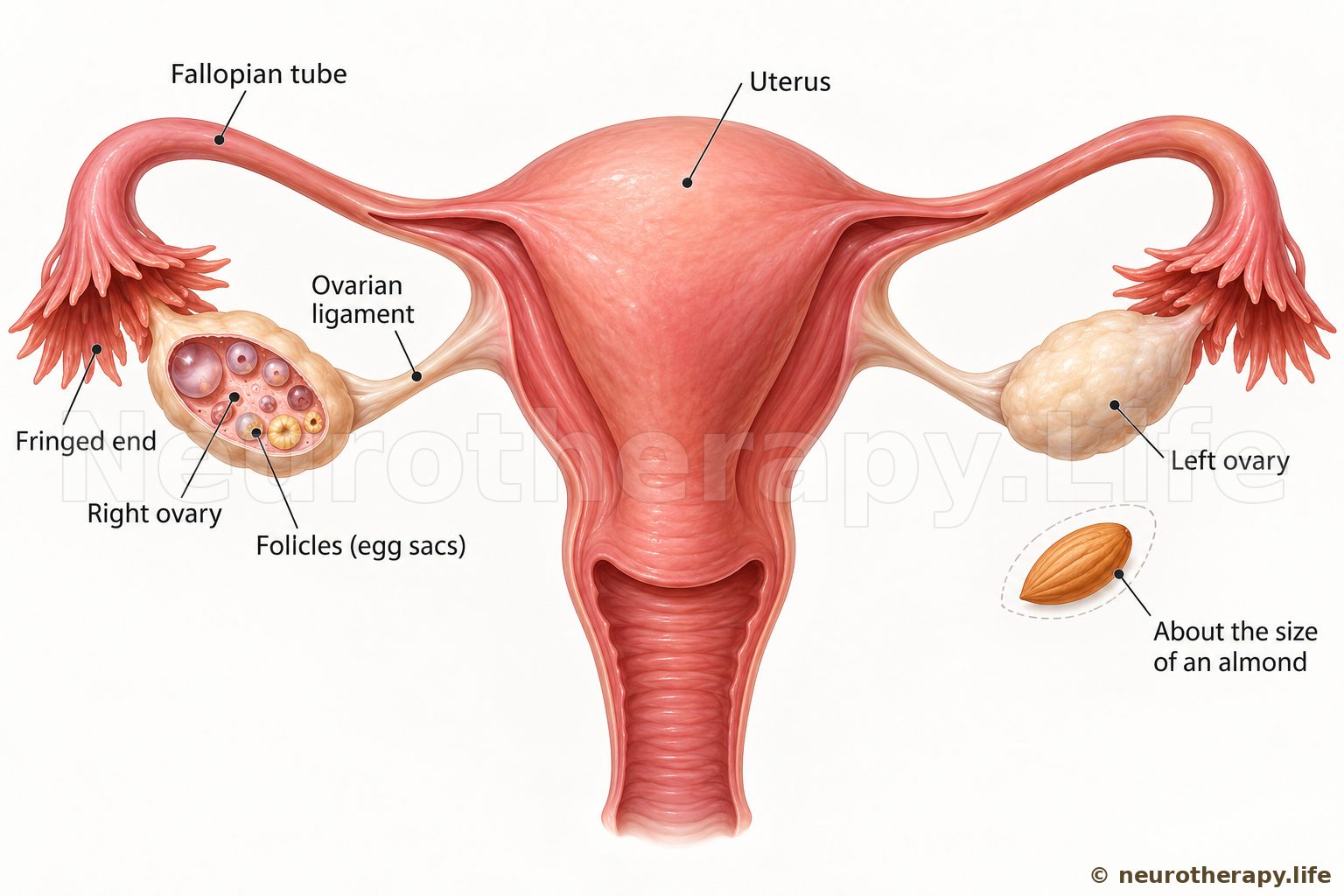
Your two ovaries are almond-sized glands deep in the pelvis. A girl is born with her whole lifetime's store of eggs already inside them, and from puberty to menopause they release, usually, one egg a month — while also making the hormones oestrogen and progesterone that run the monthly cycle and protect the bones.
Overview
What are the ovaries?
The ovaries are the two female sex glands, one on each side of the uterus (womb). Each is about the size and shape of an almond. They are the woman's egg store and one of her most important hormone glands.
Every month from puberty to the menopause, the ovaries ripen a small group of eggs and usually release one, a process called ovulation. At the same time they make oestrogen and progesterone, which prepare the uterus for a possible pregnancy and affect the skin, bones, heart and mood.
Ovary problems are common. Polycystic ovary syndrome (PCOS) alone affects an estimated 8–13% of women of childbearing age worldwide, and many do not know they have it. Most ovary cysts are harmless and go away by themselves — but a few ovary problems are emergencies, so new or severe pain low in the belly always deserves a check.
The two ovaries sit on either side of the uterus, just below the open ends of the fallopian tubes. Each is about the size of an almond.
Function
What do the ovaries do?
The ovaries have two jobs that are closely tied together: they release eggs, and they make hormones. The same tiny fluid-filled sacs that hold the eggs — called follicles — are also where most of the hormones are made.
Store the eggs — the whole lifetime's supply is present before birth.
Ripen and release usually one egg each cycle (ovulation).
Make oestrogen, which builds the uterus lining and protects bones, skin and blood vessels.
Make progesterone after ovulation, which ripens the lining so a fertilised egg can settle in it.
Make small amounts of testosterone and other hormones that feed back to the brain.
A new group wakes
While the period is running, the pituitary's FSH wakes a small group of follicles in the ovaries.
One leader grows
Usually one follicle takes the lead and grows to about 2 cm, making more and more oestrogen. The others fade.
The release
A sudden surge of LH from the pituitary makes the follicle burst open and release its egg — about 14 days before the next period.
The yellow body
The empty follicle turns into the corpus luteum ('yellow body'), which makes progesterone for the second half of the cycle.
Period or pregnancy
If no pregnancy begins, the yellow body fades after about 14 days, progesterone falls and the period starts. If a pregnancy begins, a hormone from the embryo keeps it alive until the placenta takes over.
How do the ovaries work with other organs?
Pituitary gland — Sends FSH and LH, the two messengers that ripen the egg and trigger its release.
Uterus (womb) — The ovaries' hormones build and then ripen the uterus lining every month.
Thyroid — A slow or overactive thyroid can upset ovulation and the cycle.
Adrenal glands — Also make small amounts of male-type hormones in women, alongside the ovaries.
Reproductive system — The ovaries are the egg store of the reproductive system.
Anatomy
What are the parts of the ovaries?
Each ovary has an outer egg-holding layer, an inner core of blood vessels, and a set of 'moorings' that hold it in place.
Layers of the ovary
Surface layer — A single layer of cells over a tough whitish capsule.
Cortex — The outer part, packed with follicles at every stage, from tiny resting ones to one large mature follicle.
Medulla — The inner core of loose tissue that carries the blood vessels, lymph vessels and nerves.
The life of a follicle
Each egg lives inside a follicle, and the follicle changes shape and job as the month goes on.
Resting (primordial) follicle — A single immature egg wrapped in one thin layer of cells — the form in which eggs wait, some for 40 or 50 years.
Growing follicle — Gains more cell layers and a pocket of fluid, and begins to make oestrogen.
Mature (Graafian) follicle — The one chosen follicle, about 2 cm across, bulging from the surface just before ovulation.
Corpus luteum — What the follicle becomes after releasing its egg; it makes progesterone for about 14 days.
Corpus albicans — The small pale scar left when the yellow body fades.
The moorings
The ovary is not glued in place. It hangs on ligaments, and — surprisingly — it is not attached to the fallopian tube at all.
Ovarian ligament — A short cord that ties the ovary to the side of the uterus.
Suspensory ligament — A fold running up to the side wall of the pelvis, carrying the ovarian artery and vein.
Ovarian artery — Starts high up from the aorta, near the kidneys, and runs all the way down to the ovary.
Fringed end of the tube (fimbriae) — Finger-like fringes that sweep over the ovary at ovulation to catch the egg.
Where are the ovaries located?
The ovaries lie deep in the pelvis, one on each side of the uterus, against the side walls of the pelvis in a shallow dip. They sit low in the belly — roughly below a line drawn between the navel and the bony point at the front of each hip. Their exact position shifts a little with age, after childbirth and when the bladder or bowel is full.
They cannot be felt from outside. LMNT's Rt. Ov. and Lt. Ov. points lie halfway between the navel and the bony point at the front of the hip on each side, but the teaching itself says the ovary lies deep and cannot be reached by a finger on the belly. The name marks the place where pain is found in ovary troubles — and the same low corner of the belly also holds loops of the large intestine.
An ovary is a pale, greyish-pink, almond-shaped body. Before puberty its surface is smooth. During the fertile years it looks slightly lumpy from follicles underneath, and it becomes marked with small pale scars, one left behind by each ovulation.
On an ultrasound, a healthy ovary looks like a small oval dotted with dark round bubbles — the fluid-filled follicles. After the menopause it shrinks and the bubbles disappear.
How big are the ovaries?
In an adult woman, each ovary is about 3 cm long, 1.5 cm wide and 1 cm thick — about the size of an almond — and weighs only a few grams. On ultrasound its volume is usually under about 10 millilitres.
Its size changes through the month: just before ovulation, the leading follicle alone grows to about 2 cm. The ovaries are smaller before puberty and become smaller again after the menopause.
Conditions and disorders
What conditions and disorders affect the ovaries?
The commonest ovary problems are polycystic ovary syndrome (PCOS), where eggs are not released regularly; ovarian cysts, most of them harmless fluid sacs; and endometriosis, where tissue like the womb lining grows on or around the ovaries. Rarer but urgent are ovarian torsion, when the ovary twists on its moorings, and ovarian cancer, whose early signs are easily missed. The menopause is not a disease, but it is the ovaries' natural retirement, and it changes the body.
Cancer care: Neurotherapy (LMNT) supportOvarian cancer often shows only as bloating, early fullness or pelvic pain that will not go away — see a doctor if these last for weeks.
What are common signs of an ovary problem?
Periods that are irregular, far apart or missing
Pain low on one side of the belly — around mid-cycle, during the period, or sudden and severe
Acne, extra facial or body hair, or thinning scalp hair along with irregular periods
Bloating, feeling full quickly, or pelvic pain that lasts for weeks
Hot flushes, night sweats and irregular periods in the mid-40s or later
Difficulty becoming pregnant
What tests check the ovaries?
Pelvic ultrasound — The main test: it shows the size of the ovaries, the follicles, and any cyst, often through a thin probe placed inside for a clearer view.
Hormone blood tests — FSH, LH and oestradiol early in the cycle, progesterone about a week before the expected period, plus testosterone, prolactin and thyroid (TSH).
AMH (anti-Müllerian hormone) — A blood test that gives a rough idea of how many follicles remain; it is not a test of whether a woman can conceive naturally.
Blood sugar and cholesterol — Checked in PCOS, because it affects the body's use of insulin.
CA-125 and further scans — Used alongside imaging when a doctor is concerned about a suspicious lump — not a screening test for everyone.
Laparoscopy — A small camera through a tiny cut near the navel to look directly at the ovaries, for example in suspected endometriosis.
How are ovary conditions treated?
Watchful waiting — Many simple cysts go away on their own within a few cycles; a repeat scan checks that they have.
Lifestyle first in PCOS — Regular activity and a healthy diet — and, if overweight, losing 5–10% of body weight — are the first treatment in international PCOS guidelines.
Medicines — Hormone pills to steady the cycle, medicines that improve insulin use, and medicines to help release an egg — prescribed by a doctor.
Fertility treatment — Ovulation induction, IUI or IVF, chosen after both partners are tested.
Surgery — Keyhole surgery to remove a large or suspicious cyst or endometriosis; urgent surgery to untwist an ovary that has twisted.
Menopause care — Exercise, calcium and vitamin D for bones, and — where a doctor judges it right — hormone treatment for severe symptoms.
Neurotherapy (LMNT)
In LMNT, Rt. Ov. and Lt. Ov. are the names of two pain points low in the belly, halfway between the navel and the bony point at the front of each hip. The ovary itself lies too deep to touch, so these points are given on the forearms instead — Rt. Ov. on the left forearm, Lt. Ov. on the right — at three places from elbow to wrist, six seconds each. The names are addresses: the same corner of the belly holds the lower bowel, so Lt. Ov. also reaches the last part of the colon, and the same code serves a man's testis on that side. Guruji's teaching adds its own discovery: that the two ovaries do not do the same work — more oestrogen from the left, more progesterone from the right — so treatments for menstrual disorder are given on one side in the first fortnight after the period and on the other in the second. Standard physiology describes both ovaries making both hormones; this left–right division is the therapy's own teaching.
Points
Rt. Ov. — Right ovary (or right testis). For pain below the navel on the right, and especially to increase blood circulation in the right ovary and the region of the appendix. The teaching links it with progesterone and names it for bringing on periods that do not come.
Lt. Ov. — Left ovary (or left testis). For pain below the navel on the left; the teaching links it with oestrogen. It also reaches the lower descending colon and sigmoid colon, which is why it appears in treatments for constipation.
Thrd 'P' — For absent periods or other disorders of the period, the teaching gives (4) Thrd 'P' followed, as needed, by (6) Rt. Ov. or (6) Lt. Ov. — working through FSH and LH.
(30) Medulla — The prostaglandin treatment, named for heaviness in the breasts before the period (PMS) and for menstrual pain. Not given to heart patients.
TF — In the toe treatment, the smallest toes carry the ovary stations: Rt. Ov. on the left foot, Lt. Ov. on the right — the same crossing as on the arms.
The digestion formula written for everybody; its organ part closes with (1) Rt. Ov. and (1) Lt. Ov. — the only formula in its group that carries the ovary points.
A constipation treatment in which Lt. Ov. is given not for the ovary but for the last part of the colon and the sigmoid colon that share its corner of the belly.
“We do not give treatment for any one disease; rather we treat according to the condition of the body on that day.”
— Dr. Lajpatrai Mehra
“Wherever there is a question mark, it is an indication that this is my own thinking, on which other people can now do research.”
— Dr. Lajpatrai Mehra
Never do this
Emergency — call 108/112 or go to hospital at once for sudden, severe pain on one side low in the belly, especially with vomiting, fainting or a possible pregnancy. A twisted ovary or a pregnancy outside the womb cannot wait. Nothing is pressed. How to tell a patient to see a doctor
Rt. Ov. and Lt. Ov. are never given in the teenage years or to a child being treated for height: oestrogen and progesterone close the growth plates early, and once closed, height does not increase. No substitute is named, and none is to be invented. Teenage years (care for teenagers)
Cancer: if the person has cancer, (10) Pan, Thymus, Pit, Lu + Sh, Rt. Ov / Lt. Ov and (30) Medulla are never given — the therapist changes the plan. Cancer care: Neurotherapy (LMNT) support
No deep or sustained pressure on the lower belly in pregnancy or possible pregnancy, with a coil in place, with a known cyst or lump in the pelvis, in endometriosis with a tender pelvis, after recent surgery there, or with infection there. The ovary points are given on the forearms for exactly this reason.
During the four days of the period, no treatment for other problems — only for flow that is very heavy, will not stop or is very scanty, or for pain and clots. Ku is not given during the period or with low blood pressure; (30) Medulla is not given to heart patients. Neurotherapy (LMNT) during periods: the four-day pause and its exceptions
See a doctor for bleeding after the menopause, bleeding between periods or after intercourse, bloating or pelvic pain that lasts for weeks, or heavy bleeding that leaves you tired and pale — ask for a haemoglobin test. Keep treating alongside. Warning signs that stop a Neurotherapy (LMNT) session at once
Keep taking the medicines your doctor prescribed — hormone, thyroid and diabetes tablets included. Neurotherapy (LMNT) works alongside your medical care, never instead of it.
Care
How can I keep my ovaries healthy?
You cannot add eggs, but you can keep the hormones in balance and catch problems early.
Keep a period diary
Note the first day of each period and how long it lasts. Cycles that keep going beyond about 35 days, or fewer than about eight periods a year, are worth showing a doctor.
Stay active, keep a healthy weight
Regular movement improves the body's use of insulin, which is at the heart of PCOS.
Eat for steady sugar
Whole grains, dal, vegetables and fewer sweets and sugary drinks help keep insulin — and the ovaries' hormones — steadier.
Do not smoke
Smoking is linked with an earlier menopause and lower fertility.
Sit and sleep with straight legs
Guruji's teaching asks women and girls not to sit or sleep with one leg over the other, because of the one-sided pull on the uterus and ovaries; until the habit goes, change legs often. It is a rule for the future, not a cause of an existing problem.
Plan ahead
The egg supply falls steadily, faster after about 35. If you hope for children later, talk to a doctor early rather than late.
Common questions
Do the two ovaries take turns each month?
Not in a fixed pattern. Which ovary releases the egg each month is largely a matter of chance, and one ovary may release eggs several months running. If one ovary is removed, the other can usually do the job of both.
Is PCOS the same as PCOD?
The two names are used for the same common condition in everyday speech in India. It is a hormone condition with irregular periods, signs of extra male-type hormones, and many small follicles on the ovaries. Despite the name, the 'cysts' are really small follicles that did not release an egg.
Is an ovarian cyst dangerous?
Most are not. Many are simple fluid sacs that form in the normal cycle and disappear within a few months. A doctor decides from the scan whether a cyst needs watching, a repeat scan or removal. Sudden severe pain may mean a cyst has burst or the ovary has twisted — that is an emergency.
Why do some women feel pain in the middle of the cycle?
Around the time an egg is released, some women feel a dull or sharp pain on one side low in the belly, lasting from a few minutes to a day or two. It is called ovulation pain and is usually harmless. Pain that is severe, lasts longer or comes with fever needs a doctor.
Why are the ovary points not given to my teenage daughter?
Because in LMNT teaching they stimulate oestrogen and progesterone, and these hormones close the growth plates at the ends of the long bones. Once closed, height cannot increase. Her period problems are still treated — with other points — and with a doctor where needed.
What should I ask my doctor or therapist?
Is this cyst the kind that goes away by itself, and when should it be scanned again?
Do I have PCOS, and should my sugar and cholesterol be checked?
Are my periods regular enough, and is my thyroid normal?
Which pain would mean I should go to hospital straight away?
How can I protect my bones after the menopause?
(To the therapist) Are the ovary points right for me — given my age, a possible pregnancy and my history — and which side is being treated, and why?
Surprising facts
1A lifetime of eggs, stocked before birth
Egg cells are not made after birth. A baby girl is born with about 1–2 million; about 300,000–400,000 are left at puberty; and in a whole lifetime only about 400–500 are ever released. The rest quietly fade away month after month, even during pregnancy and while taking the pill.
The ovaries of a baby girl hold their largest number of egg cells — about 6–7 million — at around five months of pregnancy. By birth most have already gone.
Source: Baker TG. Proc R Soc Lond B 1963;158:417–433 (peak germ-cell number about 7 million at five months of gestation).
3The ovary and the tube are not joined
There is a small gap between each ovary and its fallopian tube. At ovulation, the finger-like fringes at the end of the tube sweep over the ovary and catch the released egg — like hands cupped under a falling fruit.
Source: Gray's Anatomy — ovary, uterine tube and fimbriae.
4Its blood comes from near the kidneys
The ovary sits deep in the pelvis, yet its artery starts high up from the aorta at the level of the kidneys. That is because the ovaries first form up near the kidneys and move down before birth, bringing their blood supply with them — exactly as the testes do.
Source: Gray's Anatomy — ovarian arteries from the abdominal aorta; Langman's Medical Embryology — descent of the gonads.
5Some women can feel the egg leave
Around the middle of the cycle, some women feel a dull or sharp ache low on one side of the belly, lasting minutes to a day or two. This ovulation pain is usually harmless — and it is a reminder that pain low on one side below the navel can be a real signal from the ovary.
Source: NHS, 'Ovulation pain'.
6An egg lives for about a day
Once released, an egg survives only about 12–24 hours unless it meets a sperm. Sperm, by contrast, can survive in a woman's body for up to about five days — which is why the fertile window is a few days long.
Source: NHS, 'Trying to get pregnant' / 'Ovulation'; Wilcox AJ et al., N Engl J Med 1995 (fertile window of about six days).
7Every ovulation leaves a tiny scar
Before puberty the ovary's surface is smooth. Each time an egg bursts out, it leaves a small mark behind, so over the fertile years the ovary becomes dotted with tiny pale scars — a record of every cycle.
Source: Gray's Anatomy — ovary; standard histology (corpus albicans).
8By 40, about 3% of the egg store is left
A model built from many studies found that by age 30 a typical woman has only about 12% of her peak egg supply left, and by 40 only about 3%. This is why fertility falls with age, even in healthy women with regular periods.
Source: Wallace WHB, Kelsey TW. Human ovarian reserve from conception to the menopause. PLoS One 2010;5(1):e8772.
A month in the life of your ovaries
~28 daysan average cycle (21–35 is normal)
1egg usually released
~2 cmthe leading follicle just before release
12–24 hthat the released egg survives
~14 daysfrom ovulation to the next period
Yoga
Supta Baddha Koṇāsana — the reclining butterfly Supta Baddha Koṇāsana
Benefits
A restful pose that softens the belly and pelvis and eases tension.
Many women find it soothing for period discomfort.
Calms the stress response, which can upset the cycle.
How to do it
Sit with a folded blanket behind you and a cushion beside each hip.
Bring the soles of the feet together and let the knees drop out onto the cushions.
Lie back slowly onto the blanket, arms relaxed, palms up.
Breathe slowly for 3–5 minutes. To come out, bring the knees together with your hands and roll to one side.
Take care
Use more support if you feel any strain in the groin or low back. Skip it with a groin injury or hernia. In later pregnancy, do not lie flat — ask your doctor and a trained teacher.
Bālāsana — the child's pose Bālāsana
Benefits
Gently stretches the low back, which often aches with the period.
A quiet, restful position that slows the breath.
How to do it
Kneel on a mat with the big toes touching and knees a little apart.
Sit back onto your heels.
Breathing out, fold forward until the forehead rests on the mat or a cushion.
Rest the arms beside the body and breathe slowly for 1–3 minutes; come up slowly.
Take care
Put a cushion between the heels and buttocks if the knees hurt. Avoid it in pregnancy (the belly is pressed), with a recent knee injury, or if it makes you dizzy.
Bhrāmarī — the humming-bee breath Bhrāmarī Prāṇāyāma
Benefits
A simple way to calm the mind; stress can delay ovulation and upset the cycle.
The long, humming out-breath naturally slows breathing.
How to do it
Sit comfortably with a straight back and close your eyes.
Rest the index fingers on the small flaps in front of the ears, pressing very lightly.
Breathe in quietly through the nose.
Breathe out slowly while making a soft, steady humming sound. Repeat 5–7 times.
Take care
Never strain or hold the breath. Do not press hard on the ears; skip it with an ear infection. Stop if you feel dizzy.
Watch
ESTROGEN FORMULA - LMNT Neurotherapy
A demonstration of the oestrogen formula: (½) Ku for 40 seconds, (6) Medulla, (4) Thrd 'P', (4) Thrd and (6) Lt. Ov.
Ku is not given during the period or with low blood pressure; ovary points are not given to teenagers or in cancer.
TREATMENT FOR PAIN DUE TO LFT OV - LMNT Neurotherapy
A demonstration, in Hindi, for period pain felt on the left side: (30) Medulla on the nape, then (6) Lt. Ov. on the forearm, and Thymus + Chest.
(30) Medulla is not given to heart patients. Thymus + Chest is not given in pregnancy, diabetes, heart, kidney or autoimmune disease. Ovary points are not given to teenagers or in cancer.
TREATMENT FOR PAIN DUE TO RT. OV. - LMNT Neurotherapy
A demonstration, in Hindi, for period pain felt on the right side: (30) Medulla, then (6) Rt. Ov. on the forearm, and Thymus + Chest.
(30) Medulla is not given to heart patients. Thymus + Chest is not given in pregnancy, diabetes, heart, kidney or autoimmune disease. Ovary points are not given to teenagers or in cancer.
DELAY MENSUS - LMNT Neurotherapy
A demonstration, in Hindi, of two treatments for late periods: first (6) Medulla, (4) Thrd 'P' and (6) Lt. Ov.; then P. Heparin, (8) Pan, (7) Liv and (8) Ch. Only.
LMNT teaching gives (4) Thrd 'P' followed by (6) Rt. Ov. or (6) Lt. Ov., and names Rt. Ov. (progesterone) for bringing on a late period. No Heparin formula is ever given while the flow is heavy.
Test yourself
Research
Strong evidence
Combining egg counts from many studies into one model, this paper showed that the egg store peaks before birth, and that by age 30 a typical woman has about 12% of that peak left, and by 40 about 3%.
The international PCOS guideline, built from systematic reviews, recommends healthy lifestyle as the first step for every woman with PCOS, and screening for diabetes risk, because PCOS affects the whole body and not only the ovaries.
Counting egg cells in ovaries at different ages before and after birth, this classic study found the peak — about 7 million — at around five months of pregnancy, falling to around 2 million by birth.
This page explains how the body works; it does not diagnose. Neurotherapy (LMNT) works alongside your medical care — keep taking the medicines your doctor prescribed, and see a doctor for any new or severe symptom.
Ready to begin?
Send COURSE for course details, or your name, age and health issue for a consultation.