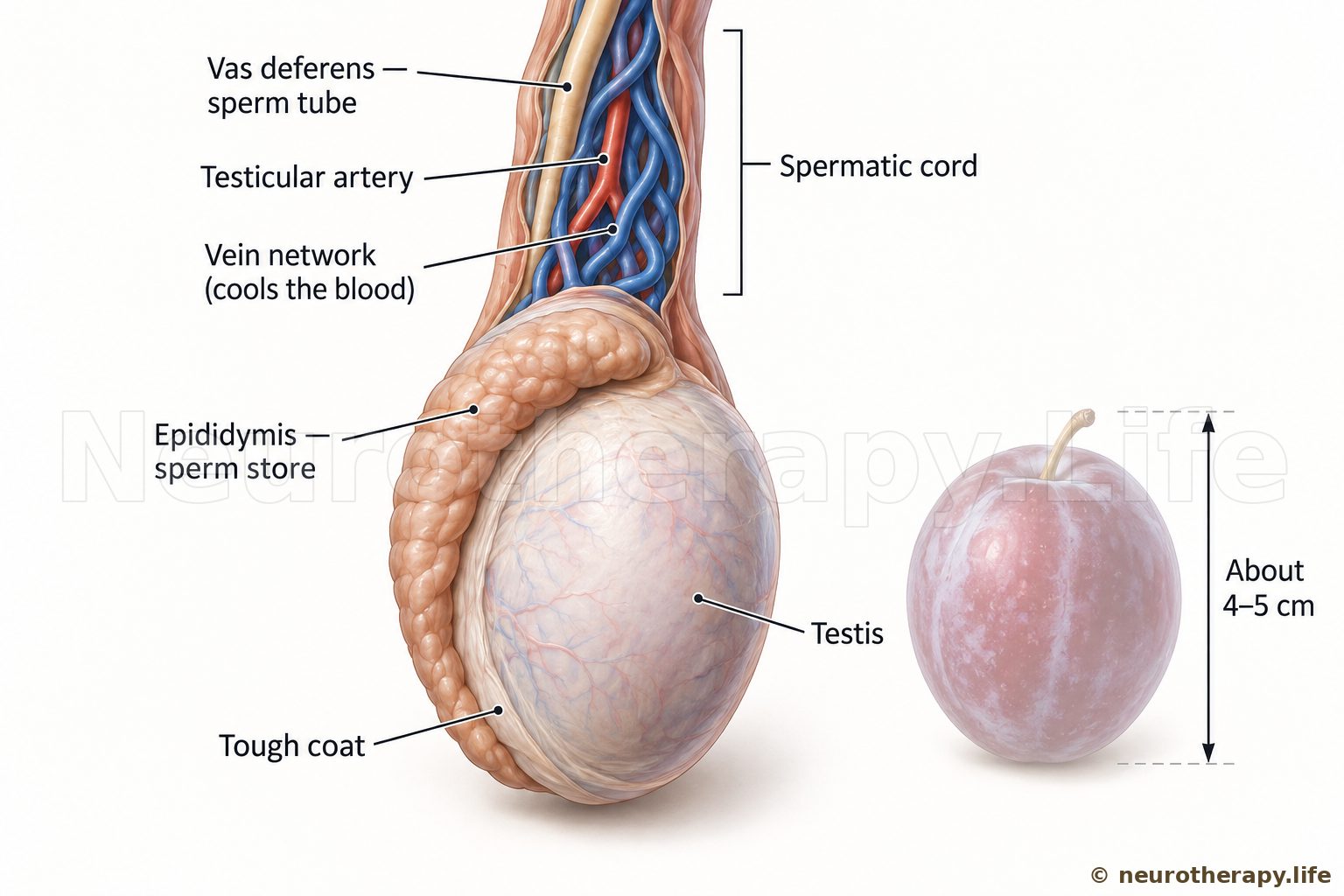
The two testes are oval glands that make sperm and the hormone testosterone. They make more than a thousand sperm every second, and to do it they hang outside the body where it is a few degrees cooler. They start life near the kidneys and travel down before birth — which is why testis trouble can be felt in the belly.
Overview
What are the testes?
The testes (also called testicles) are the two male sex glands. Each is a firm oval, about 4–5 cm long, hanging in a pouch of skin called the scrotum. Along the back of each lies a coiled tube, the epididymis, where sperm are stored.
They have two jobs: making sperm, from puberty for the rest of life, and making testosterone, the hormone that brings on a boy's puberty and keeps a man's muscles, bones, blood and energy in good order.
Many men and boys feel too shy to mention a swelling or pain here — and that is exactly how serious problems get missed. A sudden painful testis is an emergency measured in hours, and a new lump needs checking quickly. Testicular cancer, when found early, is among the most curable of all cancers.
A testis, about 4–5 cm long, with its sperm store (the epididymis) along its back and its supply cord rising from the top.
Function
What do the testes do?
Inside each testis, hundreds of tightly coiled tubes make sperm day and night, while cells between the tubes make testosterone. Both jobs are switched on by the pituitary gland under the brain.
Make sperm — up to about 120 million a day in an adult man.
Make testosterone, which brings on puberty: a deeper voice, body hair, growth of muscles and bones.
Keep up adult health through testosterone — muscle strength, bone density, red blood cell production, energy and sex drive.
Store and ripen sperm in the epididymis, where they learn to swim over a couple of weeks.
Keep themselves at the right temperature — lower in the heat, drawn up closer to the body in the cold.
How do the testes work with other organs?
Pituitary gland — Sends LH to make testosterone and FSH to support sperm production; testosterone feeds back to slow them down.
Prostate — Adds a thin, milky fluid to the sperm on their way out.
Kidneys — The testes first form beside the kidneys; their artery still starts from the aorta at kidney level.
Blood — Testosterone helps the body make red blood cells.
Reproductive system — The testes are the sperm factory of the reproductive system.
Anatomy
What are the parts of the testes?
Each testis has a tough coat, a packed interior of tubes, a sperm store on its back, and a cord that carries its supply lines up into the belly.
Inside the testis
Tunica albuginea — A tough, whitish capsule around the testis. Thin walls from it divide the inside into about 250–300 small compartments.
Seminiferous tubules — Tightly coiled tubes in each compartment, where sperm are made from stem cells in the wall.
Sertoli cells — 'Nurse' cells in the tube walls that feed and guard the developing sperm.
Leydig cells — Small clusters between the tubes that make testosterone.
The way out
Epididymis — A single tube, about 6 metres long when uncoiled, packed along the back of the testis. Sperm spend a couple of weeks here gaining the ability to swim.
Vas deferens — A firm, muscular tube that carries sperm up through the groin into the pelvis. It is the tube cut in a vasectomy.
Spermatic cord — The bundle that hangs each testis: the vas deferens, the testicular artery, a web of veins, nerves and a thin muscle. A testis that twists, twists on this cord.
The cooling system
Sperm are made best about 2–3 °C below body temperature, so the testes have their own climate control.
Pampiniform plexus — A tangle of veins wrapped around the artery that draws heat out of the incoming blood, like a radiator. When these veins swell, it is called a varicocele.
Cremaster muscle — A thin muscle in the cord that lifts the testis closer to the body in the cold, or when the inner thigh is stroked.
Scrotum — A thin, loose pouch of skin with a muscle layer that tightens in the cold and relaxes in the heat.
Tunica vaginalis — A thin two-layered sac around the front of the testis. Fluid collecting in it is a hydrocele.
Where are the testes located?
The testes hang outside the belly in the scrotum, a pouch of skin below the groin. Each hangs on its spermatic cord, which runs up through a short passage in the groin — the inguinal canal — into the belly. In most men the left testis hangs a little lower than the right.
They did not start there. Before birth the testes form inside the belly beside the kidneys, then travel down through the groin, usually reaching the scrotum by birth. That journey explains a lot: why their artery starts near the kidneys, why a hernia or hydrocele can follow the same path, and why testis pain can be felt around the navel. LMNT's Rt. Ov. and Lt. Ov. points, which also stand for the right and left testis, lie low in the belly — and the teaching says plainly that in a man no gonad lies there: the name marks where pain is found.
A healthy testis is a smooth, firm, egg-shaped oval, a little rubbery to the touch, with no lumps. The epididymis feels like a soft, slightly bumpy cord along its back and top — it is normal and is often mistaken for a lump.
It is normal for one testis to be slightly bigger than the other, and for the left to hang a little lower. A change you notice in your own body matters more than any comparison.
How big are the testes?
In an adult man each testis is about 4–5 cm long and 2.5–3 cm wide, holds about 15–25 millilitres, and weighs about 10–15 grams — roughly the size of a small plum.
Before puberty they are much smaller; growth of the testes is usually the first sign of puberty in a boy. In later life they may become a little smaller and softer.
Conditions and disorders
What conditions and disorders affect the testes?
Testis problems range from harmless to urgent. Common ones include a hydrocele (fluid around the testis), a varicocele (swollen veins), a hernia that runs down into the scrotum, and infection (epididymo-orchitis), including after mumps. A testis that has not come down at birth (undescended testis) needs a doctor's plan in the first months. Two things are urgent: torsion, when the testis twists on its cord and loses its blood supply, and testicular cancer, which usually starts as a painless lump.
Swellings in the scrotum
HydroceleFluid collecting around a testis — usually a soft, painless swelling, but always checked by a doctor first.
Hernia (groin, navel and hiatus)A bulge in the groin that can run down into the scrotum and comes and goes with standing or straining.
Fertility and hormones
InfertilityIn about half of couples who cannot conceive, a male factor is part of the cause — a semen test is simple.
ObesityExtra body fat lowers testosterone and can reduce sperm quality.
DiabetesLong-standing high sugar is linked with low testosterone and can affect fertility.
Infection
InfectionsInfection of the testis or epididymis causes a painful, hot, swollen scrotum, often with fever; mumps can inflame the testes after puberty.
Serious
Cancer care: Neurotherapy (LMNT) supportTesticular cancer is commonest in young men and is highly curable when found early — a new, firm, painless lump must be checked.
Abdominal painTestis trouble — especially torsion in boys — can be felt as pain low in the belly rather than in the scrotum.
What are common signs of a testis problem?
Sudden, severe pain in a testis or the scrotum, often with nausea or vomiting — an emergency
A firm lump or hardness in a testis, even if it does not hurt
A swelling of the scrotum, or a heavy, dragging feeling
A swelling that comes and goes with standing, coughing or straining, or runs up into the groin
A hot, red, tender scrotum with fever
In a baby or young boy, a scrotum that looks empty on one or both sides
A dull ache in the groin or lower belly without an obvious cause
What tests check the testes?
Examination — A doctor feels the testes, the epididymis and the cord, and checks the groin for a hernia — quick and routine for them.
Scrotal ultrasound with Doppler — Shows whether a swelling is fluid, veins or a solid lump, and whether blood is reaching the testis.
Semen analysis — Counts the sperm and checks their movement and shape; because sperm take about 74 days to make, a result reflects the last two to three months.
Hormone blood tests — Morning testosterone, with FSH and LH to show whether a problem lies in the testes or in the pituitary.
Tumour markers — Blood tests (AFP, hCG, LDH) used when a lump may be cancer.
Urine test — Looks for infection when the testis is painful and swollen with fever.
How are testis conditions treated?
Emergency surgery for torsion — The testis is untwisted and fixed in place. The chance of saving it is highest within about six hours of the pain starting.
Surgery for an undescended testis — If a testis has not come down by about six months of age, a small operation brings it down, ideally before 18 months, to protect fertility and allow easy self-checks later.
Repair of hydrocele, hernia or varicocele — Many small hydroceles in babies go away by themselves; larger or lasting ones, hernias and troublesome varicoceles are repaired surgically.
Antibiotics — For bacterial infection of the testis or epididymis, with rest, support and pain relief.
Cancer treatment — Removal of the affected testis, sometimes followed by chemotherapy or radiotherapy; sperm can be banked beforehand.
Hormone treatment only when truly needed — Testosterone is prescribed only for a proven deficiency. Taken without need — including bodybuilding steroids — it can switch off sperm production.
Neurotherapy (LMNT)
In LMNT, the testes share their codes with the ovaries: Rt. Ov. stands for the right ovary or right testis, and Lt. Ov. for the left — 'one point, either sex'. The points lie low in the belly, halfway between the navel and the bony point at the front of each hip, where pain is found in these troubles; they are given on the forearms, Rt. Ov. on the left and Lt. Ov. on the right, three places from elbow to wrist. The teaching names them for all problems of the testis on that side — including a same-sided hernia, itching or skin disease of the testis, and hydrocele. A separate Hydrocele point is found as a very tender spot in the calf. Raman, the peritoneum treatment, is called useful in all problems of the uterus and the testes. And the teaching's caution about Ton 'P' and Ton 'T' comes from the testes: in mumps, when the parotid glands in the cheek swell, some boys' testes are harmed, so these treatments of the parotid are not given to young people.
Points
Rt. Ov. — Right ovary or right testis. For all problems of the right testis, right-sided hernia, itching or skin disease of the right testis, and hydrocele. Given on the left forearm.
Lt. Ov. — Left ovary or left testis. For all problems of the left testis, left-sided hernia, itching or skin disease of the left testis, and left-sided hydrocele. Given on the right forearm.
Hydrocele Point — For swelling or itching in the scrotum. Such patients have great pain in the calf four to five inches above the ankle; the heel is applied from the side, press and release two to four times. The relief in the calf is real — but it is not information about the scrotum, which a doctor must examine.
Raman — The peritoneum treatment — called 'a sure-shot' for many of the body's pains, and useful in all problems of the uterus and the testes.
WD — The midline point below the navel, used to increase blood flow in the prostate and genital organs in men. Not given in cancer or in the teenage years.
Ton 'P' — A treatment of the parotid glands. Because mumps links the parotid and the testes, the teaching thinks Ton 'P' and Ton 'T' may have some relation with fertility, and does not give them to young people.
When Raman is added after four clockwise Medulla at T1/T2, the teaching reports that in boys whose testes have not come down this has 'proved quite beneficial'. This is an observation, not a substitute for the surgeon: an undescended testis is always assessed by a doctor.
“Every person, from a one-day-old infant up to the age of a hundred years, can take this treatment.”
— Dr. Lajpatrai Mehra
“I am yet to understand the human body. My knowledge is hardly the tip of the iceberg. Neurotherapy (LMNT) is just in its infancy. There is a long way to go.”
— Dr. Lajpatrai Mehra
Never do this
Emergency — call 108/112 or go to the emergency department at once for sudden severe pain in the scrotum or groin, often with vomiting, most often in a boy or young man. The testis may have twisted and can usually be saved only within hours. Nothing is pressed or manipulated. How to tell a patient to see a doctor
Any new, painful or fast-growing swelling of the scrotum is seen by a doctor the same day. A firm lump felt inside the testis itself needs urgent assessment. A swelling that comes and goes with standing or straining, or runs into the groin, may be a hernia. Hydrocele
A baby boy whose testis has not come down by about six months should be seen by a children's surgeon. No treatment of any kind is a reason to delay that visit.
Rt. Ov. and Lt. Ov. are not given in the teenage years or to a boy being treated for height, because the sex hormones close the growth plates early. WD, Ton 'P' and Ton 'T' are not given to teenagers either. Teenage years (care for teenagers)
Cancer: if the person has cancer, (10) Pan, Thymus, Pit, Lu + Sh, Rt. Ov / Lt. Ov and (30) Medulla are never given — the therapist changes the plan. WD is not given in cancer either. Cancer care: Neurotherapy (LMNT) support
Do not take testosterone, bodybuilding steroids or 'strength' supplements without a doctor: they can shut down sperm production. Keep taking the medicines your doctor prescribed. Neurotherapy (LMNT) works alongside your medical care, never instead of it.
Care
How can I keep my testes healthy?
Simple habits protect both sperm and testosterone — and one monthly check can catch the rare serious problem early.
Check yourself once a month
After a warm bath, when the skin is relaxed, gently roll each testis between thumb and fingers. Learn what is normal for you — including the soft epididymis behind — and report any new lump, hardness or change in size.
Keep them cool
Avoid resting a hot laptop on your lap for long, long hot baths and very tight underwear. Heat reduces sperm production for weeks.
No tobacco, little alcohol
Smoking and heavy drinking lower sperm quality and testosterone.
Sleep and weight
Most testosterone is made during sleep, and extra body fat lowers it. Regular sleep and a healthy weight help both.
Vaccinate and protect
The MMR vaccine protects against mumps. Wear a protective cup in contact sports and cricket.
Check baby boys
At birth and baby check-ups, ask the doctor to confirm both testes are down in the scrotum.
Common questions
Why are the testes outside the body?
Because sperm are made best at about 2–3 °C below body temperature. The scrotum, the web of cooling veins and the small muscles that lift the testes in the cold all work together to keep that temperature steady.
Is it normal for one testis to hang lower or be bigger?
Yes. In most men the left hangs a little lower, and a small difference in size is common. What matters is a change — a testis that grows, hardens, or develops a lump.
Can mumps make a man infertile?
Mumps after puberty inflames one or both testes in up to about a third of cases; the swelling usually settles, and lasting infertility is uncommon but possible. The MMR vaccine prevents it. LMNT's caution about Ton 'P' and Ton 'T' in young people comes from this same link between the parotid glands and the testes.
Can Neurotherapy (LMNT) treat a hydrocele?
LMNT has a Hydrocele point in the calf and uses Rt. Ov. / Lt. Ov. for scrotal swelling, and patients often get relief from the calf pain. But a scrotal swelling is a diagnosis to be made, not a symptom to be treated: see a doctor first, because a few swellings are urgent.
How long does it take for lifestyle changes to improve sperm?
About three months. A sperm takes about 74 days to be made and a couple of weeks more to mature, so a new semen test is usually repeated after about three months.
My son's testis has not come down. Can we wait for treatment to bring it down?
Many do come down by themselves in the first few months. If it has not come down by about six months, see a children's surgeon; the operation is best done before 18 months. LMNT reports benefit from Raman in such boys, but it is never a reason to miss that timing.
What should I ask my doctor or therapist?
Is this swelling fluid, veins, a hernia or a lump — and does it need a scan?
What do my semen test results mean, and when should it be repeated?
Is my testosterone really low, and what is causing it?
Which pain means I should go to hospital straight away?
(For a baby boy) Are both testes down, and when should we see a surgeon if not?
(To the therapist) Which points are being given for this, and which are left out because of my age or history?
Surprising facts
1More than 1,000 sperm a second
The adult testes can make up to about 120 million sperm a day — more than a thousand every second, around the clock, from puberty to old age.
Source: Guyton & Hall, Medical Physiology — male reproductive functions (up to 120 million sperm a day).
2Each sperm takes about 74 days to make
From stem cell to finished sperm takes about 74 days, plus a couple of weeks of ripening in the epididymis. That is why a change in habits — or a fever — shows up in a semen test about three months later.
Source: Heller CG, Clermont Y. Science 1963;140:184–186; Guyton & Hall, Medical Physiology.
3They have their own radiator
Warm blood going down to the testis passes through a tangle of veins bringing cooler blood back up. Heat moves from one to the other, so the testis stays about 2–3 °C below body temperature — the same trick engineers use in heat exchangers.
Source: Guyton & Hall, Medical Physiology — temperature and spermatogenesis; Gray's Anatomy — pampiniform plexus.
4They start life beside the kidneys
In the early embryo the testes form high up in the belly, beside the kidneys. Over the months before birth they travel down through the groin into the scrotum, bringing their artery, veins and nerves with them. An undescended testis is one that stopped part-way.
Source: Langman's Medical Embryology — descent of the testis; Gray's Anatomy — testicular artery from the abdominal aorta.
5Testis pain can be felt in the belly
Because the testis began near the kidneys, its pain nerves still enter the spinal cord at about the level of the navel. So testis trouble can be felt as pain in the lower belly — and kidney-stone pain can be felt in the testis. LMNT's testis codes, Rt. Ov. and Lt. Ov., sit low in the belly for the same reason: that is where the pain is found.
Source: Moore KL, Clinically Oriented Anatomy — referred pain from the testis (T10) and from the ureter. LMNT: sec. 6.3-11.
6The left usually hangs lower
In most men the left testis hangs a little lower than the right. One likely reason is that the left testis's vein takes a longer route back, draining into the kidney vein rather than straight into the great vein.
Source: Gray's Anatomy — testes and testicular veins.
7Six metres of tube behind each testis
The epididymis looks like a small comma on the back of the testis, but it is a single tube about 6 metres long, folded and coiled into a space of a few centimetres. Sperm take a couple of weeks to travel through it, learning to swim on the way.
Source: Guyton & Hall, Medical Physiology; Gray's Anatomy — epididymis.
8A cancer of the young — and one of the most curable
Testicular cancer is uncommon, but it strikes young men, most often between about 15 and 40. Found early, more than 95% of men are cured. That is why a monthly self-check, and speaking up about a lump, matter so much.
Source: American Cancer Society, 'Key statistics for testicular cancer'; NCI SEER cancer statistics (5-year relative survival about 95%).
The testes in numbers
~120 millionsperm made in a day
~74 daysto make one sperm
2–3 °Ccooler than the inside of the body
~6 mof coiled tube in each epididymis
1self-check a month
Yoga
Setu Bandhāsana — the bridge Setu Bandhāsana
Benefits
Strengthens the buttocks and the pelvic floor, which support the groin and pelvis.
A gentle way to keep active for anyone who sits for long hours.
How to do it
Lie on your back, knees bent, feet flat and hip-width apart, arms by your sides.
Breathing out, lift the hips slowly into a straight slope from knees to shoulders.
Hold for 3–5 easy breaths, without holding the breath.
Roll down slowly. Repeat 3–5 times.
Take care
Avoid it with neck pain or a recent neck, back, belly or groin operation. Stop if it causes pain in the groin or scrotum, and do not strain if you have a hernia.
Baddha Koṇāsana — the butterfly Baddha Koṇāsana
Benefits
Opens the hips and inner thighs, easing stiffness from long sitting.
Encourages good blood flow and an upright posture.
How to do it
Sit on a folded blanket with the legs straight.
Bend the knees and bring the soles together, heels as close as comfortable.
Hold the feet, sit tall, and let the knees sink slowly — never push them down.
Breathe slowly for 1–2 minutes, then straighten the legs.
Take care
Use cushions under the knees if the hips are stiff. Skip it with a groin injury, a groin hernia or pain in the scrotum.
Calms stress and helps sleep — and most testosterone is made during sleep.
Simple enough to do on a chair at any age.
How to do it
Sit comfortably with a straight back.
Close the right nostril and breathe in slowly through the left.
Close the left, open the right, and breathe out slowly.
Breathe in through the right, switch, and breathe out through the left. Continue for 5–10 minutes.
Take care
Never force or hold the breath. People with heart disease or high blood pressure should avoid breath-holding and fast breathing practices unless their doctor agrees.
Test yourself
Research
Strong evidence
Pooling data from thousands of men, researchers found that sperm counts in North America, Europe, Australia and New Zealand roughly halved between 1973 and 2011, with no sign of levelling off.
By labelling dividing cells in volunteers and following them over time, researchers showed that making a human sperm takes more than two months — the basis of the figure of about 74 days still quoted today.
The American Urological Association guideline advises that a boy whose testis has not come down by about six months should be referred to a surgeon, and that surgery be done within the following year, ideally by 18 months — earlier surgery protects the testis.
This page explains how the body works; it does not diagnose. Neurotherapy (LMNT) works alongside your medical care — keep taking the medicines your doctor prescribed, and see a doctor for any new or severe symptom.
Ready to begin?
Send COURSE for course details, or your name, age and health issue for a consultation.