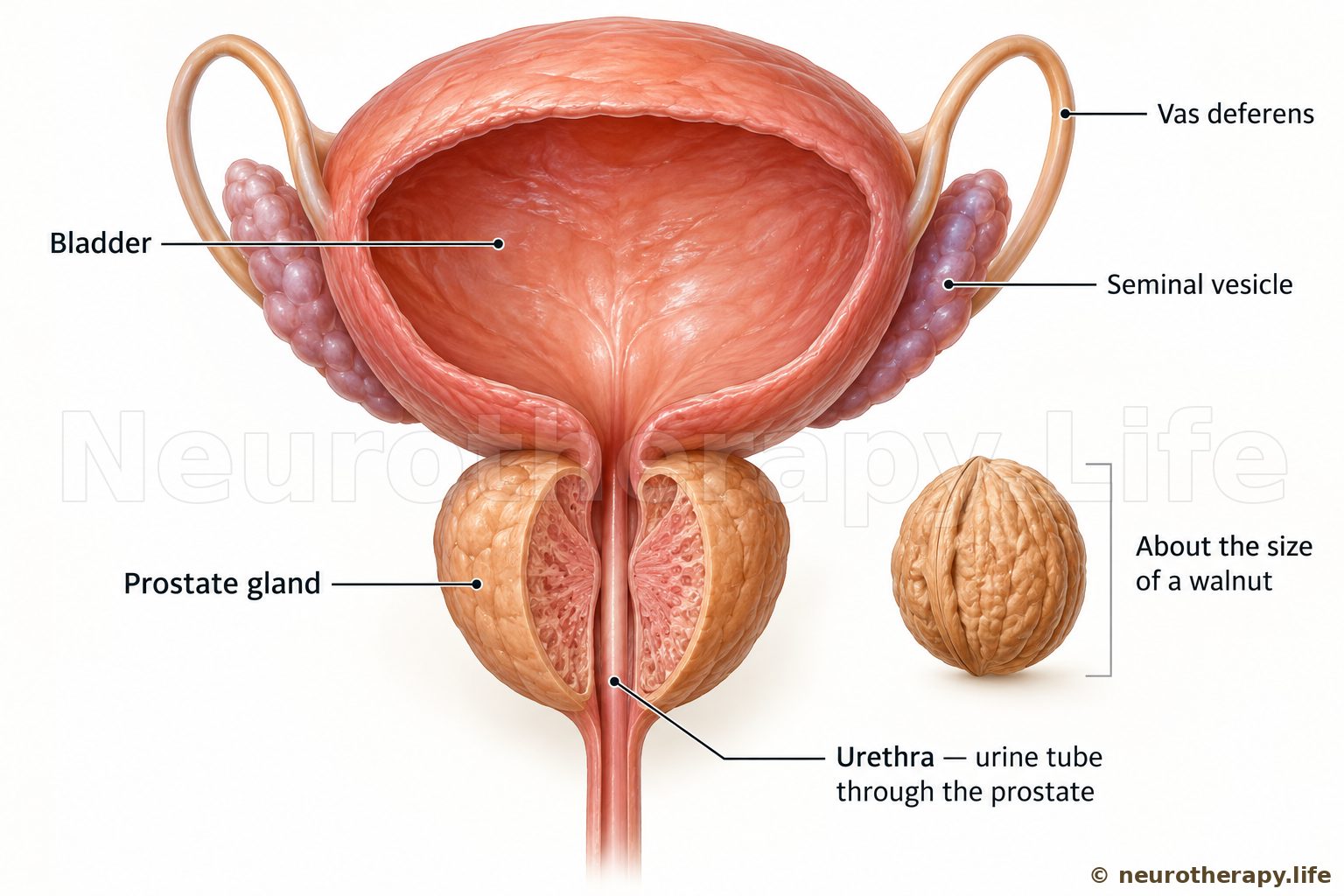
The prostate is a walnut-sized gland that sits just below a man's bladder, wrapped around the tube that carries urine out. It adds a thin, milky fluid to semen. Because it grows through most of adult life and the urine tube runs straight through it, it is the gland most likely to trouble a man's urine flow after 50.
Overview
What is the prostate?
The prostate is a small gland found only in men. It sits deep in the pelvis, just below the bladder and in front of the rectum. The urethra — the tube that carries urine from the bladder — runs straight through its middle.
Its main job is to make part of the fluid in semen, which protects and feeds the sperm. Its muscle also helps push semen out and helps close the bladder's outlet at the right moment.
Three prostate problems are common: enlargement with age (benign prostatic hyperplasia, BPH), which squeezes the urine tube; inflammation or infection (prostatitis), which can happen at any adult age; and prostate cancer, which is commonest in older men and often grows slowly. Only a doctor's tests can tell them apart.
The prostate sits just below the bladder, with the urine tube running straight through it — which is why its growth affects the urine flow.
Function
What does the prostate do?
The prostate is part gland and part muscle. The gland makes a fluid; the muscle squeezes it out at the right time and helps keep urine and semen on their separate paths.
Makes a thin, milky fluid that forms about 30% of semen.
Adds PSA (prostate-specific antigen), a protein that thins semen so sperm can swim free.
Adds zinc and other substances thought to protect sperm and fight germs.
Its muscle squeezes the fluid out during ejaculation.
Helps close the neck of the bladder at that moment, so semen and urine do not mix.
How does the prostate work with other organs?
Bladder — Sits right on top of the prostate; when the prostate grows, the bladder has to squeeze harder to push urine past it.
Kidneys — Urine that cannot get out can back up and, over time, strain the kidneys.
Testes — Their testosterone, turned into a stronger form inside the prostate, drives its growth.
Intestines — The rectum lies just behind; a doctor can feel the prostate through its wall, and a loaded bowel can worsen urine symptoms.
Kidneys and urinary system — The prostate sits at the crossroads where the urinary and reproductive paths share one tube.
Reproductive system — The prostate is one of the helper glands of the male reproductive system.
Anatomy
What are the parts of the prostate?
Doctors divide the prostate into zones, and several tubes pass through it.
Zones
Which zone a problem starts in explains why some cause early urine trouble and others stay silent.
Peripheral zone — The outer back part, about 70% of the gland. Most prostate cancers start here — away from the urethra, which is why early cancer often causes no urine symptoms. It is the part a doctor feels in a rectal examination.
Central zone — About 25% of the gland, around the ducts that carry sperm through it.
Transition zone — A small inner part, about 5% of a young man's gland, hugging the urethra. This is where age-related enlargement (BPH) grows — so it squeezes the urine tube.
Front band of muscle — A band of muscle and fibrous tissue at the front, with few glands.
What passes through it
Prostatic urethra — About 3 cm of the urine tube runs through the gland from top to bottom.
Ejaculatory ducts — Two small ducts, formed where the sperm tubes join the seminal vesicles, that pass through the prostate and open into the urethra.
Prostatic utricle — A tiny blind pouch in the middle — the leftover, in a man, of the tube that becomes the uterus in a woman.
Bladder neck — A ring of muscle at the top where the bladder empties into the prostate.
When it grows
In enlargement, the inner zone swells around the urethra like a fist closing on a straw.
Narrowed urethra — The stream becomes weak, slow to start and stop-start.
Thickened bladder — The bladder wall thickens from pushing harder, becomes irritable and may not empty fully.
Urine left behind — Leftover urine raises the risk of infection and stones, and in time can back up to the kidneys.
Where is the prostate located?
The prostate sits low in the pelvis, directly beneath the bladder, behind the pubic bone and in front of the rectum. It rests on the muscles of the pelvic floor. Because the rectum lies just behind it, a doctor can feel its back surface with a gloved finger — the rectal examination.
In LMNT, the prostate shares its point with the uterus: WD, on the midline just below the navel, whose code covers 'the uterus or the prostate'. Behind that point lies the dome of the bladder when it is full — one reason the patient passes urine before a session. LMNT's back chart also marks pain at the lower lumbar and upper sacral level as linked with the uterus, the prostate and the urinary tract: prostate trouble is often felt low in the back and over the sacrum.
The prostate is a firm, rubbery, greyish-pink gland shaped a little like an upside-down cone or a chestnut, with its broad base against the bladder and its narrower tip pointing down. It is wrapped in a thin capsule.
To a doctor's finger, a healthy prostate feels smooth and rubbery with a soft groove down the middle. An enlarged gland feels bigger but still smooth; a hard lump or irregular area is a reason for further tests.
How big is the prostate?
In a young adult man, the prostate is about 3 cm tall, 4 cm wide and 2 cm deep — about the size of a walnut — and weighs about 20 grams.
It doubles in size during puberty and then, from about age 25, keeps growing slowly for most of life. In many older men it becomes two or three times larger, or more. Size alone does not decide symptoms: a large gland can cause little trouble, and a small one a lot.
Conditions and disorders
What conditions and disorders affect the prostate?
The three main prostate problems are benign enlargement (BPH), inflammation or infection (prostatitis), and cancer. BPH is not cancer and is not thought to raise the risk of it — but the two can exist together, and early cancer usually causes no symptoms. That is why urine symptoms in an older man always deserve a doctor's check before any other treatment.
Enlargement and urine
Enlarged prostate (BPH)Benign prostatic hyperplasia (BPH): the gland grows with age and squeezes the urine tube.
Urinary problemsA weak stream, dribbling, urgency and waking at night to pass urine.
Kidney diseaseLong-standing blockage can back up urine and harm the kidneys.
Infection and inflammation
InfectionsBacterial prostatitis brings fever, chills and painful urination — it needs a doctor quickly.
Low back painProstate trouble can be felt as pain low in the back, over the sacrum or between the legs.
Fertility
InfertilityBecause the prostate makes part of semen, infection or blockage here can affect fertility.
Signs that overlap
DiabetesDiabetes also causes frequent urination and can affect the bladder's nerves — it must be ruled out.
ConstipationA loaded bowel just behind the prostate can make urine symptoms worse.
A weak or slow stream, or waiting a long time for it to start
Stop-start flow, straining, or dribbling at the end
Needing to pass urine often, urgently, or two or more times a night
A feeling that the bladder has not emptied
Being unable to pass urine at all, with a painful full bladder — an emergency
Burning on passing urine with fever or chills; blood in the urine or semen
Pain between the legs, low in the back, or in the bones, especially with weight loss
What tests check the prostate?
PSA blood test — Measures a protein made by the prostate. It rises with enlargement, infection and cancer, so a raised level needs a doctor to work out the reason; it is not a cancer test on its own.
Rectal examination — The doctor feels the back of the prostate with a gloved finger for size, texture and any hard lump. It takes under a minute.
Urine test — Looks for infection, blood and sugar.
Flow test and bladder scan — Measures how fast urine flows, and an ultrasound shows how much is left behind after passing urine.
Kidney function — A blood test (creatinine) to check that blocked urine has not strained the kidneys.
MRI and biopsy — When cancer is suspected, an MRI scan guides where small samples should be taken.
How are prostate conditions treated?
Watchful waiting and habits — For mild BPH: less fluid in the two hours before bed, less tea, coffee and alcohol, and not holding urine for long — with regular reviews.
Medicines — Some relax the muscle around the urethra; others slowly shrink the gland — prescribed and adjusted by a doctor.
Procedures and surgery — Removing the part that blocks the urethra, through the urine passage (TURP) or by laser, when medicines are not enough.
Catheter — A thin tube to drain the bladder when urine cannot be passed at all.
Antibiotics — For bacterial prostatitis, often for several weeks.
Cancer care — From careful monitoring of slow cancers to surgery, radiotherapy or hormone treatment, planned by a specialist team; pelvic floor exercises help continence afterwards.
Neurotherapy (LMNT)
In LMNT, the prostate is reached through WD — the point on the midline just below the navel, whose code covers the uterus in a woman and the prostate in a man. WD is given on the forearms, never pressed on the belly, to increase blood flow in the prostate and genital organs. Over sixty years of practice the teaching found pain below the navel in practically all diseases of the genital organs, and so it names the New Genes formula — (8) Pan (6) WD (8) Ch. Only (20) Round Arrow — for all problems of the prostate gland and the uterus. Its last two steps are there to keep the acid–alkali balance. Where the pain below the navel is severe, and there is no diabetes or autoimmune disorder, Thymus + Chest takes the place of those last steps; Thymus + Chest is also named on its own for an enlarged prostate, always with the armpits. Because WD is not given in cancer, the PSA test and the doctor's opinion come before the first session.
Points
WD — The midline point below the navel; its code covers the uterus and the prostate. Given on both forearms to increase blood flow in the prostate and genitals. Not given in cancer.
Th + Ch — Named 'if the prostate gland is enlarged', and used in LMNT to dry up excess water in the body. Not given in pregnancy, heart disease, diabetes, kidney disease, rheumatoid arthritis or other autoimmune disease, polio or inflammatory disease.
Armpit — Whenever Thymus + Chest is given, the armpits must be given too. Not in lymph-node cancer, polio, diabetes or autoimmune disorder.
(8) Pan — The first step of the New Genes formula, given at the thigh–hip crease.
(8) Ch. Only — With the Round Arrow, one of the 'inseparable pairs' that keep the acid–alkali balance at the end of the formula.
Round Arrow — The closing step of the New Genes formula, down one side of the spine to L5 and up the other.
Liv° — With Mu°, the kidney points. When urine is blocked, the kidneys are part of the picture; the teaching provokes them through Liv° – Mu° and always adds the balance pair after.
(8) Pan (6) WD (8) Thymus + Chest — for severe pain below the navel when there is no diabetes and no autoimmune disorder. The last two steps are replaced, not added to.
“In this therapy we do not treat the disease; rather, we improve the body.”
— Dr. Lajpatrai Mehra
“Whenever there is an obstruction or blockage in the blood circulation of any part of the body, then pain or numbness is felt in that part.”
— Dr. Lajpatrai Mehra
“No other drink can be a substitute for water.”
— Dr. Lajpatrai Mehra
Never do this
Emergency — go to hospital the same day if you cannot pass urine at all, especially with a painful, swollen lower belly. A catheter may be needed at once. Urinary problems
See a doctor promptly for blood in the urine or semen, fever or chills with painful urination, severe pain low in the belly or between the legs, or bone pain with weight loss. How to tell a patient to see a doctor
Only a doctor's tests can tell an enlarged prostate from prostate cancer. WD is not given in cancer, so the PSA and the doctor's opinion come before the first session. WD
Thymus + Chest is not given in diabetes, heart disease, kidney disease, rheumatoid arthritis or other autoimmune disease, polio or inflammatory disease. When it is given, the armpits are always given too — and the armpits are not given in lymph-node cancer, polio, diabetes or autoimmune disease. Th + Ch
Pass urine before a session. No deep or sustained pressure is put on the lower belly; the prostate point is given on the forearms.
Cancer: if the person has cancer, (10) Pan, Thymus, Pit, Lu + Sh, Rt. Ov / Lt. Ov and (30) Medulla are never given — the therapist changes the plan. Cancer care: Neurotherapy (LMNT) support
Keep taking the medicines your doctor prescribed — never stop prostate tablets on your own, as stopping can bring urine retention back. Neurotherapy (LMNT) works alongside your medical care, never instead of it.
Care
How can I keep my prostate healthy?
You cannot stop the prostate growing with age, but habits make a big difference to how much it troubles you — and timely checks catch what matters.
Drink well — but time it
Do not cut down water through the day; Guruji's teaching says no other drink can substitute for it, and concentrated urine irritates the bladder. Drink less in the two hours before bed, and pass urine just before sleeping.
Less tea, coffee and alcohol
They make the bladder more urgent, especially in the evening.
Don't hold it in
Go when you feel the need, take your time, and try passing urine again a minute later to empty fully.
Keep the bowel regular
A loaded bowel presses on the prostate and bladder; fibre, water and movement help.
Stay active and trim
Obesity, diabetes and inactivity are linked with worse urine symptoms.
Talk about PSA
From about 50 — or earlier if a father or brother had prostate cancer — ask your doctor about the pros and cons of a PSA test.
Common questions
Is an enlarged prostate the same as cancer?
No. Benign enlargement (BPH) is not cancer and is not thought to raise the risk of it. But the two are common in the same age group and can exist together, which is why a doctor checks with a PSA test and an examination.
Why do I wake up at night to pass urine?
An enlarged prostate is one common reason, but not the only one: drinking late in the evening, diabetes, swelling of the legs that drains at night, some medicines and poor sleep can all do it. Tell your doctor how many times a night, and for how long.
Should I drink less water?
Not during the day — too little water makes urine concentrated and can irritate the bladder and invite infection and stones. Just drink less in the two hours before bed.
Should every man have a PSA test?
It is a choice to make with a doctor. PSA can pick up cancer early, but it can also be raised for harmless reasons and can find slow cancers that would never have caused harm. Men over about 50, or younger men with a family history, should discuss it.
Can Neurotherapy (LMNT) help an enlarged prostate?
LMNT gives WD, the New Genes formula and, where it is allowed, Thymus + Chest for prostate problems, alongside medical care. First the doctor rules out cancer and infection; then the therapist marks the points that are blocked for you. Keep taking your prostate medicines, and let your doctor judge any change in the flow.
What should I ask my doctor or therapist?
Is this enlargement, infection or something else — and do I need a PSA test?
How much urine is left in my bladder after I pass urine?
Are my kidneys affected?
Which of my other medicines could make passing urine harder?
Which signs mean I should go to hospital straight away?
(To the therapist) Is Thymus + Chest allowed for me with my other conditions, and are the armpits given with it?
Surprising facts
1The urine tube runs straight through it
The prostate is only about the size of a walnut, but it is wrapped all the way around the urethra. That is why even a small amount of growth in the wrong place can squeeze the flow — like a fist tightening around a straw.
The prostate doubles in size in early puberty. Then, from about age 25, it begins a second, slow growth phase that continues for most of a man's life. That second phase is what leads to enlargement in later years.
Examined under the microscope, prostate enlargement is found in about half of men in their fifties and in up to about 90% of men over 80 — though many of them never have troublesome symptoms.
Source: Berry SJ, Coffey DS, Walsh PC, Ewing LL. The development of human benign prostatic hyperplasia with age. J Urol 1984;132:474–479; NIDDK.
4Size does not decide the symptoms
A very large prostate can cause little trouble, while a modestly enlarged one can block the flow badly. What matters is how much the inner zone presses on the urethra — not the weight of the whole gland.
Source: NIDDK (NIH), 'Prostate enlargement' — size does not always determine the severity of blockage or symptoms.
5About a third of semen comes from the prostate
Only a tiny fraction of semen is sperm. About 30% is prostate fluid and about 60% comes from the seminal vesicles. The prostate's PSA protein has a real job: it thins semen after release so the sperm can swim free — the same protein doctors measure in the blood.
Source: Guyton & Hall, Medical Physiology — function of the seminal vesicles and prostate; standard andrology (PSA liquefies the seminal coagulum).
6Early cancer is often silent — and here is why
Most prostate cancers start in the large outer zone at the back, away from the urethra, so they rarely affect urine flow early on. Enlargement, by contrast, starts in the small inner zone right around the urethra. Urine symptoms usually mean enlargement — and silence does not mean all is well.
Source: McNeal JE. The zonal anatomy of the prostate. Prostate 1981;2:35–49.
7Inside every prostate is a trace of the womb
In the early embryo, boys and girls both have the tube that becomes the uterus in a girl. In a boy it fades away, leaving only a tiny pouch in the middle of the prostate — the prostatic utricle. LMNT gives the uterus and the prostate one point, WD; embryology shows the two regions share a common beginning.
Source: Langman's Medical Embryology — paramesonephric (Müllerian) duct remnants; Gray's Anatomy — prostatic utricle. LMNT: sec. 6.3-10.
8The PSA test is a choice, not a verdict
Large trials show that PSA screening finds more cancers, but has little or no effect on overall deaths, and some men are treated for slow cancers that would never have harmed them. That is why doctors now discuss the test with each man rather than ordering it for everyone.
Source: Ilic D et al. Prostate cancer screening with prostate-specific antigen (PSA) test: a systematic review and meta-analysis. BMJ 2018;362:k3519.
The prostate in numbers
~20 gthe weight of a young adult's prostate
~3 cmof urine tube running through it
~30%of semen fluid made by the prostate
2growth spurts: puberty, and from about 25 onwards
~1 in 2men in their fifties with enlargement under the microscope
Strengthens the muscles that help control the bladder outlet.
Doctors and physiotherapists teach these exercises to help with dribbling and with continence after prostate surgery.
Can be done anywhere — sitting, standing or lying.
How to do it
Sit upright with your feet flat and your thighs, buttocks and belly relaxed.
Squeeze and lift the muscles you would use to stop passing wind and to stop the flow of urine.
Hold for up to 5–10 seconds while breathing normally, then let go completely and rest.
Repeat up to 10 times, three times a day. A gentle squeeze just after passing urine also helps clear the last drops.
Take care
Do not practise it by repeatedly stopping your urine stream. Never hold your breath or strain. After prostate surgery, start only when your surgeon or physiotherapist says so.
Baddha Koṇāsana — the butterfly Baddha Koṇāsana
Benefits
Opens the hips and groin, easing stiffness around the pelvis from long sitting.
A comfortable way to sit upright rather than slumped.
How to do it
Sit on a folded blanket with the legs straight.
Bend the knees and bring the soles together, heels as close as comfortable.
Hold the feet, sit tall, and let the knees sink slowly — never push them down.
Breathe slowly for 1–2 minutes, then straighten the legs.
Take care
Use cushions under the knees if the hips are stiff. Skip it with a groin injury, a groin hernia, or pain between the legs.
Bhujaṅgāsana — the gentle cobra Bhujaṅgāsana
Benefits
Gently stretches the front of the body and strengthens the low back, where prostate trouble is often felt.
Counteracts long hours of sitting bent forward.
How to do it
Lie face down with the legs straight and the forehead on the mat.
Place the forearms flat on the mat, elbows under the shoulders.
Breathing in, lift the head and chest gently, keeping the hips and belly on the mat.
Hold for 3–5 easy breaths, lower slowly, and rest. Repeat 3 times.
Take care
Keep the lift small; stop if it pinches the low back. Avoid it after recent belly or prostate surgery, with a hernia, or in severe back pain.
Watch
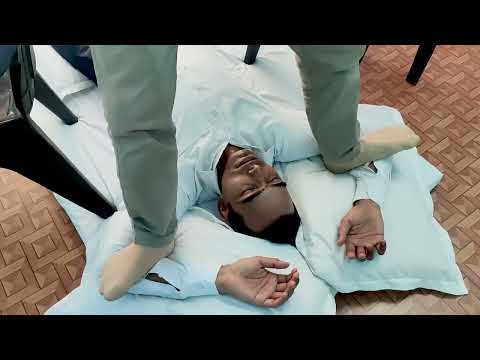
NEW GENES FORMULA - LMNT Neurotherapy
A step-by-step demonstration, in Hindi, of the New Genes formula: (8) Pan at the thigh–hip crease, (6) WD on both forearms, (8) Ch. Only and the Round Arrow, with the patient's position and how each count is kept.
Test yourself
Research
Strong evidence
Pooling five large trials of over 700,000 men, this review found that PSA screening finds more prostate cancers and may slightly reduce deaths from prostate cancer, but has little or no effect on overall deaths — and brings harms from false alarms and over-treatment.
A review of population studies shows that urinary symptoms from an enlarged prostate become steadily more common with age, affecting a large share of men over 70, and that obesity, diabetes and inactivity make them more likely.
Careful study of whole prostates showed that the gland has distinct zones: enlargement arises in the small inner zone around the urethra, while most cancers arise in the large outer zone — which explains why the two behave so differently.
This page explains how the body works; it does not diagnose. Neurotherapy (LMNT) works alongside your medical care — keep taking the medicines your doctor prescribed, and see a doctor for any new or severe symptom.
Ready to begin?
Send COURSE for course details, or your name, age and health issue for a consultation.