Hydrocele Point (a scrotal complaint treated at the calf)
Also called: Hydrocele point, हाइड्रोसील पॉइंट
Hydrocele Point is a Neurotherapy (LMNT) treatment for swelling or itching in the scrotum, given not at the scrotum but at a tender spot on the lower calf, a little above the ankle. It is always given alongside a doctor's examination of the swelling, never in place of it.
Overview
What is Hydrocele Point?
A hydrocele is a collection of fluid around a testis that makes one side of the scrotum swell. Hydrocele Point is one of the uncommon points of the therapy — treatments found one at a time for one trouble each, and kept because they worked.
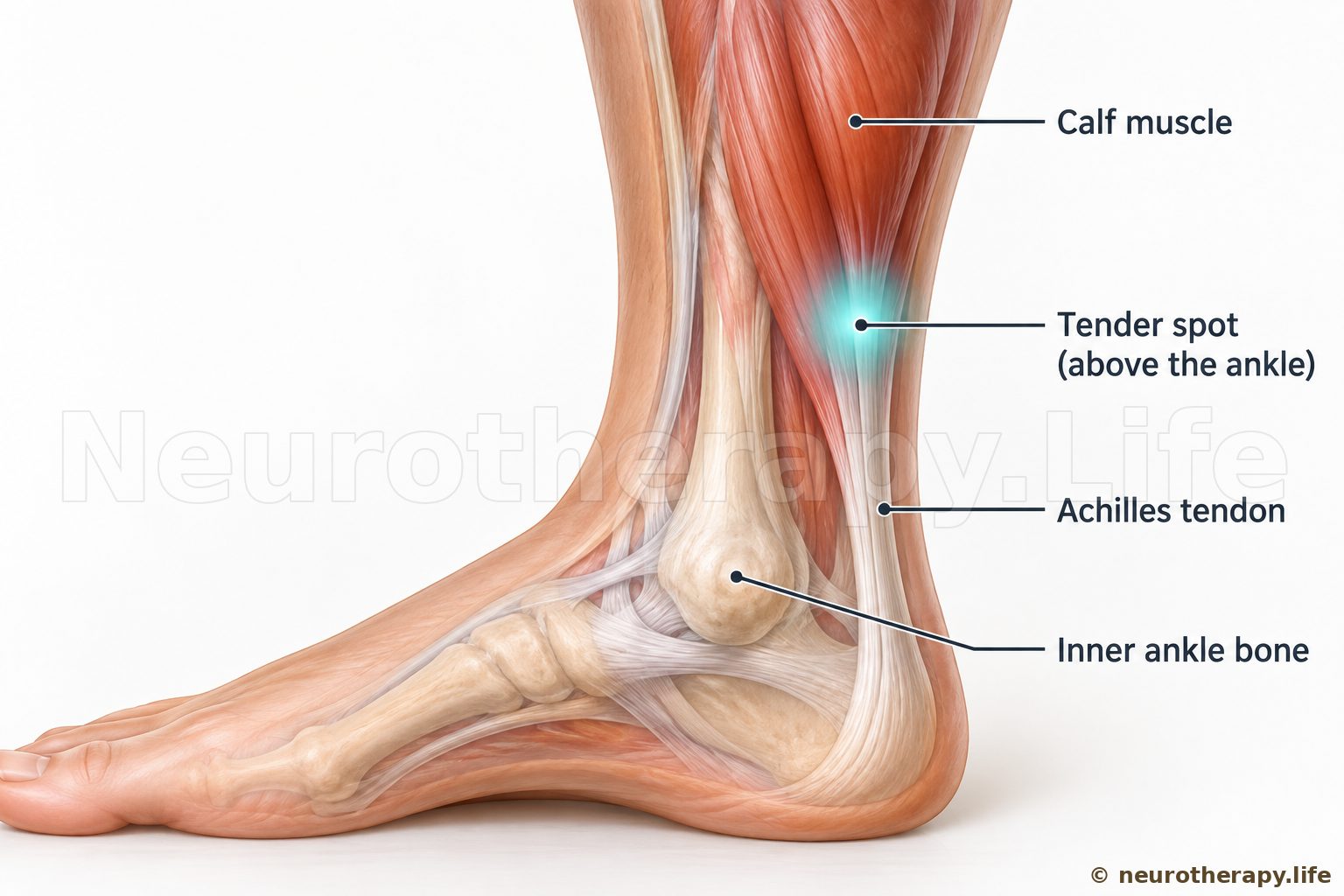
The teaching observes that people with swelling or itching in the scrotum have a great deal of pain at one place in the calf muscle, a little above the ankle. So the point is found by touch before it is treated: pressed gently there, the patient with this trouble reports it at once.
Its uses table adds inguinal hernia, and explains that pressing at the painful part of the calf increases the flow of blood in the testis of that side, and the patient gets relief.
Hydrocele Point lies on the lower calf, where the muscle narrows into the tendon a little above the ankle.
Where it is given
Where is Hydrocele Point given?
PositionLying on the back
Body areaA tender spot on the lower leg, in the muscle beside the shin bone (about four fingers from the bone) — tender only in a person who has the problem; one leg or both
You lie on your back with the legs a little apart. The place is a spot on the lower leg in the muscle beside the shin bone, about four fingers from the bone. It hurts when pressed only in a person who has the problem — that tenderness is how the spot is found, and it may be on one leg or both.
The chemical treatment for the condition is separate and comes first; the demonstration video shows how the spot is found and treated.
How it is given
How is Hydrocele Point given?
How this point is given — the tool, the pressure, the count and the exact movement — is deliberately not described here. A demonstration video for this point is being prepared; until it is on this page, learn the method hands-on from a trained Neurotherapist before giving it. Please do not give any point from a written description alone: a point given in the wrong place or the wrong way can do harm.
Which legOne or both, according to the pain
The exact technique is taught hands-on in the Neurotherapy (LMNT) course. See the course →
What it does
What does Hydrocele Point do?
The teaching says pressing the painful part of the calf increases the flow of blood in the testis of the same side, giving relief in hydrocele and inguinal hernia, and relieving the calf pain too. How a press on the calf reaches the scrotum is the therapy's own explanation, offered from clinical experience; body science has not shown such a link.
Relieves the sharp calf pain found in these patients.
Is used for swelling or itching in the scrotum.
Is used in inguinal hernia, alongside medical care.
Organs it reaches
Testes — The organ the treatment is aimed at, on the same side.
Muscles — The calf muscle where the tender spot is found.
Blood vessels — The teaching speaks of increasing blood flow on that side.
Its family
Which other points are used for hydrocele?
The ovary points are also named for problems of the testis on their own side, including hydrocele.
Rt. Ov. — For problems of the right testis, including right-sided hydrocele. Never in cancer.
Lt. Ov. — For problems of the left testis, including left-sided hydrocele and hernia. Never in cancer.
P point — Another uncommon point found for one problem — a descended womb.
Opposite Point — Another rule of the uncommon points: treat a limb through its diagonal partner.
What it is used for
What is Hydrocele Point used for?
Always after the swelling has been examined by a doctor.
Any new, painful or quickly growing swelling of the scrotum must be examined by a doctor the same day. Several different things cause it, and two are urgent. How to tell a patient to see a doctor
Sudden severe pain in the scrotum, often with nausea, most often in a boy or young man, may be a twisted testis. It is measured in hours: emergency department at once, and nothing is manipulated.
A firm lump felt within the testis itself needs urgent assessment; caught early, testicular cancer is among the most curable cancers. In cancer care, never (10) Pan, Thymus, Pit, Lu+Sh, Rt.Ov/Lt.Ov or (30) Medulla. Cancer care: Neurotherapy (LMNT) support
A swelling that comes and goes with standing or straining, or runs up into the groin, suggests a hernia and also needs a doctor. Hernia (groin, navel and hiatus)
One calf hot, swollen and tender may be a clot: that leg is not pressed. Thrombosis (blood clots)
Teaching case: the young man who came about his calf
A teaching case, put together from several patients: a student in his early twenties came about six weeks of pain in one calf, and took a long while to mention the scrotal swelling that had really brought him. The tender calf spot was there, and the calf was treated — but the most important thing done that day was sending him, without embarrassment, for a doctor's examination of the swelling.
A composite case written to teach the reasoning — not one patient’s file.
Common questions
Will the therapist touch my scrotum?
No. Hydrocele Point is given only on the lower calf, a little above the ankle.
Do I still need to see a doctor?
Yes. A scrotal swelling is a diagnosis to be made by a doctor. Some causes are urgent. The calf treatment goes alongside that care, never instead of it.
Why does my calf hurt there?
The teaching observes that people with this trouble have a tender spot at that place. It is used as a finding first, then as the place to treat.
Surprising facts
1A leftover pouch
Before birth each testis travels down from the belly into the scrotum, pulling a pouch of the belly lining with it. If that pouch does not close, fluid can collect — the cause of many hydroceles in babies.
Source: Gray's Anatomy, 41st ed., descent of the testis and processus vaginalis.
2A light test
Because a hydrocele is clear fluid, a torch held behind it often makes the swelling glow — a simple bedside clue doctors use, followed by an ultrasound.
Source: Standard clinical examination texts on scrotal swelling (transillumination).
3Measured in hours
A twisted testis cuts off its own blood supply; the chance of saving it falls sharply after about six hours, which is why sudden scrotal pain is an emergency.
Source: Standard urology texts on testicular torsion.
This page explains what a Neurotherapy (LMNT) treatment is for; it is not a self-treatment guide and does not diagnose. Neurotherapy (LMNT) works alongside your medical care — keep taking the medicines your doctor prescribed.
Ready to begin?
Send COURSE for course details, or your name, age and health issue for a consultation.