Also called: Pituitary, Pit point, (1) Pit, (4) Pit, पिट्यूटरी पॉइंट
Pit is the Neurotherapy (LMNT) point named for the pituitary, the pea-sized master gland under the brain that sends out many hormones. It is given on both upper arms together while you lie on your back, and it carries firm bars: never in diabetes, high blood pressure, cancer or fits.
Overview
What is the Pit point?
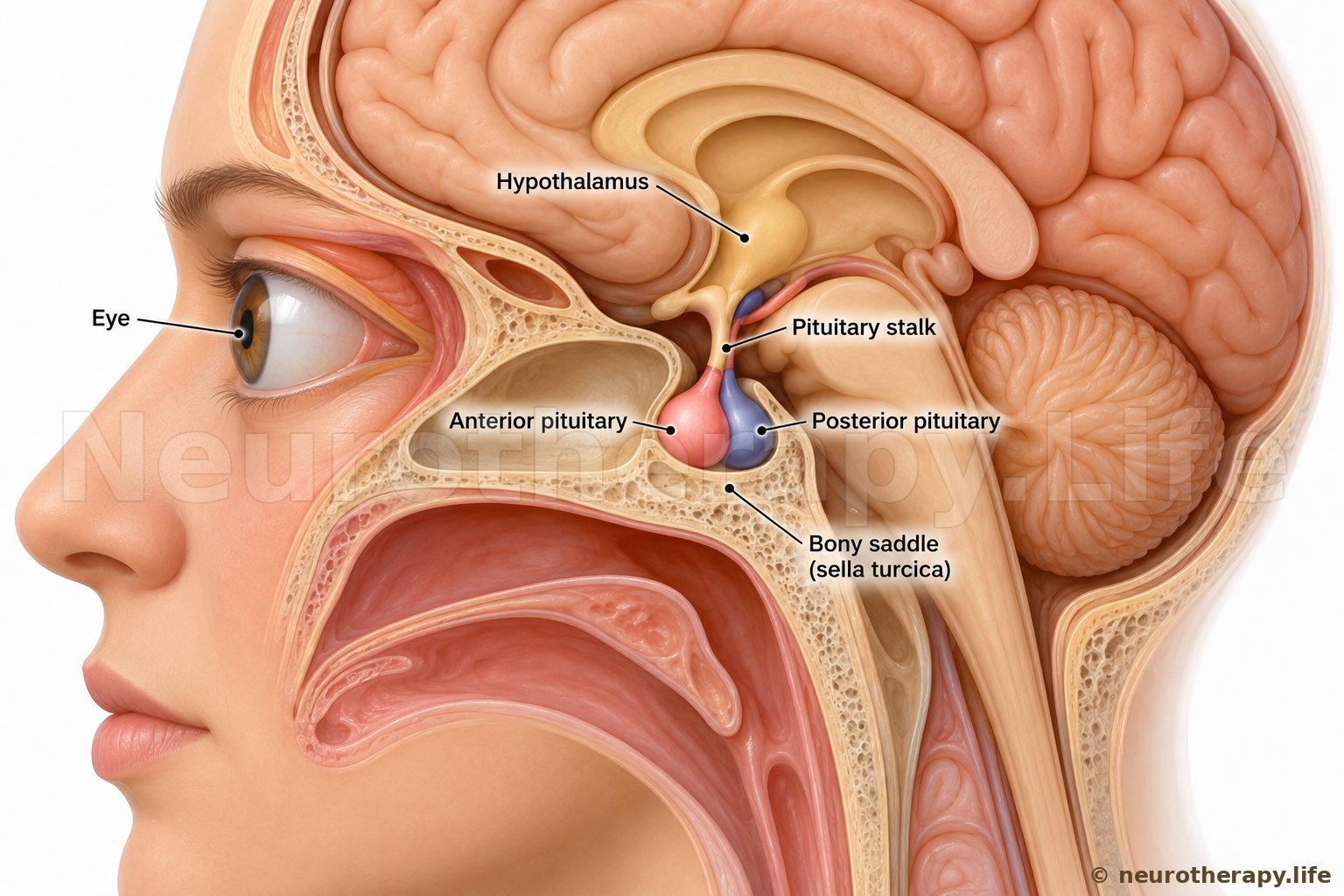
Pit is short for pituitary. The pituitary is a small gland, about the size of a pea, that hangs from the underside of the brain. It sits in a little hollow of bone right behind the eyes.
It is often called the master gland, because its hormones — chemical messengers carried in the blood — tell other glands what to do. It sends growth hormone for growing and for keeping sugar up, and signals that wake the thyroid, the adrenal glands and the ovaries or testes. Its back lobe releases a hormone that holds water in the body.
In Neurotherapy (LMNT), Pit is given when we wish to stimulate the pituitary gland to make many hormones. Like every gland point, it is named for the gland it aims at, not for the place it is given — and nothing on the arm touches the gland itself.
Two forms are written on cards: (1) Pit and (4) Pit. The number in brackets names the form the therapist has chosen for this patient; it is not a strength you can turn up at home.
The pituitary hangs below the brain, behind the eyes. The Pit point is named for it, not placed over it.
Where it is given
Where is Pit given?
PositionLying on the back
Body areaBoth upper arms together, near the elbows and near the shoulders
You lie flat on your back, usually with no pillow under the head unless you need one. The therapist works from above your head, holding their own weight on two chairs.
Pit is given on both upper arms at the same moment — near the elbows and near the shoulders. Of the three gland points on the arms, Pit is the one given on both arms together; Para uses the right arm only and Thrd 'P' the left arm only.
Because the therapist stands at the head end, the neck rule applies: nothing presses on the front or sides of your neck at any time. The feet may rest beside the neck but carry no weight there.
How it is given
How is Pit given?
How this point is given — the tool, the pressure, the count and the exact movement — is deliberately not described here. A demonstration video for this point is being prepared; until it is on this page, learn the method hands-on from a trained Neurotherapist before giving it. Please do not give any point from a written description alone: a point given in the wrong place or the wrong way can do harm.
The exact technique is taught hands-on in the Neurotherapy (LMNT) course. See the course →
What it does
What does Pit do in the body?
Neurotherapy (LMNT) teaching gives Pit a clear list of uses, and an equally clear warning: it raises sugar and it raises alkali. Both halves come from the same idea — rousing a gland whose hormones push sugar up.
To stimulate the pituitary gland to make many hormones.
To correct weakness that comes from a lack of sugar — and for players who feel worn out after a few hours of play.
To increase appetite and height in children.
To fill water anywhere in the eye, the ear or the brain — including dry eyes, where the eyes have no moisture.
For the dizziness of vertigo — people who feel giddy in tall buildings, buses or aeroplanes. Teaching adds that (4) Up Arrow given afterwards completes the benefit.
Organs it reaches
Pituitary gland — The gland Pit is named for — the master gland that sends hormones to the others.
Thyroid — Woken by the pituitary's signal; its sister point Thrd 'P' aims at the same front lobe.
Adrenal glands — Also driven by a pituitary signal; Pit is often written beside an Adr point in formulas.
Ears — Named among the places where Pit helps 'fill water', and in giddiness.
Its family
Which points are Pit's sisters?
Three gland points share one place and one movement on the upper arms. They are told apart by the arm alone — and each has its own uses and its own bars.
Para — The parathyroid point, on the right arm only — linked to calcium and to the back lobe of the pituitary.
Thrd 'P' — Thyroid 'P', on the left arm only — aimed at the front lobe of the pituitary, mainly growth hormone.
Up Arrow — Given after Pit in vertigo to complete the benefit.
What it is used for
What is Pit used for?
Pit is never chosen from a disease name alone. The therapist first checks the blocked list — diabetes, high blood pressure, cancer and fits — and only then looks at the uses.
Pit appears in the stage written 'to make the hormones'.
Safety: when it is held back
Blocking comes first. Before any treatment, the points not to be given for the patient's disease are marked on the diagnosis card. Pit is on several of these lists. Conditions that block certain points: the six families
Diabetes: Pit is never given, because it raises blood sugar. Where a sugar-raising point must be replaced, (10) Pan is given in its place. Diabetes
High blood pressure: Pit raises alkali, and in this teaching high blood pressure comes from raised alkali — so Pit is not given. Formulas that carry Pit are refused to high-pressure patients for the same reason. High blood pressure
Fits, epilepsy and seizures: Pit is blocked. The teaching puts it simply — do not give Pit to a fit. Epilepsy (fits)
The neck: the therapist works from the head end, but no pressure ever falls on the front or sides of the neck. New neck pain with a headache unlike any before, disturbed vision or numbness stops the session and goes to a doctor. Headache and migraine
A teaching case, put together from several patients: a short but healthy schoolboy was brought for height, and also had a soft lump on his thigh. The lump was sent to a doctor first, before anything was given. He then received (4) Pan, (4) Pit and (4) Thrd 'P' for appetite and height — while (2) Pan, which his father asked for because it 'ends lumps', was refused, because it holds back growth hormone. Within weeks his appetite had changed; the doctor's growth chart stayed the judge of height.
A composite case written to teach the reasoning — not one patient’s file.
Common questions
Does Pit press on my brain or my pituitary?
No. The pituitary sits deep inside the skull, and Pit is given on the upper arms. Nothing near the head or neck is pressed.
I have diabetes. Why was Pit left off my card?
Because Pit raises blood sugar. It is on the blocked list for diabetes, and other points are chosen in its place. Keep taking your medicines and checking your sugar as your doctor advises.
My child has had fits. Can Pit help with height?
Pit is blocked in fits, so it is not given. Tell the therapist about any fits, even old ones, before treatment starts.
What is the difference between (1) Pit and (4) Pit?
They are two written forms, chosen by the therapist for the patient in front of them; formulas use one or the other. The number is a selector, not a dose to raise at home.
Surprising facts
1A master gland the size of a pea
The pituitary weighs only about half a gram, yet its hormones steer the thyroid, the adrenal glands, growth, milk, and the ovaries and testes.
Source: Guyton & Hall, Textbook of Medical Physiology, the pituitary hormones and their control by the hypothalamus.
2It sits in a 'Turkish saddle'
The bony hollow that holds the pituitary is called the sella turcica — Latin for 'Turkish saddle' — because of its shape.
Source: Gray's Anatomy, 41st edition, the sphenoid bone and pituitary fossa.
3Half of it is really brain
The back lobe of the pituitary is made of nerve endings that grow down from the brain. It releases vasopressin, the hormone that tells the kidneys to keep water.
Source: Guyton & Hall, Textbook of Medical Physiology, posterior pituitary hormones.
4Growth hormone pushes sugar up
Besides building bone and muscle, growth hormone works against insulin and raises blood sugar — a body-science echo of why Pit is barred in diabetes.
Source: Guyton & Hall, Textbook of Medical Physiology, metabolic effects of growth hormone.
This page explains what a Neurotherapy (LMNT) treatment is for; it is not a self-treatment guide and does not diagnose. Neurotherapy (LMNT) works alongside your medical care — keep taking the medicines your doctor prescribed.
Ready to begin?
Send COURSE for course details, or your name, age and health issue for a consultation.