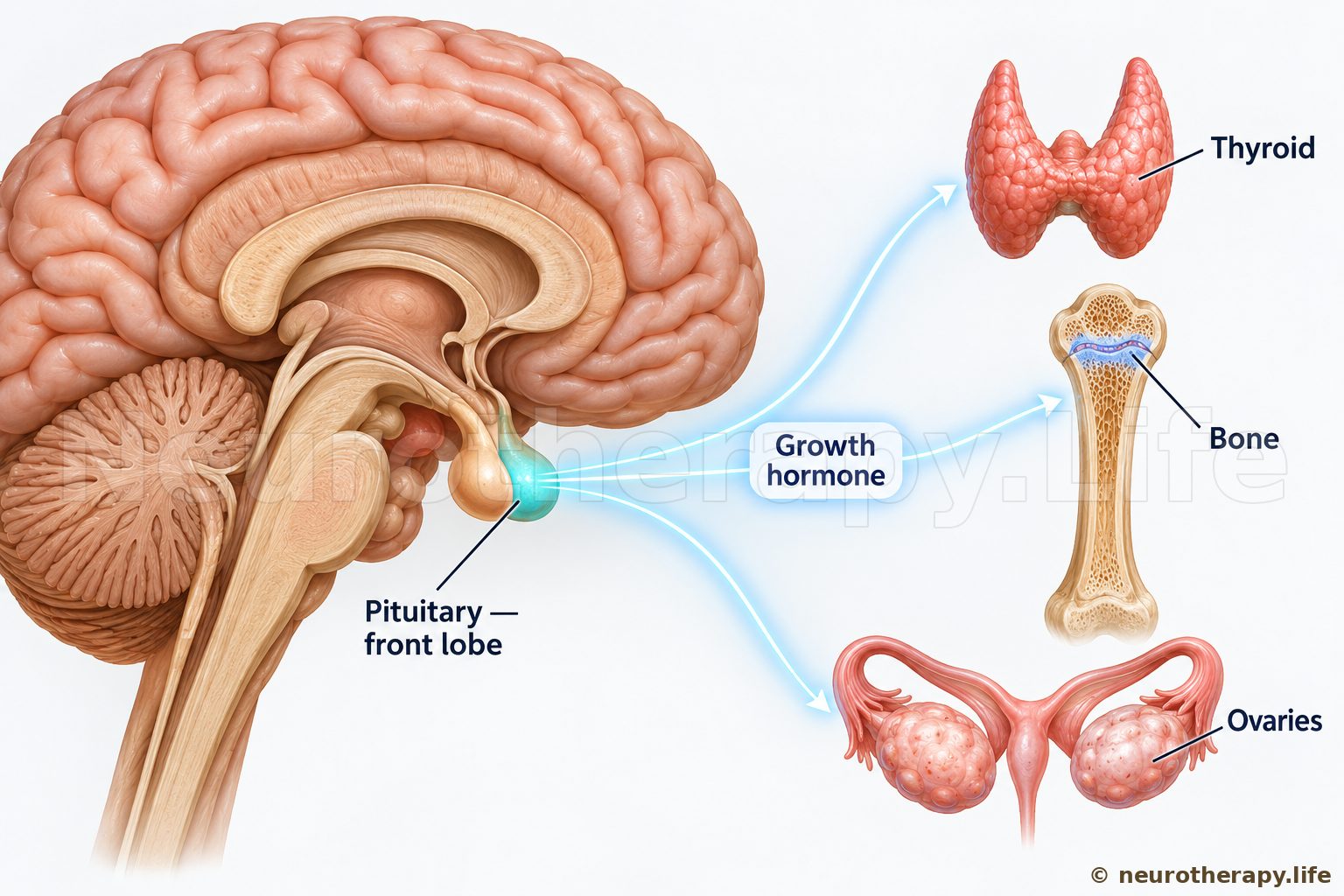
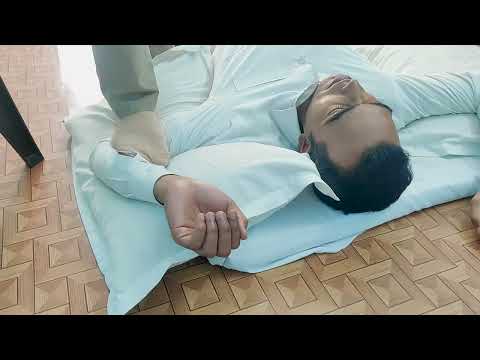
Thrd 'P' is a Neurotherapy (LMNT) point given on the left arm only, while you lie on your back. Despite its name it works through the pituitary gland — chiefly growth hormone — and it is paired with the thyroid or the ovary points to reach the thyroid, the bones and the monthly cycle.
Overview
What is Thrd 'P'?
Thrd 'P' means Thyroid 'P'. The letter P is part of the name and must always be read, because Thrd 'P' is a completely different treatment from Thrd: different place, different tool, different count.
In the source teaching, (4) Thrd 'P' is given to stimulate the anterior pituitary — the front part of the small master gland under the brain — so that it makes its hormones, mainly growth hormone. Through growth hormone, children with a smaller head are also said to benefit.
Its power lies in its partners. Given with (4) Thrd, the pituitary's signal prompts the thyroid to make iodine-based hormones. Followed by an ovary point, its signals for the ovaries are used to correct absent or disordered periods.
Thrd 'P' is named for the thyroid but works through the pituitary, the gland that gives the thyroid, bones and ovaries their orders.
Where it is given
Where is Thrd 'P' given?
PositionLying on the back
Body areaLeft upper arm, near the elbow and near the shoulder
You lie on your back, with no pillow under the head unless one is needed. The therapist works from the head end.
It is given on the left arm only — near the elbow bone and near the shoulder. The arm alone tells three sister points apart: Pit uses both arms, Para the right arm, and Thrd 'P' the left.
How it is given
How is Thrd 'P' given?
How this point is given — the tool, the pressure, the count and the exact movement — is deliberately not described here. Watch the demonstration video on this page, and learn the method hands-on from a trained Neurotherapist before giving it. Please do not give any point from a written description alone: a point given in the wrong place or the wrong way can do harm.
The number written before a point's name is not a strength setting. Each numbered form is a separate named treatment with its own method and timing, taught hands-on in the course.
SideLeft arm only
Not to confuse withThrd, which is given at the throat with the palms
The exact technique is taught hands-on in the Neurotherapy (LMNT) course. See the course →
What it does
What does Thrd 'P' do?
In the source teaching, (4) Thrd 'P':
Stimulates the anterior pituitary to make its hormones — mainly growth hormone.
Given with (4) Thrd, prompts the thyroid, through the pituitary's signal, to make its T₃ and T₄ hormones.
Followed by (6) Rt. Ov. or (6) Lt. Ov. as needed, helps correct absent periods and other period disorders through the ovary-signalling hormones FSH and LH.
Through growth hormone, helps children with a smaller head.
Helps lay calcium into the bones through the bone-building cells, and helps repair ligaments.
Rouses the supervisors of digestion — the vagus nerve, the anterior pituitary and the pathways to the brain — then takes out the pain at Pan
Safety: when it is held back
Not in bamboo spine, spur, or wherever bone has grown where it should not — Thrd 'P' builds bone through the bone-building cells, so the disease could grow. Ankylosing spondylitis (bamboo spine)
This bar also covers a report that says calcification at a shoulder or heel, even if the patient has never heard the words bamboo spine or spur. Heel spur
Never confuse it with Thrd. Say the whole code aloud before starting: 'Thyroid P — left arm'. Thrd
Children receive light treatment, and those being treated for height are not given the ovary points. Neurotherapy (LMNT) works alongside medical care. Teenage years (care for teenagers)
Common questions
Why is it called Thyroid 'P' if it works on the pituitary?
The name records its main partner: given with (4) Thrd, it is how the thyroid is prompted through the pituitary. The 'P' reminds the reader it is not the throat point.
Why only the left arm?
Because the arm is what tells three similar points apart: both arms for Pit, the right for Para and the left for Thrd 'P'.
Can it make a child taller?
It is used to support growth hormone, but height depends on many things, and once the growth plates at the ends of the bones have closed, no treatment reopens them.
Surprising facts
1A pea that runs the body
The pituitary is about the size of a pea, yet its front part makes growth hormone and the signals that steer the thyroid, adrenals and ovaries or testes.
Source: Hall JE, Hall ME. Guyton and Hall Textbook of Medical Physiology, 14th ed. Elsevier, 2020.
2Growth comes in pulses
Growth hormone is released in pulses that vary through the day; its levels rise in childhood, peak around puberty and fall with age.
Source: Brinkman JE et al. Physiology, Growth Hormone. StatPearls (NCBI), 2023.
3Growth by messenger
Growth hormone works mostly indirectly: it tells the liver to make IGF-1, and IGF-1 drives the growth of cartilage and bone.
Source: Brinkman JE et al. Physiology, Growth Hormone. StatPearls (NCBI), 2023.
Watch
Hypothyroidism के लिए LMNT Neurotherapy Treatment | Step-by-Step Training in Hindi |
A step-by-step training demo of a hypothyroidism formula: Half Kundli for 40 seconds on the edge of a chair, (6) Medulla on both sides of the neck, 4 Thyroid-P near the elbow and shoulder, and 4 Thyroid at the base of the neck. It is given in one go, without gaps, to support a slow thyroid.
Note: LMNT teaching gives Thrd with the flat of the palm, never a fingertip, and no neck work with goitre. Keep taking your thyroid tablet.
ESTROGEN FORMULA - LMNT Neurotherapy
A demonstration of the oestrogen formula: (½) Ku for 40 seconds, (6) Medulla, (4) Thrd 'P', (4) Thrd and (6) Lt. Ov.
Ku is not given during the period or with low blood pressure; ovary points are not given to teenagers or in cancer.
DELAY MENSUS - LMNT Neurotherapy
A demonstration, in Hindi, of two treatments for late periods: first (6) Medulla, (4) Thrd 'P' and (6) Lt. Ov.; then P. Heparin, (8) Pan, (7) Liv and (8) Ch. Only.
LMNT teaching gives (4) Thrd 'P' followed by (6) Rt. Ov. or (6) Lt. Ov., and names Rt. Ov. (progesterone) for bringing on a late period. No Heparin formula is ever given while the flow is heavy.
Test yourself
Research
Strong evidence
A clinical reference on growth hormone: it is made by cells in the front part of the pituitary, released in pulses, and works mostly through IGF-1 from the liver to drive growth of cartilage and bone.
This page explains what a Neurotherapy (LMNT) treatment is for; it is not a self-treatment guide and does not diagnose. Neurotherapy (LMNT) works alongside your medical care — keep taking the medicines your doctor prescribed.
Ready to begin?
Send COURSE for course details, or your name, age and health issue for a consultation.