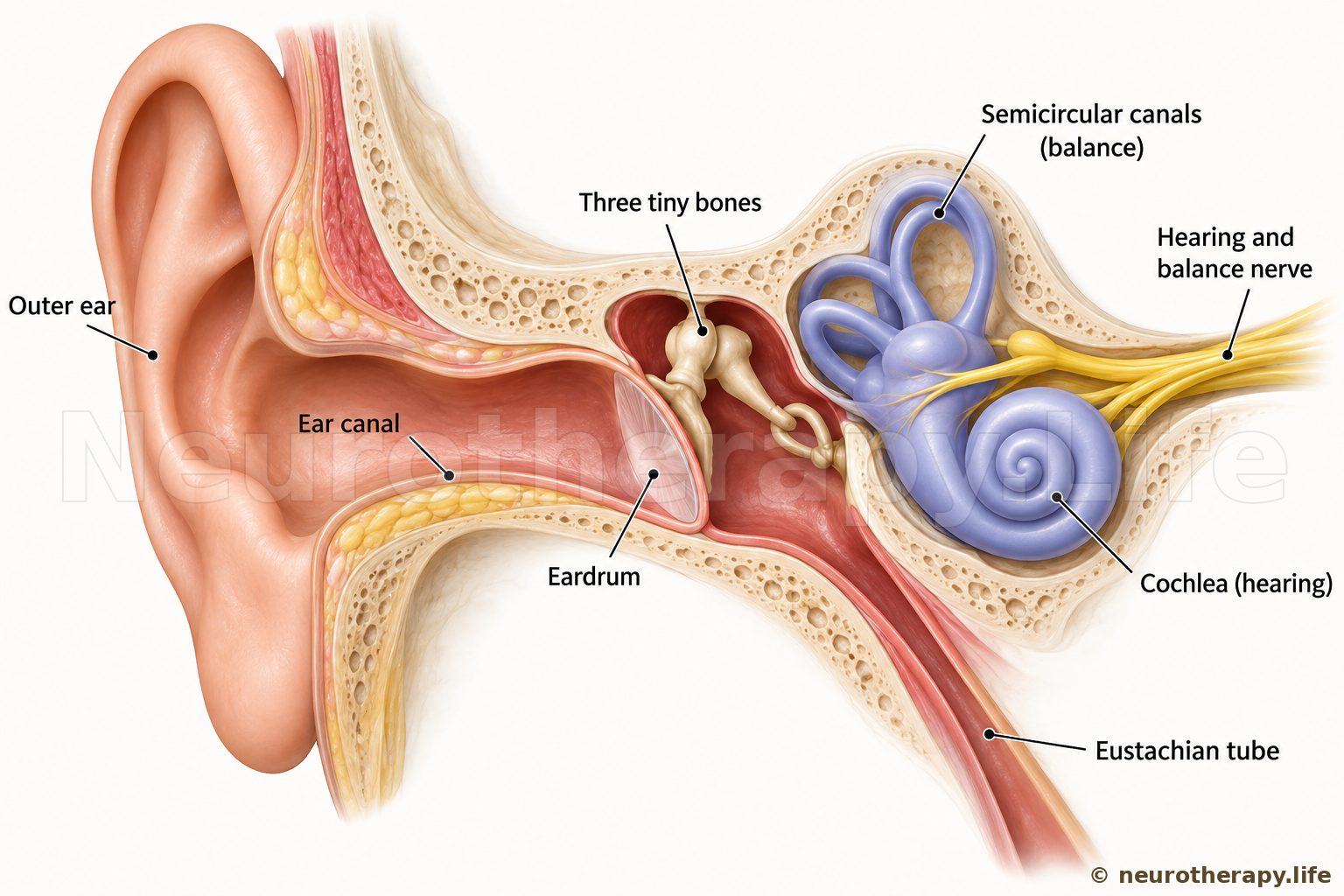
Your ears do two jobs at once: they hear, and they keep you balanced. A drum, the three smallest bones in your body and a fluid-filled snail shell turn air waves into nerve signals, while three tiny fluid rings next door tell your brain which way is up.
Overview
What are the ears?
Your ears are the organs of hearing and balance. What you see on the side of the head is only the outer ear. Most of the ear lies hidden inside the hardest part of the skull bone, the temporal bone, just behind the jaw joint.
Each ear has three parts. The outer ear collects sound. The middle ear, an air-filled room behind the eardrum, boosts it. The inner ear turns it into nerve signals and also holds the balance organ. The eighth cranial nerve carries both hearing and balance to the brain.
Hearing loss is common and often slow and unnoticed. The World Health Organization estimates that over 430 million people need care for disabling hearing loss, and that over a billion young people are at risk from loud music and noise.
Outer, middle and inner ear: collect, boost, then turn sound into signals — with the balance organ built in.
Function
What do the ears do?
Sound is a wave of air pressure. The outer ear funnels it to the eardrum, which vibrates. Three tiny bones pass the vibration to the fluid of the inner ear, where hair cells in the cochlea turn it into electrical signals. Separately, fluid moving in the balance canals tells the brain how your head is moving.
Collects sound and works out which direction it came from, by comparing the two ears.
Turns sound into nerve signals the brain hears as speech, music and warning noises.
Senses turning of the head through three fluid-filled balance canals.
Senses gravity and straight-line movement — lifts, cars, standing up — through two small chambers.
Keep the pressure on both sides of the eardrum equal through the Eustachian tube.
Protect themselves: the canal makes wax, and tiny muscles stiffen the bones against very loud sounds.
Sound is caught
The ear flap funnels sound waves down the 2.5 cm ear canal.
The eardrum vibrates
The thin eardrum moves in and out with every wave.
The bones boost it
The hammer, anvil and stirrup pass the movement on, concentrating it onto a much smaller window of the inner ear.
The fluid ripples
The stirrup pushes on the fluid of the cochlea and sets up a travelling wave along a membrane inside it.
Hair cells fire
Hair cells at the place matching the pitch bend and send signals up the hearing nerve to the brain.
How do the ears work with other organs?
Brain — The hearing areas at the side of the brain make sense of sound; the cerebellum uses balance signals to steady your movements.
Eyes — Balance signals from the ear keep your eyes fixed on a target while your head moves.
Nose — The Eustachian tube joins the middle ear to the back of the nose, so a cold or a hard nose-blow can block the ear.
Cranial nerves — The eighth nerve carries hearing and balance; the fifth, seventh, ninth and tenth serve the ear's skin, muscle and middle ear.
Jaw — The jaw joint sits just in front of the ear canal, so jaw pain is often felt as earache.
The ear is built in three rooms, one behind the other: the outer ear, the middle ear and the inner ear.
The outer ear
Pinna (ear flap) — Skin over springy cartilage, shaped to catch sound and help tell front from back.
Ear canal — A slightly S-shaped tube about 2.5 cm long. Glands in its outer part make wax, which traps dust and slowly moves outward on its own.
Tragus — The small flap of cartilage in front of the canal opening — the flap pressed gently in one of the LMNT Ear Points.
The middle ear
Eardrum (tympanic membrane) — A thin, pearly-grey skin about 1 cm across, stretched across the end of the canal.
Three ossicles — The hammer (malleus), anvil (incus) and stirrup (stapes) — the smallest bones in the body — linked in a chain.
Eustachian tube — A narrow tube from the middle ear to the back of the nose. It opens when you swallow or yawn to let air in and even out the pressure.
Two tiny muscles — One on the stirrup and one on the hammer tighten against very loud sounds; the stirrup muscle is run by the facial nerve.
The inner ear
A maze of fluid-filled tunnels carved in bone, with two sets of sensors: one for hearing and one for balance.
Cochlea — A snail shell of about two and a half turns. Inside, the organ of Corti holds about 15,000 hair cells in rows.
Semicircular canals — Three fluid-filled rings set at right angles to each other, sensing nodding, turning and tilting of the head.
Utricle and saccule — Two small chambers with tiny crystals on a jelly, sensing gravity and forward, backward, up and down movement.
Vestibulocochlear nerve — The eighth cranial nerve, carrying hearing and balance signals to the brainstem.
Where are the ears located?
The ears sit on each side of the head, level with the eyes and nose. The canal runs inward into the temporal bone; the middle and inner ear lie deep inside it, only a few centimetres from the brain.
Just in front of the canal is the jaw joint; just behind and below is the bony bump called the mastoid, full of small air cells connected to the middle ear. Below the ear runs the upper neck — the place where the LMNT Medulla treatment is given, behind the ears and down the side of the neck.
The outer ear is a curled shell of skin and cartilage with an outer rim, inner ridges and a soft lobe at the bottom that has no cartilage. Its folds are as individual as a fingerprint.
Seen through a doctor's lamp, a healthy eardrum is a thin, shiny, pearly-grey disc with the handle of the hammer bone showing through it. The inner ear is never seen from outside: it is a tiny, glassy maze of tunnels set in the densest bone of the skull.
How big are the ears?
The ear canal is about 2.5 cm long and a little under 1 cm wide. The eardrum is about 1 cm across. The stirrup, the smallest bone in the body, is about 3 mm long.
The whole cochlea is about the size of a pea, and uncoiled it would be only about 3 to 3.5 cm long. A young healthy ear hears pitches from about 20 to 20,000 vibrations a second; the top of that range falls slowly from our twenties onward.
Conditions and disorders
What conditions and disorders affect the ears?
Ear problems can block the canal, inflame the middle ear, damage the hair cells or the nerve, or upset the balance organ. Many cause both hearing and balance symptoms because the two share one organ.
Hearing
Hearing loss (deafness)From wax, fluid or infection (blocked sound) or from worn or damaged hair cells and nerve (age, noise).
Bell's palsyThe facial nerve runs through the ear bone; pain behind the ear or sensitivity to loud sound can come with it.
Paralysis and strokeSudden giddiness with slurred speech, double vision or weakness can be a stroke — an emergency.
High blood pressureLMNT teaching gives a daily ear practice for high blood pressure — alongside the doctor's treatment.
What are common signs of an ear problem?
Hearing less, or asking people to repeat themselves
Ear pain, fullness or a blocked feeling
Ringing, buzzing or hissing in the ears
Discharge or bleeding from the ear
Spinning, giddiness or unsteadiness, especially on getting up or turning the head
In children: pulling at the ear, fever, poor attention or slow speech
What tests check the health of the ears?
Otoscopy — A lighted scope shows the canal and eardrum — wax, infection or a hole.
Tuning-fork tests — Simple tests that tell a blocked-sound loss from a nerve loss.
Audiometry (hearing test) — Beeps through headphones map how well each ear hears each pitch.
Tympanometry — Measures how the eardrum moves, to find fluid or pressure problems in the middle ear.
Balance tests — Head-position tests and eye-movement recordings find the cause of vertigo.
Newborn hearing screen — A quick, painless test so hearing loss can be found in the first weeks of life.
How are ear conditions treated?
Wax removal — Only when wax truly blocks the canal, by a trained person — softening, gentle suction or careful irrigation.
Medicines — Antibiotics or drops for some infections, and short courses for sudden nerve deafness or vertigo — as a doctor decides.
Hearing aids — Small amplifiers that make sounds louder and clearer; they work best when fitted early.
Ear surgery — To repair a hole in the eardrum, place tiny tubes for fluid in children, or treat bone disease of the middle ear.
Cochlear implant — An electronic device that stimulates the hearing nerve directly when the hair cells are too damaged for a hearing aid.
Balance exercises and repositioning — Special head movements can move loose crystals back in the commonest kind of vertigo; exercises retrain balance.
Neurotherapy (LMNT)
LMNT teaching works on the ear from three sides. First, the Medulla treatment below the ears is numbered for the ear's nerves — five numbers for one organ, because the outside, the middle and the inner ear each have different wiring; when you cannot tell which part is at fault, (8) Medulla is the teaching's safety net 'for all problems of the ear'. Second, the Ear Points: four gentle stations at each ear, the left ear first. Third, and often first of all, the teaching asks how the patient bathes and gets out of bed — because water in the ear and standing up too quickly are, in its experience, common reasons for hearing less and for giddiness.
Points
Ear Points — Seated, left ear first: six strokes down behind the ear, six down in front of it, the small flap in front of the canal pressed in, held a moment and released, then the rim pressed at 45° inward and upward. On the third station the teaching says hearing improves from that ear for a few moments. Given for reduced hearing, deafness and all problems of the ear.
(8) Medulla — The inner-ear number: deafness, ringing in the ears, vertigo from the balance canals, the organ of Corti, and 'all problems of the ear'. With (6) Adr where the ear is inflamed.
Medulla — The other ear numbers: (5) for feeling in the inner and outer ear and the ear opening; (7) for the middle-ear muscle on the stirrup; (9) for the middle ear and the Eustachian tube; (10) for the outer ear and the lining at the back of the skull. Each is usually given three times with a rest of a minute and a half.
Down Arrow — A palm slid slowly down the back from T1 to L5. The teaching gives it for Ménière's disease — giddiness when the fluid in the inner ear has increased.
Up Arrow — The same strip worked the other way, from L5 up to T1, always lying down. The teaching gives it for vertigo when the ear fluid has decreased.
(6) Adr — Added with (8) Medulla where there is inflammation in the ear.
Hammering — Light tapping round the head through a folded towel to increase circulation — the teaching's rule is that the ear itself is never struck.
The Medulla family — one place on the neck and different counts. For the ear the teaching uses (5), (7), (8), (9) and (10), each usually × 3 with a rest of a minute and a half.
“Whether or not the patient gets immediate benefit from our treatment, let no harm reach him through our carelessness — attend to this.”
— Dr. Lajpatrai Mehra
“Wherever there is a question mark, it is an indication that this is my own thinking, on which other people can now do research.”
— Dr. Lajpatrai Mehra
Never do this
Emergency: sudden giddiness with slurred speech, double vision, a drooping face, weakness or numbness, or a sudden severe headache — call 108/112. This can be a stroke, not an ear problem. Paralysis and stroke
Sudden hearing loss in one ear, over hours or a day or two, needs an ear doctor within a day or two — early treatment matters. Hearing loss (deafness)
See a doctor, not the mat, for ear pain with fever, discharge or bleeding from the ear, swelling or redness behind the ear, or ear pain in a small child who is unwell. How to tell a patient to see a doctor
Nothing is poured into the ear: the teaching's rule is no drops into an ear — oil applied lightly on cotton outside is allowed — and never dig out wax with buds, pins or keys.
Ear Points are given gently with the soft pad of the thumb; no point is given on an ear that is painful, discharging, recently operated or has a known hole in the eardrum until the ear doctor agrees. In Hammering the ear is never struck. Ear Points
Up Arrow is always given lying down. With any giddiness, the patient sits on the edge of the couch for at least thirty seconds before standing. Up Arrow
(6) Adr lowers immunity and is not given in high blood pressure. (6) Adr
The Medulla count is the treatment: a different number is a different treatment, not a stronger or weaker one. Only a trained therapist chooses the number, after examining you that day. Medulla, the graded series
Cancer: if the person has cancer, (10) Pan, Thymus, Pit, Lu + Sh, Rt. Ov / Lt. Ov and (30) Medulla are never given — the therapist changes the plan.
Keep taking the medicines, drops and treatments your doctor prescribed, and never stop or change them on your own. Neurotherapy (LMNT) works alongside your medical care, never instead of it.
Care
How can I keep my ears healthy?
The ear cleans itself and the hair cells cannot be replaced, so protecting them matters more than cleaning them.
Leave the wax alone
Guruji's rule: never clean out the wax. The more you remove, the more the ear makes. Clean only the outer ear with a cloth.
Pour the first mug on the head
Guruji's bathing rule: the first lota of water goes on the crown, kept off the ears; then the back and shoulders; then the body. Cold water landing first on the shoulders makes you gasp, and water can run into the ear.
Sit for thirty seconds before you stand
On waking, turn onto your side, sit on the edge of the bed for at least thirty seconds, then stand. Getting up with a start can bring giddiness from the balance canals.
Blow the nose with both nostrils open
In a cold, clean the nose gently. Forcing air out of one nostril with the other closed can push mucus into the tube of the ear.
Turn it down
Keep headphones below about 60% volume and take breaks; wear ear protection near loud machines, drums or firecrackers. Guruji's teaching even advises a soft-toned doorbell, as a sharp bell can bring ringing in the ears.
Get hearing checked
Check hearing if family members complain you do not hear, after 50 every few years, and for any child with slow speech.
Common questions
Should I clean my ears with cotton buds?
No. Ear-nose-throat doctors advise against putting anything in the canal: buds push wax deeper and can scratch the canal or the eardrum. The ear moves its wax out on its own; Guruji's teaching says the same — never clean out the wax.
Why do my ears pop in an aeroplane or on a hill road?
The outside air pressure changes faster than the Eustachian tube can even it out, so the eardrum is pushed in or out. Swallowing, yawning or chewing opens the tube and makes the 'pop'. Try not to fly with a heavy cold.
Why does my head spin when I get up quickly?
Two common reasons: blood pressure dips for a moment on standing, and the balance organ is upset by sudden movement. Guruji's teaching gives a simple habit — turn to the side and sit on the bed for thirty seconds before standing. Spinning that comes with lying down or turning in bed is worth showing to a doctor.
Does hearing loss matter if I can manage?
Yes. Untreated hearing loss in midlife is linked with loneliness, falls and a higher risk of memory loss later. A hearing test is quick and painless, and a hearing aid is a tool, not a sign of old age.
Can Neurotherapy (LMNT) help ringing in the ears?
LMNT teaching lists (8) Medulla and the Ear Points for ringing in the ears, given alongside an ear check. Ringing in only one ear, or with sudden hearing loss or giddiness, should be seen by an ear doctor first.
What should I ask my doctor or therapist?
Is my hearing loss from a blockage or from the nerve, and in which ear?
Is my eardrum whole? Is it safe to put anything in or near the ear?
Is my giddiness coming from the ear, the blood pressure or the brain?
Would a hearing aid help me, and how soon?
Which symptoms mean I should come back the same day?
(To the therapist) Which Medulla number are you giving for my ear, and should I change how I bathe or get out of bed?
Surprising facts
1The smallest bone in your body is in your ear
The stirrup (stapes) in the middle ear is about 3 millimetres long — smaller than a grain of rice. With the hammer and the anvil it forms a chain of three levers, the three smallest bones you own.
Sound in air would mostly bounce off the fluid of the inner ear. The middle ear solves this: the large eardrum focuses its push onto the tiny window of the stirrup, raising the pressure about twenty times.
Source: Guyton & Hall — impedance matching by the ossicular system (pressure increased about 22 times).
3Your ears move their own wax outward
The skin of the ear canal grows outward from the eardrum like a slow conveyor belt, carrying wax and dust with it; jaw movement helps. That is why ear doctors say the canal usually needs no cleaning.
Source: Schwartz SR et al., AAO-HNS Clinical Practice Guideline: Earwax (Cerumen Impaction), Otolaryngol Head Neck Surg 2017. LMNT rule: never clean out the wax (db §38.10).
4A piano keyboard rolled into a pea
Along the cochlea's spiral each place answers a different pitch: high notes at the wide start, low notes at the narrow tip. About 15,000 hair cells line it — and in humans, once lost to age or noise, they do not grow back.
Source: Purves, Neuroscience; Guyton & Hall — tonotopic organisation of the cochlea; ≈3,500 inner and ≈12,000 outer hair cells per ear.
5Your ears keep you upright even in the dark
Three fluid-filled rings, set at right angles like the corner of a box, sense every turn of the head, while tiny crystals in two chambers sense gravity. When loose crystals drift into a ring, simple head turns can bring on spinning — the commonest cause of vertigo.
Source: Guyton & Hall — vestibular apparatus; Bhattacharyya N et al., AAO-HNS guideline on benign paroxysmal positional vertigo (2017).
6Hearing loss is the biggest changeable risk for dementia
A major international report found that, of the risks for dementia that people can change, hearing loss in middle age carries the largest share — around 8% of cases. Treating hearing loss is one of the simplest ways to protect the brain.
Source: Livingston G et al., Dementia prevention, intervention, and care: 2020 report of the Lancet Commission. Lancet 2020;396:413–446.
7A gasp can put water in your ear
Guruji noticed that when cold water first lands on the shoulders or back of the neck, people gasp — and water runs into the ear. His teaching says this water thins the wax, which then presses on the ear opening and reduces hearing, and that changing how one bathes brings a difference quickly.
Source: LMNT teaching, db §38.8 and §38.10 (bathing order; 'this is a matter of experience'). The gasp reflex on cold water is well described (cold-shock response; Tipton MJ et al., Exp Physiol 2017).
Your ears in numbers
~3 mmthe stirrup, smallest bone in the body
~2.5 cmlength of the ear canal
~15,000hair cells in each cochlea
20–20,000vibrations a second a young ear can hear
3balance rings in each ear
30 secto sit on the bed before standing
Yoga
Bhrāmarī — the humming-bee breath Bhrāmarī
Benefits
Calms the mind; many people find the steady hum soothing.
Humming lengthens the out-breath, which slows the breathing rate.
Humming moves air through the nose and sinuses, which helps them ventilate.
How to do it
Sit comfortably with a straight back and close your eyes.
Rest the thumbs gently on the small flaps in front of the ear openings — do not push anything into the ear.
Breathe in slowly through the nose.
Breathe out slowly while making a soft, steady 'mmm' hum with the lips closed.
Repeat 5 to 7 times, then sit quietly.
Take care
Keep the hum soft and never press hard on the ears. Skip it with an ear infection, a discharging ear, or soon after ear surgery. Stop if you feel dizzy.
Vṛkṣāsana — the tree pose, with support Vṛkṣāsana
Benefits
Trains the teamwork of the inner ear, the eyes and the leg muscles that keeps you steady.
Better balance practice is linked with fewer falls in older people.
How to do it
Stand beside a wall with feet together and one hand lightly on the wall.
Fix your eyes on one point straight ahead.
Shift your weight onto one leg and place the other foot on the inner calf or ankle — never on the side of the knee.
Bring the free hand to the chest and breathe steadily for 5 to 10 breaths.
Lower the foot slowly and repeat on the other side.
Take care
Always keep a wall or chair within reach. Do not practise during an attack of vertigo, and older people or anyone who has fallen recently should practise only with someone nearby.
Gentle neck turns Grīvā-sañcālana
Benefits
Loosens the neck muscles below the ears, the area where the Medulla treatment is given.
Gently accustoms the balance organ to head movement.
How to do it
Sit upright on a chair, feet flat.
Slowly turn the head to the right as far as is comfortable, pause, and come back to the centre.
Do the same to the left.
Slowly lower the chin towards the chest and raise it again.
Repeat 5 times each way, breathing normally.
Take care
Do not roll the head in full circles or tip it far back. Stop if it brings on spinning, tingling in the arms or neck pain; people with cervical spondylosis should ask their doctor first.
Test yourself
Research
Strong evidence
The American ear-nose-throat guideline on earwax says wax is normal and self-cleaning, that cotton buds and other objects should not be put in the ear, and that wax needs removing only when it causes symptoms or blocks an examination.
The Lancet Commission on dementia found twelve changeable risk factors that together account for about 40% of dementia cases worldwide; hearing loss in middle age was the largest single one.
The WHO's World Report on Hearing estimates that nearly 2.5 billion people will have some hearing loss by 2050, and that much of it can be prevented by protecting ears from noise, treating ear infections and checking hearing early.
This page explains how the body works; it does not diagnose. Neurotherapy (LMNT) works alongside your medical care — keep taking the medicines your doctor prescribed, and see a doctor for any new or severe symptom.
Ready to begin?
Send COURSE for course details, or your name, age and health issue for a consultation.