During a session: say when it hurts, and never help with the pillow
A patient has one real job during a Neurotherapy (LMNT) session: to say at once if the pressure hurts. And one polite habit to drop: lifting the body to help when the therapist places a pillow.
Overview
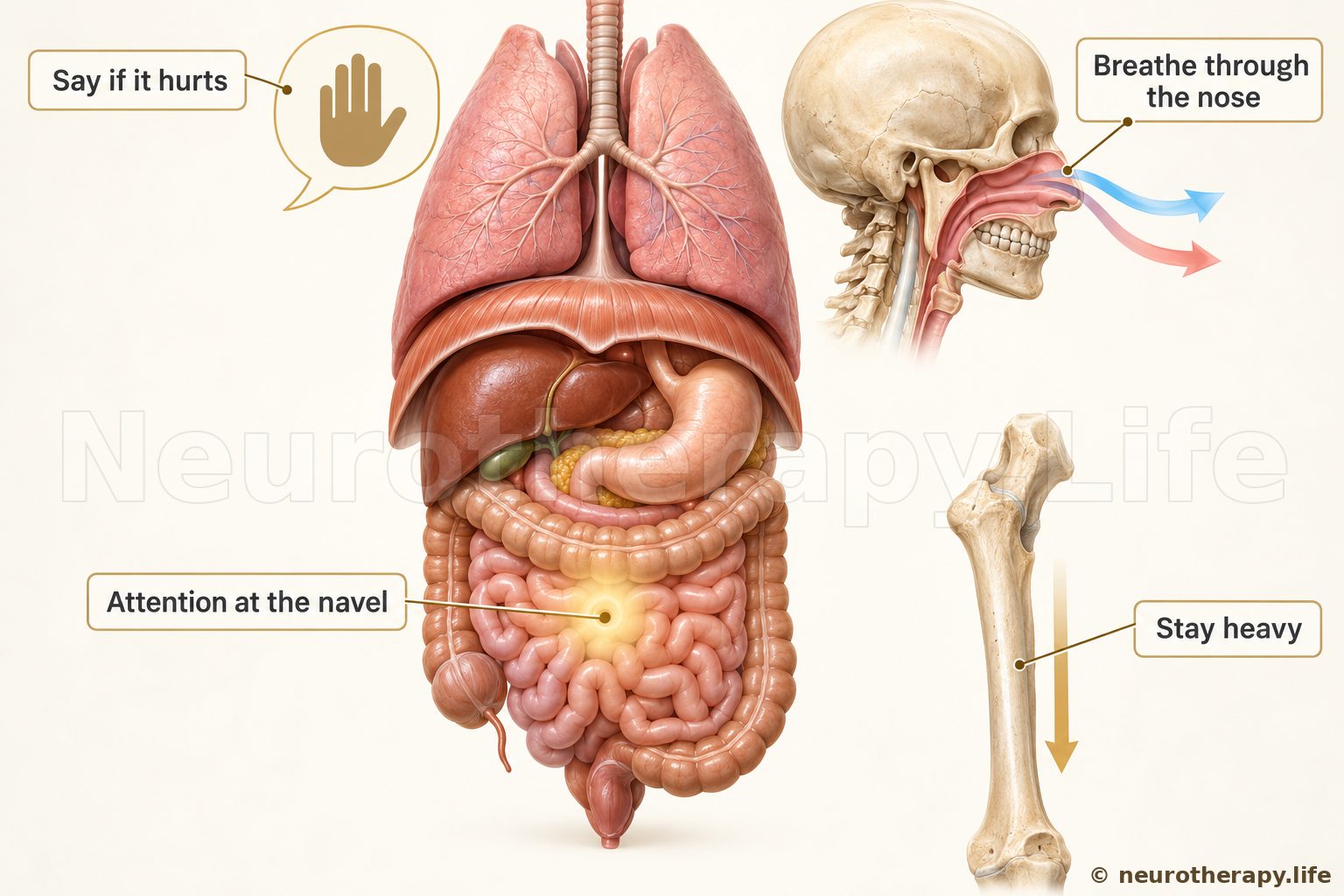
Ordinarily you should not feel pain from the pressure. If it hurts, tell the therapist at once. They will change the angle or the way the foot is placed, and the treatment will lose none of its effect. If you stay quiet, pain may remain after the session, or you may feel weak. Many patients stay silent out of politeness, so a good therapist asks during the treatment: "Tell me when to change the angle."
When a pillow goes under your thigh, do not lift your waist; when it goes under your leg, do not lift the leg. The therapist is trained to do it and can be hurt if you move. Do not raise your forehead. Do not take a pillow under the head unless needed. Do not talk during the treatment; keep questions for the gap between steps.
Stay relaxed, breathe long and slow through the nose, and keep your attention on the sensations around the navel. The more relaxed you are, the more you gain. Some patients feel the therapist is giving less weight today, but weight does not matter: the place decides the effect. Women do not take treatment for other problems during the period, but may come for very heavy, unending or very scanty flow, or for pain or clots.
Key points
- Tell the therapist at once if the pressure hurts.
- Never lift your waist or leg when a pillow is placed.
- Stay quiet, breathe through the nose and rest attention at the navel.
- The right place matters, not the therapist's weight.
Go deeper
Where pillows go during treatment, and where they never go
The pillow rules from the therapist's side
Consent, dignity and a chaperone during treatment
Consent, dignity and the chaperone
Why the therapist stands between two chairs
Why pressure is about place, not weight
The Navel Speaks First: The Map of the Pain Points
Why attention rests at the navel
Period problems (irregular, heavy or painful)
Period problems
Treating Women: Periods, Pregnancy and Care
Treating women
How to lie down and get up by turning onto your side
How to lie down and get up
Read the full guide
This topic is part of: Between Two Sessions: Daily Rules for Patients
Safety: when it is held back
- Unspoken pain during a session can leave pain or weakness afterwards. Say it the moment it hurts.
- During the period, women are treated only for period problems: very heavy, unending or very scanty flow, pain or clots. Period problems (irregular, heavy or painful)
- Neurotherapy (LMNT) works alongside your medical care. Do not stop or change any medicine on your own; ask the doctor who prescribed it.
This page explains what a Neurotherapy (LMNT) treatment is for; it is not a self-treatment guide and does not diagnose. Neurotherapy (LMNT) works alongside your medical care — keep taking the medicines your doctor prescribed.