Between Two Sessions: Daily Rules for Patients
A treatment lasts about half an hour; the rest of the day belongs to the patient. These simple rules for the treatment hour, sleep, rising and bathing help the body hold on to what each session corrects.
Overview
A treatment lasts about half an hour; the rest of the day belongs to the patient. These simple rules for the treatment hour, sleep, rising and bathing help the body hold on to what each session corrects.
Half an hour on the mat, the whole day at home
A therapist has the patient for about half an hour. The patient has the other twenty-three and a half hours. Whatever is corrected on the mat is handed back to those hours, and they can either hold it or undo it by morning.
A teaching case shows how. A schoolteacher with neck pain improved for a few days and then got stuck: every morning his fingers were numb and his chest ached. The treatment was correct. The cause was that he had slept with both hands under his head all his life. Once he kept his arms down, his fingers were warm by the third morning and the treatment began to hold.
So when a treatment helps many people but not this one, the first step is not to change the treatment. It is to ask about the patient's day and night.
During the treatment: speak up, and do not help
Normally the pressure should not hurt. If it does, tell the therapist at once. The angle or the way the foot is placed will be changed, and the effect will not be reduced. Pain kept silent may stay after the treatment, or leave a feeling of weakness.
Some patients feel the therapist is giving 'less weight' today. Weight is not what matters. The pressure guides blood towards glands it was not reaching. If the place is right, a light therapist gives as good a treatment as a heavy one.
- When a pillow is placed under your thigh or leg, do not lift your waist or leg to help — the therapist may get hurt. Stay heavy and let the therapist do the lifting.
- Do not raise your forehead, and do not take a pillow under the head unless it is needed.
- Do not talk during a press. Breathe long and easy through the nose and keep your attention around the navel. Save questions for the gap between treatments.
Lying down and getting up: always by the side
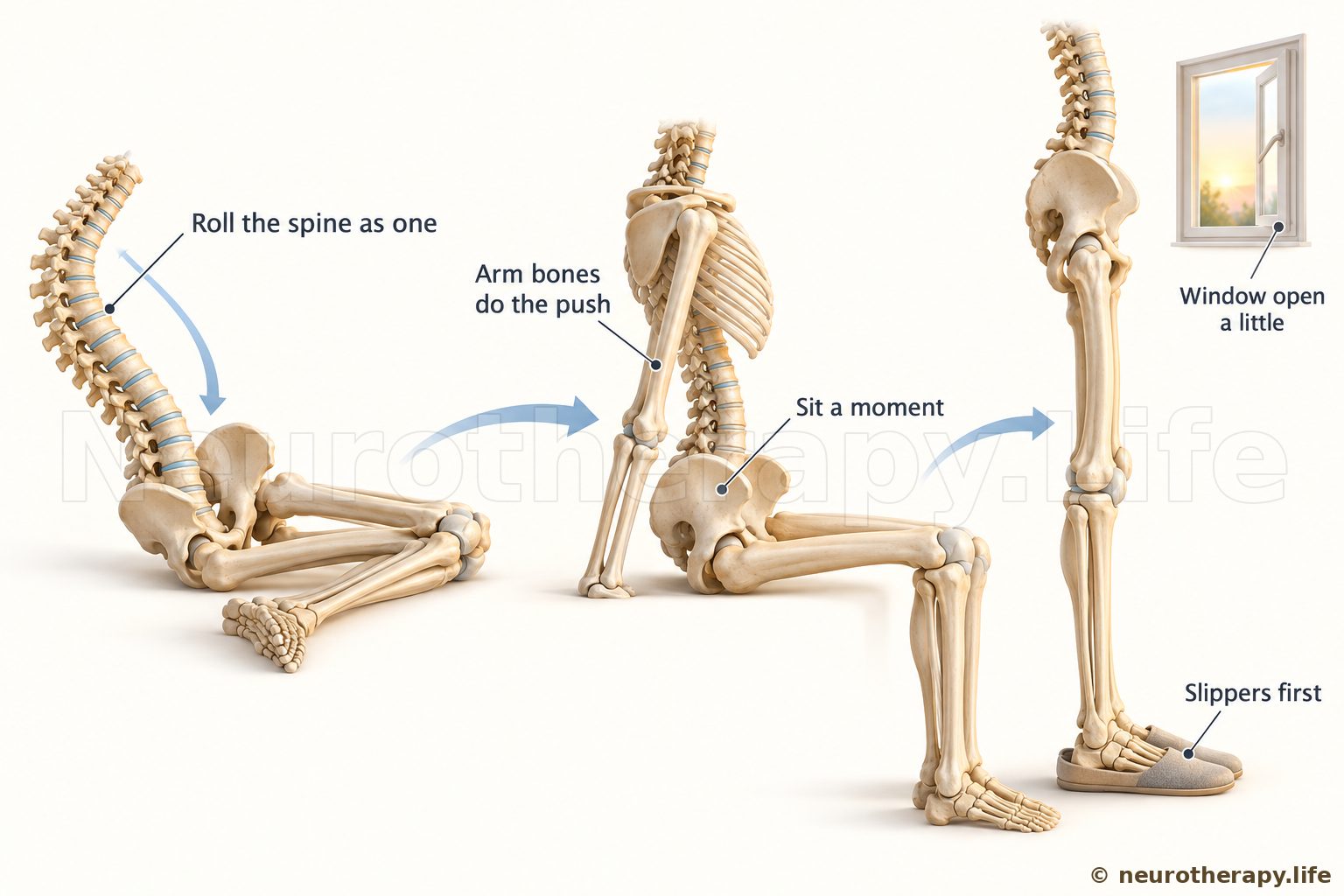
The side-turn (karvat) is the most repeated instruction in the whole of the patient's routine, and it applies all day, not only in the clinic. To lie down: sit on the bed, bring the feet together with the knees bent, lower yourself onto either side using your hands, then straighten the legs. To get up: first turn onto your side, bend the legs, then push up with your hands.
The reason given is that sitting straight up out of bed puts a sudden strain across the navel, and the heart's need for blood rises. Over the years this is named as one cause of indigestion, asthma, diabetes, cervical spondylosis (wear in the neck bones) or heart trouble. Rolling first lets the arms do the work instead.
After waking, sit on the edge of the bed for at least half a minute before standing. Behind the ear are three small fluid-filled tubes (the semicircular canals) that keep our balance; jumping up suddenly can bring giddiness. Then put your feet on slippers, not straight onto a cold floor.
Sleep: early, dark, airy — and arms down
The sleep rules come with their reasons. Lie down before 10.30 at night: the pineal gland is said to do its work around half past midnight, and an ordinary person needs about two hours to reach deep sleep. Keep the room completely dark — better not even a night lamp. Lie loose, with a calm mind.
Sleep with a window open. In a closed room the carbon dioxide we breathe out builds up, and the body stays tired all day. The rule is about air, not cold: a hand's width at the top of the window, a ventilator or a door left ajar is enough in winter.
Do not sleep with the hands under or above the head, or with an arm across the eyes. The great vessels to the arm come out from under the collarbone; with the arms raised for hours, the collarbone presses on them. Chest pain or numb fingers may follow. If light troubles you, cover the eyes with a cloth instead.
At bedtime, a simple breathing habit is taught: a few breaths on the left side, more lying straight, and still more on the right side. It is given to lower the chance of high blood pressure and to help those who cannot fall asleep. Long, slow breaths bring sleep; short, quick ones do not.
The bath: oil first, head first, no soap
Before the bath, a drop of mustard oil (or any oil) goes behind the ears, in the nostrils, at the navel, at the anus and in the armpits — the openings and folds of the body. Then oil the whole body, and bathe with plain water, without soap. Sweat has germ-killing substances of its own, and soap destroys them. This rule is only about the bath: hands are always washed with soap before food and after the toilet.
Bathe in cold water as far as you can, in every season; people who do so are observed to catch fewer colds. Pour the first mug on the head, keeping it off the ears, then on the back and shoulders, then on the whole body. Water on the shoulders first makes you gasp, and water can enter the ears, soften the wax and dull the hearing. Do not pour water on the knees first.
After a cold bath, wait at least forty-five minutes before breakfast. The body takes that long to warm up, and meanwhile the blood stays near the skin rather than at the stomach. Eating in that window leaves gas. And do not bathe straight after a meal.
- No drop of oil in a baby's or small child's nose — oily drops can be breathed into the lungs.
- Do not put oil drops into the ears; oil may be applied lightly with cotton. Leave ear wax alone — the more you remove, the more the body makes.
Why a reason travels with every rule
Every rule is given with its reason, because adults do not keep orders from strangers for weeks. Some reasons name a body structure, like the vessel under the collarbone or the canals behind the ear. Others are honestly labelled 'a matter of experience' — observed, not explained. Keeping that label belongs to the teaching itself.
The teaching also asks people who dye their hair every month to think about the extra work it gives the kidneys, since the dye is said to pass out in the urine for many days. It is offered as something to consider, and the choice stays with the patient.
Key points
- Most of the healing time is spent at home; daily habits can hold or undo each session's work.
- Tell the therapist at once if pressure hurts; do not help lift your body when pillows are placed.
- Always lie down and get up by turning onto the side, then sit a moment before standing.
- Sleep early, in a dark room with fresh air, with the arms down by the sides.
- Oil before the bath, plain water without soap, the first mug on the head away from the ears.
- Leave at least forty-five minutes between a cold bath and breakfast.
- When a treatment stalls, ask about the patient's day and night before changing the treatment.
Topics in this guide
Go deeper
Food as Medicine: Eating and Drinking Rules
The rules of the plate and the glass
The Hand That Heals: What Neurotherapy (LMNT) Is
What Neurotherapy (LMNT) is, and why the open window matters
Weeks, Not Sessions: How a Neurotherapy (LMNT) Course Is Planned
What to do when a course of treatment stalls
Taking a Patient's Story: The History That Cannot Mislead
Questions that get real answers from patients
Treating Women: Periods, Pregnancy and Care
The rules that apply to women in particular
Insomnia (sleeplessness)
When sleep will not come
Vertigo and giddiness
Giddiness and the balance canals of the ear
Ears
How the ear hears and keeps balance
Safety: when it is held back
- If pressure hurts, say so at once. Pain kept silent may remain after treatment or leave weakness.
- Cold-water bathing is not for everyone: people with uncontrolled blood pressure, unstable chest pain or a recent heart problem, and the very old or frail, should leave it until they are steady. High blood pressure
- Anyone who cannot feel their feet properly must test bath water with the elbow, never with the numb foot. Numbness in the legs
- Never put oil in the nose of a baby or small child. The Child, the Elder and the Frail: Neurotherapy (LMNT) for Delicate Bodies
- Chest pain or fingers that go numb at night can have other causes too; if they continue, see a doctor while treatment goes on. How to tell a patient to see a doctor
- Never stop or change prescribed medicines because you are following these rules.
Guruji says
“This is a matter of experience.”
Common questions
You want me to open my window in December. Won't I catch a cold?
The rule is about air, not cold. In a shut room the air fills with the gas you breathe out, and you wake tired. How much of the window is open is your choice — a hand's width at the top, a ventilator, or a door left ajar will do.
I have slept with my hands under my head since childhood. How can that be wrong?
For two minutes, nothing happens. For seven hours a night, the collarbone presses on the vessel that feeds the arm, and numb fingers can follow. Try two nights with your arms down and see how your fingers feel.
Without soap, won't I smell?
The body is oiled first, so the skin is not bare in the water, and sweat carries germ-killing substances of its own that soap removes. And your hands still get soap, always.
Why must I be asleep before 10.30?
The rule is really about being in deep sleep by around half past midnight, when the pineal gland is said to work. Deep sleep takes about two hours to reach, so the bedtime is worked backwards from that.
Test yourself
Research
- Emerging evidence
In mice, sleep widened the spaces between brain cells and sped up the clearing of waste such as beta-amyloid — a clue to why good, deep sleep matters for brain health.
Explore more
Organs
Body systems
Diseases
Points
Topics
Read more
This page explains what a Neurotherapy (LMNT) treatment is for; it is not a self-treatment guide and does not diagnose. Neurotherapy (LMNT) works alongside your medical care — keep taking the medicines your doctor prescribed.