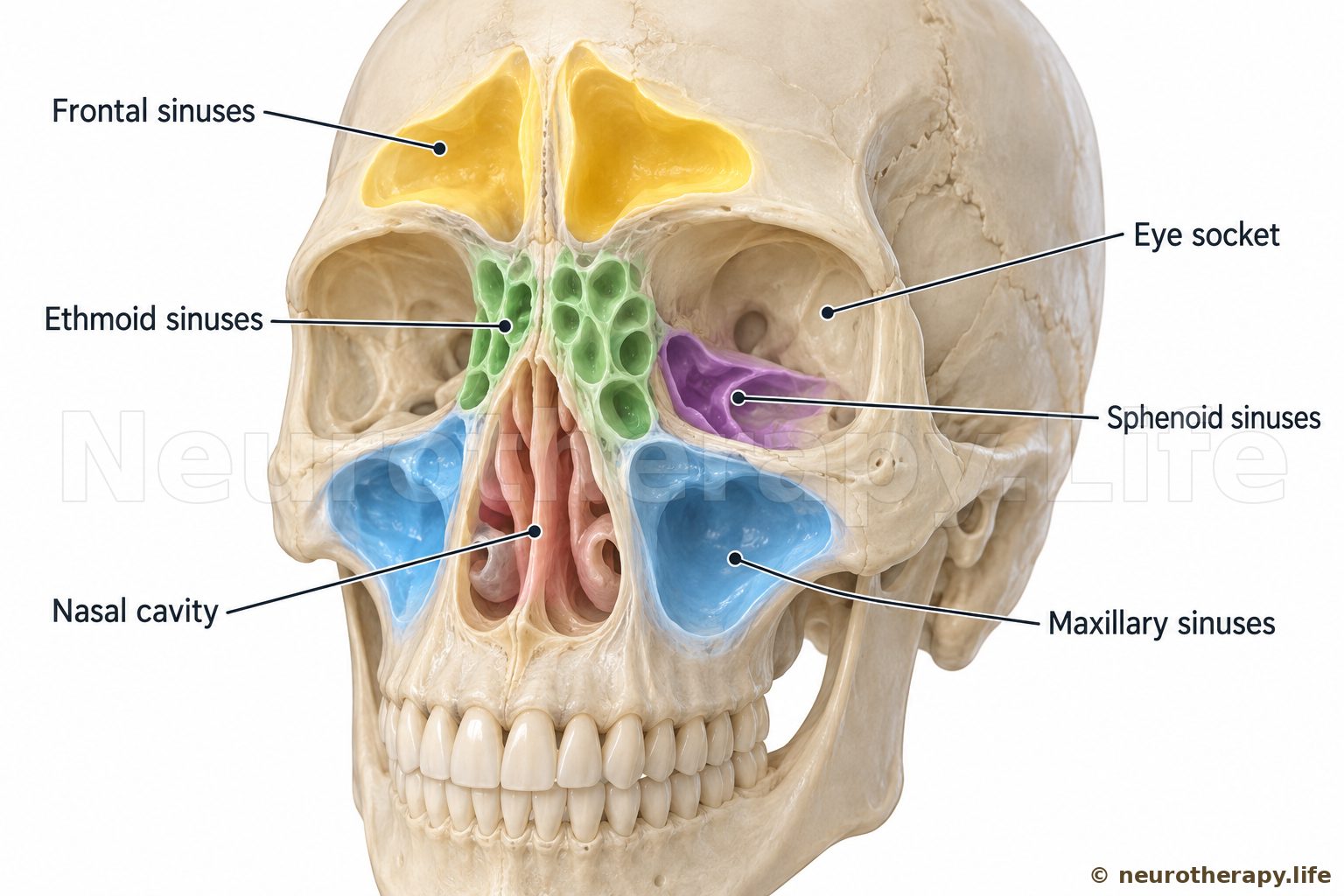
Your sinuses are four pairs of air-filled caves hidden in the bones of your face. They are lined with the same moist skin as the nose and drain into it through openings no wider than a pencil lead — which is why a simple cold so easily becomes a blocked, aching face.
Overview
What are the sinuses?
The sinuses (paranasal sinuses) are hollow, air-filled spaces inside the bones around the nose: in the forehead, between the eyes, in the cheeks and deep behind the nose. They are part of the breathing system, joined to the nose by small channels.
Each sinus is lined with a thin, moist skin that makes mucus. Tiny beating hairs sweep that mucus through a small opening into the nose. As long as the opening stays open, you never notice your sinuses at all.
When the lining swells — with a cold, an allergy or smoke — the openings close, mucus is trapped, and pressure, pain and sometimes infection follow. Sinusitis is one of the commonest reasons people see a doctor, and most of it is caused by viruses that clear up on their own.
Four pairs of air caves around the nose: forehead, between the eyes, cheeks, and deep behind.
Function
What do the sinuses do?
Scientists still debate exactly why we have sinuses. The best-supported ideas are that they make the skull lighter, add resonance to the voice, help warm and moisten the air, add their mucus to the nose's cleaning system, and may act as a crumple zone that protects the eyes and brain from a blow to the face.
Make the front of the skull lighter.
Give the voice its resonance — the reason you sound different with a blocked nose.
Make mucus that traps germs and dust, and sweep it into the nose.
Help warm and moisten the air you breathe.
Make nitric oxide, a gas that helps fight germs and keeps the airways open.
May cushion the eyes and brain against a blow to the face.
How do the sinuses work with other organs?
Nose — Every sinus drains into the nose; whatever blocks the nose can block the sinuses.
Eyes — Thin plates of bone separate the sinuses from the eye sockets, so sinus infection can spread to the eye — a warning sign.
Mouth — The roots of the upper back teeth sit just under the cheek sinuses, so tooth pain and sinus pain are easily confused.
Lungs — Mucus from the sinuses drips down the throat, and sinus disease often goes with asthma.
Cranial nerves — The fifth (trigeminal) nerve carries feeling from the sinuses — and the pain of sinusitis.
Lungs and breathing — The sinuses belong to the lungs-and-breathing system, with the nose.
Anatomy
What are the parts of the sinuses?
There are four pairs, named after the bones they sit in, plus the drainage channels that join them to the nose.
The four pairs
Maxillary sinuses — The largest, in the cheekbones below the eyes. Their drainage opening is high on the inner wall, so they must drain uphill.
Frontal sinuses — In the forehead above the eyebrows; often unequal in size, and missing in a few people.
Ethmoid sinuses — A honeycomb of small air cells between the eyes, separated from the eye socket by a paper-thin plate of bone.
Sphenoid sinuses — Deep in the centre of the skull behind the nose, close to the pituitary gland and the optic nerves.
The lining and the drains
Mucous membrane — A thin, moist lining, continuous with the nose, that makes mucus.
Cilia — Microscopic hairs that beat in waves, sweeping mucus towards the drainage opening.
Ostia (openings) — Tiny openings, a few millimetres or less across, where each sinus empties into the nose.
The common drainage pathway — The frontal, maxillary and front ethmoid sinuses share one narrow drainage area under the middle shelf of the nose, so swelling there can block several sinuses at once.
Where are the sinuses located?
All four pairs surround the nose. The frontal sinuses lie behind the eyebrows, the ethmoids between the eyes, the maxillaries under the eyes in the cheeks, and the sphenoids deep behind the nose at the centre of the skull.
That is why sinus pain is felt in the forehead, between or behind the eyes, in the cheeks and upper teeth, or deep in the head. It is also why the LMNT Sinus Point is a circuit over exactly these places: the cheeks, the sides of the nose and the brows.
On an X-ray or CT scan, healthy sinuses look dark, because they are full of air, with a thin, smooth lining at the edges. An inflamed sinus looks grey or white where swollen lining or fluid has taken the place of air.
The maxillary sinus is roughly pyramid-shaped; the frontal sinus is a pair of uneven pockets; the ethmoids look like a honeycomb.
How big are the sinuses?
In an adult each maxillary sinus holds roughly 15 ml of air — about a tablespoon. The others are smaller, and sizes vary a great deal from person to person and even between the left and right side.
They grow with the face. A newborn has only tiny maxillary and ethmoid sinuses; the sphenoids develop in early childhood, and the frontal sinuses usually appear on X-ray around age 6 to 8 and keep growing into the teens. So young children rarely get frontal sinusitis.
Conditions and disorders
What conditions and disorders affect the sinuses?
Almost every sinus problem begins with a swollen lining that closes the small drains. What differs is the cause — a virus, an allergy, bacteria, a tooth, or a structural narrowing — and how long it lasts.
Inflamed sinuses
Sinusitis, blocked nose and coldBlocked nose, facial pressure and thick mucus; acute after a cold, or chronic if it lasts beyond 12 weeks.
AllergyAllergic swelling of the lining is a common cause of repeated sinus trouble.
InfectionsBacteria can settle in trapped mucus, usually after a cold that fails to clear.
Fever and viral feverFever with facial pain and swelling means the infection needs a doctor.
Pain that can feel like sinus
Headache and migraineMany 'sinus headaches' without fever or thick mucus turn out to be migraine.
Dental check — When only one cheek sinus is affected, a tooth may be the cause.
How are sinus conditions treated?
Time, rest and fluids — Most sinusitis after a cold is viral and settles within 7 to 10 days without antibiotics.
Salt-water rinses and steam — Rinsing with sterile or boiled-and-cooled salt water helps clear mucus; warm steam soothes.
Steroid nasal sprays — Reduce swelling of the lining, especially in chronic or allergic sinusitis, as a doctor advises.
Antibiotics — only when needed — For symptoms lasting beyond about 10 days, severe illness with high fever, or getting worse after first improving.
Endoscopic sinus surgery — Widens blocked drains or removes polyps when long treatment has not helped.
Neurotherapy (LMNT)
LMNT teaching gives the sinuses a hands-on circuit and a nerve treatment, and it is honest about what the hands can and cannot do. The Sinus Point is a four-stage thumb circuit over the cheeks, the sides of the nose and the brows. The teaching's own note says a thumb on the cheek cannot drain a sinus, whose opening lies deep inside rigid bone — but the circuit passes directly over the small holes where the nerves of feeling for the front of the face come out of the bone, which is where sinus pain is felt. The Medulla treatment adds (5) for the cheek and forehead sinuses. And because a blocked or running nose is read as a sign of which way the body is leaning, the nose and sinuses may also be treated from the belly and the low back.
Points
Sinus Point — Seated, therapist in front: (1) thumbs draw the skin of the cheeks from the nose towards the ears; (2) press up along both sides of the nose; (3) palms higher, the brow skin taken to the outer corners of the eyes and rotated; (4) back down and inward to the sides of the nose and drawn out to the cheeks — without letting go between stages 3 and 4.
Medulla — (5) Medulla for the maxillary (cheek) sinus and for the frontal (forehead) sinus, and for the lining and skin of the nose — given × 3 with a rest of a minute and a half.
Satnam — The teaching's treatment for headache, given from behind with the forehead supported; useful where sinus trouble comes with a heavy head.
Mu — Given for a blocked nose; withheld in a running nose.
(6) Adr — Opens a blocked nose; not given when the nose is already running.
Mukha Dhauti — A long breath in through the nose and out through the mouth, the shape of the mouth chosen by whether Mu° or Liv° is tender — a practice the patient can take home.
Digestion is corrected first in long-standing trouble, following the teaching's rule that the body is improved rather than the single complaint chased.
“We do not give treatment for any one disease; rather we treat according to the condition of the body on that day.”
— Dr. Lajpatrai Mehra
“Whether or not the patient gets immediate benefit from our treatment, let no harm reach him through our carelessness — attend to this.”
— Dr. Lajpatrai Mehra
Never do this
Same day to a doctor — no hands on the face: facial pain with fever, thick discharge, swelling around the eye or eyelid, a bulging eye, double vision or any change in vision. Sinus infection can spread to the eye and, rarely, the brain. How to tell a patient to see a doctor
A headache is screened before it is treated: a first-ever severe headache, one that reaches full strength within seconds, or one with fever, stiff neck, weakness, numbness, drowsiness or change in vision is assessed by a doctor, not rubbed. Headache and migraine
Around the face: short, smooth nails that never touch the skin; tell the patient before each stage; keep well away from the eyeballs. Sinus Point
Swelling of one cheek with a bad tooth, or sinus pain on one side only with bloody discharge, needs a dentist or ear-nose-throat check.
Nose rinses only with sterile, distilled or boiled-and-cooled water; never tap water straight.
Do not take leftover antibiotics or stop a prescribed course early.
The Medulla count is the treatment: a different number is a different treatment, not a stronger or weaker one. Only a trained therapist chooses the number, after examining you that day. Medulla, the graded series
Cancer: if the person has cancer, (10) Pan, Thymus, Pit, Lu + Sh, Rt. Ov / Lt. Ov and (30) Medulla are never given — the therapist changes the plan.
Keep taking the medicines, drops and treatments your doctor prescribed, and never stop or change them on your own. Neurotherapy (LMNT) works alongside your medical care, never instead of it.
Care
How can I keep my sinuses healthy?
Healthy sinuses need open drains: a moist, un-irritated nose lining and mucus that can flow.
Drink enough water
Thin mucus drains more easily. Sip water through the day; on waking, drink it at room temperature or warm — Guruji's teaching says cold water first thing provokes phlegm.
Blow gently, both nostrils open
Hard, one-sided blowing can push mucus back into the sinuses and the ears.
Rinse and steam
A salt-water rinse with safe water, or warm steam for a few minutes, helps a blocked nose drain.
Avoid smoke
Tobacco and chulha smoke paralyse the cilia that sweep the sinuses clean.
Treat allergies
If sinus trouble keeps returning, find and reduce the allergy triggers — dust, mould, pollen.
Hum
Humming moves air in and out of the sinuses and raises the nitric oxide in the nose many times over.
Common questions
Do I need antibiotics for sinusitis?
Usually not. Most sinusitis after a cold is caused by a virus and clears in 7 to 10 days. Doctors consider antibiotics when symptoms last beyond about 10 days, are severe with high fever, or get worse after first getting better.
Is every headache over the eyes a sinus headache?
No. Many people told they have 'sinus headaches' actually have migraine. Sinus pain usually comes with a blocked nose and thick mucus and often follows a cold.
Why does the pain get worse when I bend forward?
Bending moves the trapped mucus and raises the pressure inside the blocked sinus, and blood flow to the swollen lining increases. This is a typical sign of sinus pressure.
Can a tooth cause sinusitis?
Yes. The roots of the upper back teeth sit just under the floor of the cheek sinus, and an infected tooth can spread into it — usually on one side only. A dentist should check.
Does the Sinus Point drain the sinuses?
The teaching itself says it cannot: each sinus drains through a tiny opening deep in rigid bone. What the circuit does is pass over the points where the nerves of feeling for the face come out of the bone — where sinus pain is felt. It is given alongside medical care.
What should I ask my doctor or therapist?
Is this viral, bacterial or allergic, and do I really need antibiotics?
Which spray or rinse should I use, and for how long?
Could a tooth, polyps or a bent septum be the cause?
Which signs mean I should come back the same day?
(To the therapist) Is my nose on the blocked side or the running side, and are you treating it from the face, the neck or the back?
Surprising facts
1A cold nearly always reaches your sinuses
When researchers scanned adults in the first days of an ordinary cold, most of them — 87% — already had changes in their cheek sinuses. Most of these cleared up on their own within two weeks, without antibiotics.
Source: Gwaltney JM Jr et al., 'Computed tomographic study of the common cold', N Engl J Med 1994;330:25–30.
2Your cheek sinus drains uphill
The opening of the maxillary sinus is high up on its inner wall, not at the bottom. So it cannot empty by gravity when you stand; it relies on its cilia to sweep mucus upward. That is one reason it is the sinus most often infected.
Source: Gray's Anatomy — maxillary ostium on the upper medial wall; StatPearls, 'Anatomy, Head and Neck, Nose Paranasal Sinuses'.
3Humming boosts your nose's germ-fighting gas 15 times
The sinuses make nitric oxide, a gas that helps fight germs. In a study, humming raised the nitric oxide in the nose about fifteen-fold compared with quiet breathing out, because the vibration moves air in and out of the sinuses.
Source: Weitzberg E, Lundberg JON, 'Humming greatly increases nasal nitric oxide', Am J Respir Crit Care Med 2002;166:144–145.
4Babies are born almost without sinuses
A newborn has only tiny cheek and between-the-eye sinuses. The forehead sinuses usually show on X-ray only around age 6 to 8 and keep growing through the teens — so a small child's 'sinus headache' in the forehead is unlikely to be frontal sinusitis.
Source: Gray's Anatomy; StatPearls, 'Anatomy, Head and Neck, Nose Paranasal Sinuses' (development of the paranasal sinuses).
5Nobody is quite sure why we have them
For centuries scientists have argued about the purpose of the sinuses. Lightening the skull, voice resonance, warming air, making nitric oxide and cushioning the face have all been suggested; none explains everything.
Source: Keir J, 'Why do we have paranasal sinuses?', J Laryngol Otol 2009;123:4–8.
6Your sinuses can explain a toothache
The roots of the upper back teeth sit right under the floor of the cheek sinus, sometimes poking into it. So a blocked sinus can make healthy upper teeth ache — and a bad tooth can infect the sinus.
Source: Gray's Anatomy — relation of the maxillary molar and premolar roots to the floor of the maxillary sinus.
7A thumb cannot drain a sinus — and the teaching says so
Each sinus drains through an opening the width of a pencil lead, deep in rigid bone. LMNT teaching states this plainly beside its own Sinus Point, and explains the circuit another way: it passes over the small holes where the face's nerves of feeling come out of the bone.
Source: LMNT sinus.md §19.5-1 ('What lies beneath'); Gray's Anatomy — supraorbital, infraorbital foramina and the sinus ostia.
Yoga
Bhrāmarī — humming breath Bhrāmarī
Benefits
Humming moves air through the sinuses and raises nasal nitric oxide.
Lengthens the out-breath and calms the mind.
How to do it
Sit comfortably with a straight back and close your eyes.
Rest your index fingers lightly on the flaps in front of the ears (optional).
Breathe in slowly through the nose.
With the lips closed, breathe out while making a soft 'mmm', feeling the buzz in the face.
Repeat 5 to 10 times.
Take care
Keep it gentle. If the nose is completely blocked, breathe in through the mouth and hum out. Stop if you feel dizzy or the face pain increases.
Jala-neti — salt-water nose rinse Jala-neti
Benefits
Rinses mucus, dust and pollen out of the nose.
Salt-water rinsing is shown in research to ease long-lasting sinus symptoms.
How to do it
Use only boiled-and-cooled, distilled or sterile water, lukewarm, with about a quarter teaspoon of plain salt per cup.
Lean forward over a basin and tilt the head to one side.
Breathing through the mouth, pour gently into the upper nostril and let it flow out of the lower one.
Change sides, then blow the nose gently with both nostrils open.
Wash and dry the pot after each use.
Take care
Never use tap water straight — rare but dangerous germs in it can infect the brain through the nose. Learn it from a trained teacher first. Do not do it with an ear infection, a completely blocked nose, after recent nose or ear surgery, or in young children.
Test yourself
Research
Strong evidence
CT scans of adults with ordinary colds showed sinus changes in 87%, which mostly cleared on their own — showing that a cold is itself a mild sinus inflammation and does not usually need antibiotics.
A Cochrane review found that large-volume salt-water nose rinses improved the symptoms of chronic rhinosinusitis compared with no rinsing, with few side effects.
In healthy volunteers, humming raised the nitric oxide measured in the nose about fifteen times compared with quiet breathing out, suggesting humming ventilates the sinuses.
This page explains how the body works; it does not diagnose. Neurotherapy (LMNT) works alongside your medical care — keep taking the medicines your doctor prescribed, and see a doctor for any new or severe symptom.
Ready to begin?
Send COURSE for course details, or your name, age and health issue for a consultation.