Mental slowness (intellectual disability)
Intellectual disability — what families often call mental slowness or 'mand buddhi' — means a child learns, thinks and picks up everyday skills more slowly than other children of the same age. It begins before 18 and lasts for life, but every child can keep learning with the right support.
- About 1 in every 100 people has an intellectual disability
- It is recognised before age 18, from learning ability and everyday living skills together
- About 1 in every 3,000–4,000 babies is born with a low thyroid — once a leading preventable cause, now found by newborn screening
Source: MedlinePlus (intellectual disability); StatPearls (congenital hypothyroidism)
What is Mental slowness (intellectual disability)?
A child with intellectual disability may sit, walk or talk later than others, find school hard, and need more help with daily tasks like dressing, money or staying safe. Doctors look at two things together: how the child thinks and learns, and how well the child manages everyday life.
There are many causes — a change in the genes (such as Down syndrome), infections before or after birth, lack of oxygen at birth, a thyroid that does not work in the newborn, poor nutrition, or alcohol and some drugs in pregnancy. Often no cause is found. It is lifelong, but therapy, special education and a loving family help a child reach their best.
What are the symptoms?
- Sitting, crawling, walking or talking much later than other children
- Trouble learning at school and remembering things
- Needing help for longer with self-care — eating, dressing, toileting
- Little curiosity, and difficulty with new situations
- Trouble understanding social rules or the results of actions
What causes it, and who is more likely to get it?
Before birth
- Changes in the genes or chromosomes, such as Down syndrome
- Infections in the mother during pregnancy
- Alcohol or harmful drugs taken in pregnancy
Around birth
- Lack of oxygen or injury during birth
- Very high jaundice (bilirubin) in the newborn
- A thyroid gland that does not work in the newborn
After birth
- Serious infections such as meningitis
- Head injury
- Poor nutrition, or lead poisoning
How is it found?
Parents are often the first to notice that a child is slow to reach milestones. A children's doctor then looks at how the child is developing and searches for a cause.
Developmental screening
Checks movement, speech, play and self-care against what is usual for the child's age.
Adaptive behaviour and IQ tests
Measure everyday living skills and learning ability; together they confirm the diagnosis.
Thyroid and other blood tests
The newborn thyroid test finds a low thyroid early, when treatment protects the brain. Other tests look for genetic or metabolic causes.
A neurotherapist asks for the child's reports — especially the thyroid report — and about the birth: did the baby cry at once, was the cord cut early, and did the child ever have pneumonia. The child's age matters too, because some points are held back in 13–20-year-olds having height treatment.
How Neurotherapy (LMNT) sees Mental slowness (intellectual disability)
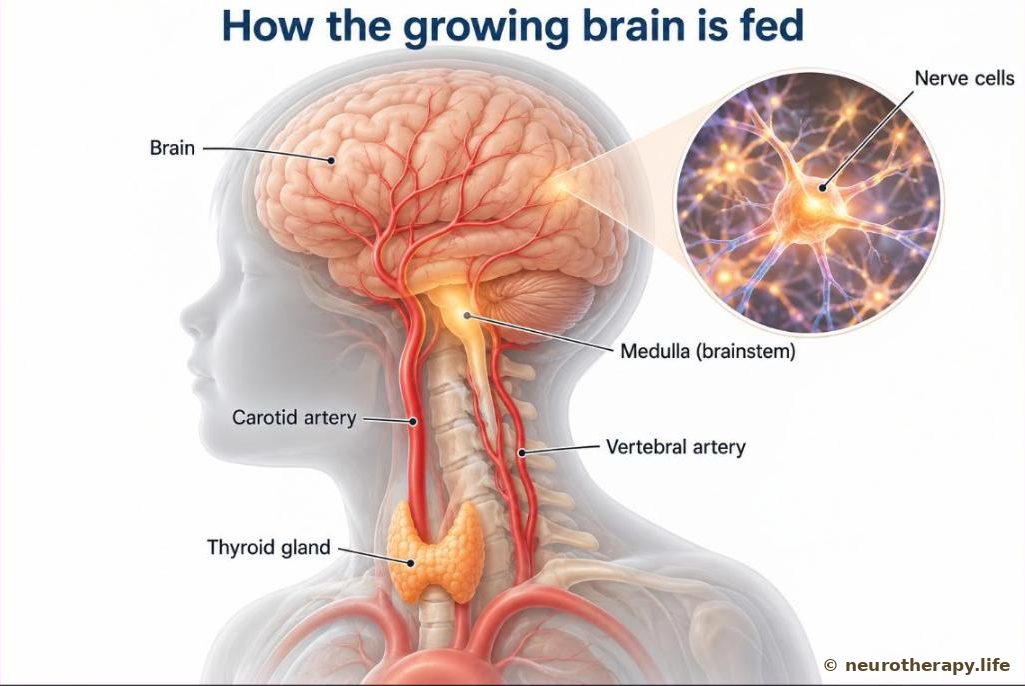
LMNT's work with these children has a story. Guruji first treated them by setting their digestion, and parents came back saying: 'His movements are better. He eats. He walks better. But in his mind there is not much change.' He took that as a failure to learn from, and studied how the brain is supplied with blood. That search led to the Medulla treatment, given on the patch of skin between the ear and the neck.
What LMNT looks at in a slow-learning child
- Birththe cord is left until the baby has cried and the blood in it stops moving, so the brain keeps its oxygen
- Blood to the brainarteries rise through the neck beside the ear — P. and M. Heparin support this flow
- Calciumthe glands, the thyroid among them, need blood calcium to work properly
- Thyroida slow thyroid can hold back the growing brain
- Oxygen and hormonesthe Oxygen-Hormonal treatment works on both together
Guruji reasoned that because a shortage of blood calcium keeps the thyroid from working properly, the 1,25 DCC formula would help in hypothyroidism — and LMNT teaching reports that children with mental slowness from hypothyroidism have benefited from it. This is support for comfort, function and daily ability, given alongside the child's doctor, therapists and school — it does not reverse the condition.
This matter is to be publicised as widely as possible: that the cord should not be cut until the child itself has cried properly for some time.
Neurotherapy (LMNT) treatment for Mental slowness (intellectual disability), step by step
Examine first
The therapist checks Liv° and Mu°, reads the thyroid and other reports, asks about the birth and any past pneumonia, and notes the child's age and whether height treatment is going on.
Blood supply to the brain
P. Heparin, whose uses in LMNT include children of dull intellect, and M. Heparin — the same formula headed by (6) Medulla — named for brain diseases and dullness of intellect.
When the thyroid is low
Where mental slowness comes with hypothyroidism, the 1,25 DCC formula and (4) Thrd are given. Half an hour of gentle morning sun is part of the 1,25 DCC formula.
Oxygen and hormones
The Oxygen-Hormonal treatment is also listed in LMNT for these children, to support oxygen supply and the balance of the glands.
If the child once had pneumonia
For a slow-learning child who had pneumonia, ADK is given.
Points and formulas used
P. Heparin (plasmin)
The parent Heparin formula — written in LMNT to support blood flow; children of dull intellect are on its list of uses.
Works through
Open →M. Heparin (medulla)
The Heparin formula headed by (6) Medulla — named in LMNT for brain diseases, memory and dullness of intellect.
Works through
Open →1,25 DCC (ordinary form)
Supports the body's own chain for keeping calcium in the blood — used where mental slowness comes with hypothyroidism.
Works through
Open →Oxygen-Hormonal treatment
A long, many-part treatment for oxygen supply and the balance of the glands.
Open →Never do this
- Children get half the adult dose and light treatment only, given by a trained therapist.
- Intellectual disability is lifelong. Neurotherapy (LMNT) may support comfort, function and daily ability, with reported improvement, but it does not reverse the condition. Keep the doctor, speech therapy, physiotherapy, special education and school going — never in place of them.
- M. Heparin's (6) Medulla is not given to 13–20-year-olds who are having treatment to increase height, unless there is a special need. (6) Medulla
- Here (4) Para is given only inside the full 1,25 DCC formula — given on its own it lifts calcium out of the bone. Liv is not given in liver cancer, and Ch. Only not in lung cancer. (4) Para
- A newborn who is not breathing needs help to breathe within the first minute — dry, warm, rub the back, and if needed, breathing with a bag and mask. The cord is left alone; the baby is not.
- See a doctor promptly if a child loses skills already learned, has fits, or suddenly becomes much slower or drowsier. Fits
- Cancer: if the person has cancer, (10) Pan, Thymus, Pit, Lu + Sh, Rt. Ov / Lt. Ov and (30) Medulla are never given — the therapist changes the plan.
- Keep taking the medicines your doctor prescribed. Neurotherapy (LMNT) works alongside your medical care, never instead of it.
Watch

Shows the P. Heparin formula: (8) Pan at the top of the thighs, (7) Liv on the thigh and forearm, and (8) Chest Only with the palms on the chest. In the video it is given as the last part of the Angina treatment, to support circulation.

A demo of the M. Heparin formula — the Heparin formula headed by Medulla ((6) Medulla, (8) Pan, (7) Liv, (8) Chest Only) — used for neck and shoulder pain and for headache that keeps coming back.
The P. Heparin and M. Heparin formulas, shown on adults. For a child the therapist gives half the dose, light treatment only.
From Ayurveda and the kitchen
Test yourself
What research says
- Strong evidence
Thyroid hormone is needed for nerve cells to form, connect and be wrapped in their insulating sheath. A baby born with a low thyroid who is not treated in time can be left with lasting learning and movement problems — which is why newborn screening and prompt treatment matter so much. This fits LMNT's attention to the thyroid in these children.
Bowden SA, Goldis M. Congenital Hypothyroidism. StatPearls. 2023.
- Strong evidence
WHO recommends that the cord is not clamped earlier than one minute after birth. The extra blood that flows from the placenta may improve the baby's iron for up to six months — a modern echo of Guruji's rule not to hurry the cord.
No clinical trial of Neurotherapy (LMNT) in intellectual disability has been published yet. Improvements reported by neurotherapists and parents are clinical observations.
For you
Parents
Start early: therapy, special education and daily practice at home make a real difference. Celebrate small steps, and keep every doctor's and therapist's appointment.
Pregnant women
Take no new medicine in pregnancy without asking the doctor looking after you — and never stop one you have already been given without asking the same person. That includes 'natural' remedies bought from a stall.
Birth attendants
Do not rush to cut the cord — but never wait for a silent baby to start breathing on its own. Help the baby breathe at once.
This page explains; it does not diagnose. Neurotherapy (LMNT) works alongside your medical care — keep taking the medicines your doctor prescribed, and see a doctor for any new or severe symptom.