Meningitis
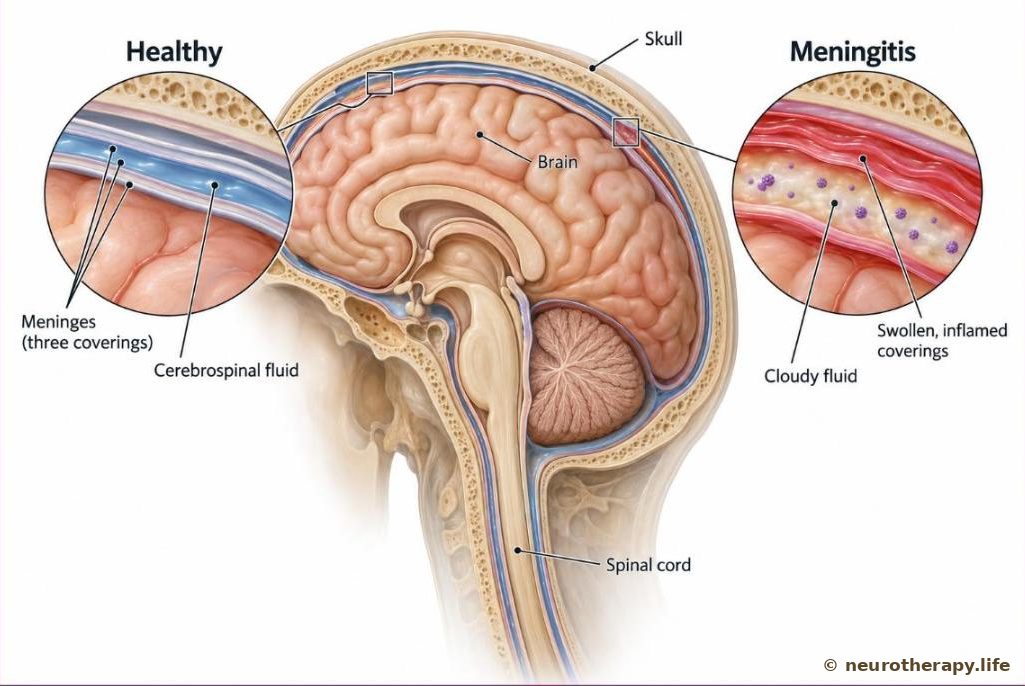
Meningitis is swelling of the thin coverings around the brain and spinal cord, usually from an infection. It can become dangerous within hours — with fever, a stiff neck and a severe headache, call 108/112 and go to hospital now.
- About 1 in 6 people who get bacterial meningitis die of it
- About 1 in 5 are left with serious lasting problems, such as hearing loss or brain damage
- Viral meningitis, the most common kind, usually settles in 7 to 10 days
Source: Cleveland Clinic; NHS; MedlinePlus
What is Meningitis?
The brain and spinal cord are wrapped in three thin layers called the meninges. Between them flows a clear, watery cushion — the cerebrospinal fluid (CSF).
In meningitis, germs — most often a virus, sometimes bacteria, rarely a fungus — reach these layers and they swell. Viral meningitis is usually milder. Bacterial meningitis is rarer but can cause brain damage, hearing loss, stroke or death within hours or days.
What are the symptoms?
- Sudden high fever
- Severe headache that keeps getting worse
- Stiff neck — hard to bend the chin to the chest
- Vomiting, and dislike of bright light
- Confusion, heavy drowsiness, or being hard to wake
- A rash that does not fade when a glass is pressed on it
- In babies: a bulging soft spot on the head, poor feeding, irritability, floppiness
What causes it, and who is more likely to get it?
Germs
- Viruses — the most common cause
- Bacteria — rarer, but the most serious
- Fungi or parasites — rare
Who is at higher risk
- Babies and children under 5, and adults over 65
- Teenagers and young adults, especially living in hostels
- People with weak immunity, or without a spleen
Not an infection
- Autoimmune disease or cancer
- A reaction to some medicines
- Head injury
How is it found?
Meningitis is a hospital diagnosis. Doctors often start treatment before every result is back, because bacterial meningitis moves fast.
Lumbar puncture (spinal tap)
A thin needle in the lower back takes a little of the brain's fluid, which is checked for germs — the key test.
Blood tests
Look for infection and grow the germ to find which one it is.
CT or MRI scan
Pictures of the brain to check for swelling or other problems.
Nose or throat swab
A cotton swab can help find the germ.
A neurotherapist's first job is to recognise the signs and send the person to hospital at once. LMNT help comes later, in recovery, after the doctors' treatment — the therapist asks for the discharge papers, the person's age and blood pressure, and whether a shunt was fitted.
How Neurotherapy (LMNT) sees Meningitis
LMNT links meningitis to the hypothalamus — the small control centre that governs temperature, hunger and thirst. (6) Medulla, the very first Medulla treatment Guruji found, was seen to act on it: temperature below normal could rise, hunger and thirst returned, and patients with brain trouble after meningitis were reported to benefit.
The path of the brain's fluid
- Lateral ventriclesthe fluid is made in these two inner chambers
- Third ventricleits wall is formed by the hypothalamus
- Cerebral aqueducta narrow passage — LMNT's reasoning holds a blockage here can stop the flow
- Fourth ventriclethe fluid passes on towards the brainstem
- Around brain and cordit bathes the brain and spinal cord, then is absorbed
Guruji's reasoning is that in meningitis a blockage can form near the third ventricle, and that (6) Medulla may help open the passage. The therapy itself marks this as reasoning — a “perhaps” — not a measured fact. LMNT support is for recovery after the doctors' treatment, never instead of it.
Wherever there is a question mark, it is an indication that this is my own thinking, on which other people can now do research.
Neurotherapy (LMNT) treatment for Meningitis, step by step
Hospital first
Fever with a stiff neck, severe headache, drowsiness or a rash means 108/112 at once. Meningitis is treated in hospital; Neurotherapy (LMNT) is never first aid for it.
Examine first
In recovery, the therapist checks Liv° and Mu°, reads the discharge papers, and asks the person's age and whether a shunt was fitted.
The M. Heparin formula
(6) Medulla followed by the Heparin sequence. LMNT names it for meningitis — “swelling in the brain because of fever” — and for other brain diseases.
(6) Medulla — the hypothalamus
Six applications on both sides of the neck below the ears, seated, one side at a time — for temperature, hunger and thirst.
Points and formulas used
Never do this
- Meningitis is an emergency. Call emergency services (108/112) immediately. LMNT works best alongside your existing medical care — always call emergency services first. Fever with a stiff neck, a severe headache, confusion, drowsiness, a rash that does not fade under a glass, or a bulging soft spot in a baby: hospital at once.
- LMNT is given only for recovery, after the hospital has treated the infection — never instead of it.
- (6) Medulla is not given to boys and girls of 13 to 20 who come for treatment to increase height, unless there is a special need. (6) Medulla
- If a shunt has been fitted, M. Heparin can be given — but with much less pressure on the neck. M. Heparin (medulla)
- No Heparin treatment at all while a wound is open.
- Children get half the adult dose and light treatment only, given by a trained therapist — and a child with fever who is drowsy, floppy or has a rash goes to hospital first.
- Cancer: if the person has cancer, (10) Pan, Thymus, Pit, Lu + Sh, Rt. Ov / Lt. Ov and (30) Medulla are never given — the therapist changes the plan.
- Keep taking the medicines your doctor prescribed, and finish every course of antibiotics. Neurotherapy (LMNT) works alongside your medical care, never instead of it.
Watch

A demo of the M. Heparin formula — the Heparin formula headed by Medulla ((6) Medulla, (8) Pan, (7) Liv, (8) Chest Only) — used for neck and shoulder pain and for headache that keeps coming back.
The M. Heparin formula — for recovery after hospital treatment, never as first aid.
From Ayurveda and the kitchen
Test yourself
What research says
- Strong evidence
In bacterial meningitis, the body's own inflammatory chemicals build up around the brain, damage the blood–brain barrier, and cause swelling and poor blood supply that injure the brain.
- Strong evidence
The brain's fluid flows from the lateral ventricles into the third ventricle, through the cerebral aqueduct into the fourth — the same path LMNT's reasoning about (6) Medulla describes. A blocked aqueduct makes fluid collect.
Margetis K, Baker S. Physiology, Cerebral Spinal Fluid. StatPearls. 2025.
No clinical trial of Neurotherapy (LMNT) in meningitis has been published yet. Improvements reported by neurotherapists are clinical observations.
For you
Parents of babies and small children
Babies may not show a stiff neck. A bulging soft spot, poor feeding, unusual crying or floppiness with fever means hospital at once. Keep your child's vaccines up to date.
Teenagers and students
Living close together in hostels raises the risk. Ask your doctor about meningitis vaccines, and never sleep off a fever with a stiff neck.
After meningitis
Get your hearing checked and keep every follow-up. Tell your therapist about the hospital stay and any shunt before LMNT support begins.
This page explains; it does not diagnose. Neurotherapy (LMNT) works alongside your medical care — keep taking the medicines your doctor prescribed, and see a doctor for any new or severe symptom.