Also called: ADK sequence, ADK treatment, Angiotensin–Dopamine–Kidney
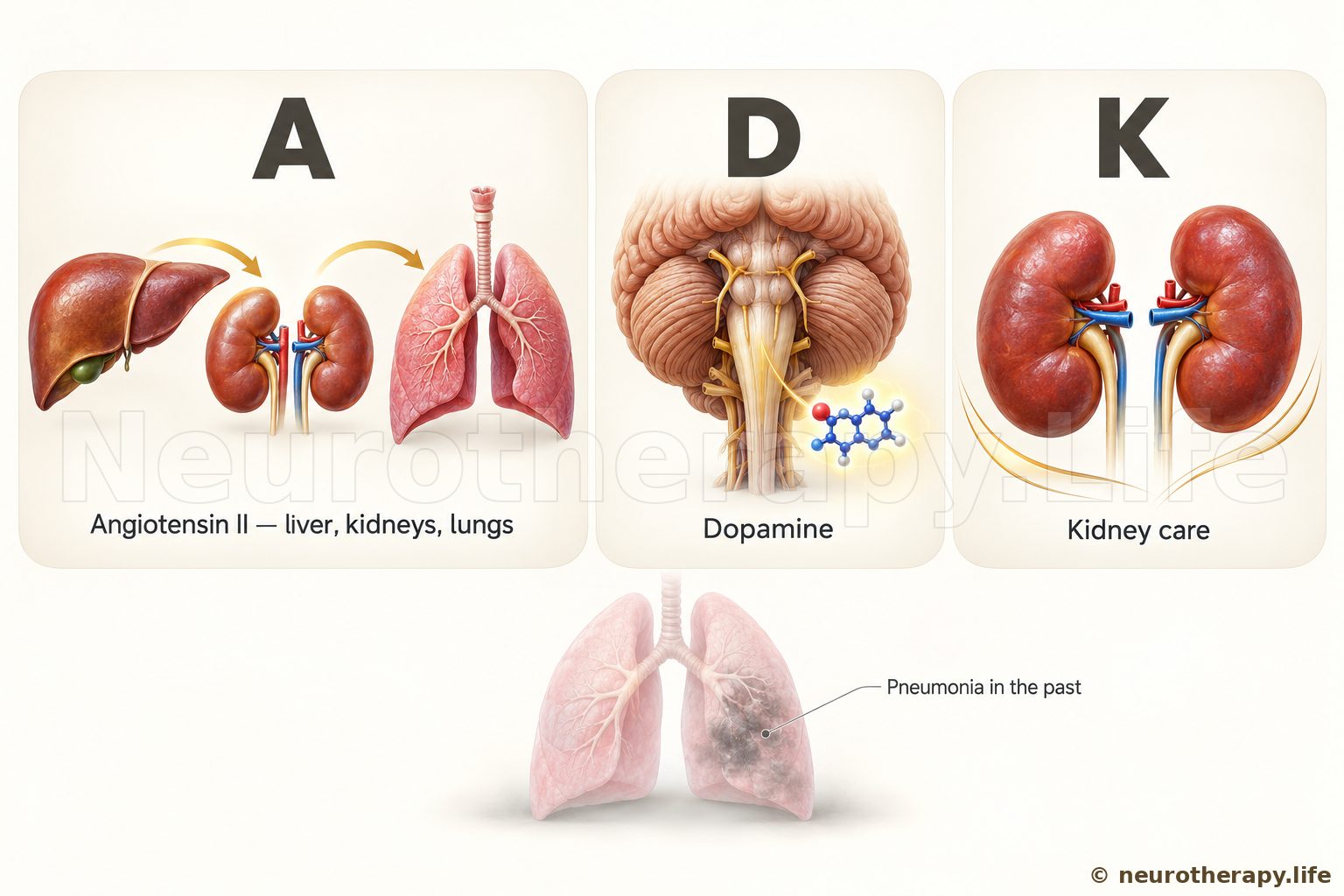
ADK is a three-part Neurotherapy (LMNT) sequence for a person who had pneumonia in childhood — or whose mother had it in pregnancy — and who comes years later with any complaint at all. Its letters are its memory aid: A for the Angiotensin No. 2 formula, D for dopamine through (20) Medulla, K for the Kidney Clear treatment.
Overview
What is the ADK sequence?
The idea began in hospitals. For a severe double pneumonia, doctors give two medicines to hold up the blood pressure: dopamine and angiotensin II. LMNT already had a treatment believed to rouse each of them — (20) Medulla for dopamine, and the Angiotensin No. 2 formula, built on the liver, kidneys and lungs that make angiotensin II.
LMNT teaching also observes that pneumonia leaves a mark on the kidneys. So a third part was added: the Kidney Clear treatment, in the strength that suits the patient's body on that day.
The three parts together became ADK. It is used for people who once had pneumonia, even when they come for something quite different — and for children whose mother had pneumonia during or just before pregnancy, on the reasoning that what the mother lacked, the child may lack too.
ADK in one picture: A for angiotensin, D for dopamine, K for the kidneys.
What it is for
What is ADK used for?
For a person who had pneumonia in childhood and comes many years later — for any complaint at all.
For children with slow mental development who had pneumonia in childhood, alongside their other treatments — parents have reported a clear difference.
For a child whose mother had pneumonia during the pregnancy or a few days before it.
Points it works through
Which points and treatments does ADK work through?
I Angiotensin #2 · II (20) Medulla for dopamine · III the Kidney clear treatment
ADK is made of three treatments. The points are listed here as a set, with what each contributes. The exact method, and how the Kidney Clear strength is chosen, are taught hands-on in the Neurotherapy (LMNT) course. This page lists the points of the formula and what each one contributes; it does not describe how any point is given. For the method, watch the demonstration video of each point on its own page and learn hands-on from a trained Neurotherapist. Please do not give a formula from a written description alone.
The right kidney point, one of the points of the Kidney Clear part.
Position:Lying on the back (supine) for the Angiotensin No. 2 part, seated for (20) Medulla, and supine and face down (prone) for Kidney Clear.
The exact technique is taught hands-on in the Neurotherapy (LMNT) course. See the course →
How it works
How does ADK work?
Angiotensin II is a hormone that tightens blood vessels and holds salt and water, so blood pressure rises. The body makes it in a chain that runs through the liver, the kidneys and the lungs. The Angiotensin No. 2 formula rouses those three organs; LMNT teaching named it after it was seen to bring a low blood pressure back up.
Dopamine is a chemical messenger. LMNT teaching reasons that (20) Medulla rouses it, because the same treatment eased the hand tremor of Parkinson's patients and lowered a raised prolactin — two things linked with dopamine. The therapy says honestly that the hospitals it asked could not test dopamine, so the link rests on these observations.
The Kidney Clear part looks after the kidneys, on which pneumonia is believed to leave its effect. Its strength is chosen by the condition of the body that day — milder for a frail or very chronic patient.
Its family
Which formulas are related to ADK?
ADK belongs to the water-and-salt family and is built from three of its members.
Angiotensin No. 2 — The A of ADK — for a blood pressure that has suddenly fallen after blood loss, and for double pneumonia.
Kidney Clear — The K of ADK, given in the strength that suits the day.
Mild Kidney Clear — The milder Kidney Clear, for a frail or very chronic patient.
Vasopressin formula — For a blood pressure that has been low for years — a different picture from the sudden fall.
Lu + Sh is not given in high blood pressure or heart disease, and (20) Medulla is blocked in heart disorders and high blood pressure — so ADK is not given to these patients without a senior teacher's advice. High blood pressure
The kidney points are never roused in kidney failure or kidney cancer; Chest Only is not given in lung cancer. Kidney disease
Pneumonia now — fever, fast breathing, falling blood pressure — is a hospital emergency. Call 108 / 112. Neurotherapy (LMNT) works alongside medical care, never instead of it. Pneumonia
“And I do not hide this from my students — as soon as any good results are obtained, I tell all those who are in contact with me at once.”
— Dr. Lajpatrai Mehra
Common questions
I had pneumonia as a child. Why does that matter now?
LMNT teaching holds that pneumonia can leave a lasting effect, including on the kidneys, and has found ADK helpful for such people even when they come for something else. Your therapist will ask about it as part of your history.
Why treat a child for the mother's pneumonia?
The reasoning is that while a child is in the womb, whatever the mother lacks, the child lacks too. If the mother had pneumonia in pregnancy, the same shortfall may have reached the child.
Does ADK put dopamine or angiotensin into the body?
No. Nothing is injected. The names describe what the treatments are believed to rouse in the body's own organs. LMNT teaching itself marks some of these links as still to be tested.
Can ADK help kidney patients?
LMNT teaching leaves this as an open question to be tested — for example, whether it lowers creatinine in kidney patients without high blood pressure. It is not claimed.
Surprising facts
1A hormone finished in the lungs
Angiotensin II is made in steps: the liver makes the raw protein, the kidneys release renin, and an enzyme called ACE, plentiful in the lungs' small vessels, finishes the job.
Source: Guyton & Hall, Medical Physiology, 14th ed. — the renin–angiotensin system.
2Your kidneys filter a lot
The two kidneys filter about 180 litres of fluid a day, yet you pass only about one and a half litres of urine — the rest is taken back.
Dopamine is a brain messenger for movement and reward, and it also holds back the hormone prolactin. That is why low dopamine is linked with Parkinson's tremor and with raised prolactin.
Source: Guyton & Hall, Medical Physiology, 14th ed. — basal ganglia and prolactin regulation.
Test yourself
Research
Strong evidence
This large hospital trial (about the hormone itself, not about Neurotherapy (LMNT)) showed that giving angiotensin II raised blood pressure in patients in shock whose pressure had not responded to other medicines — the same hospital use that started the idea behind ADK.
This page explains what a Neurotherapy (LMNT) treatment is for; it is not a self-treatment guide and does not diagnose. Neurotherapy (LMNT) works alongside your medical care — keep taking the medicines your doctor prescribed.
Ready to begin?
Send COURSE for course details, or your name, age and health issue for a consultation.