Also called: Kidney Clear grade I, Mild Kidney Clear formula
Mild Kidney Clear is the first and lightest step of Neurotherapy (LMNT)'s Kidney Clear formula, which rouses both kidneys and then balances acid and alkali. It is the grade to begin with in a frail, elderly or long-ill patient, and it is also a stage of the light Jeevan Dhara.
Overview
What is Mild Kidney Clear?
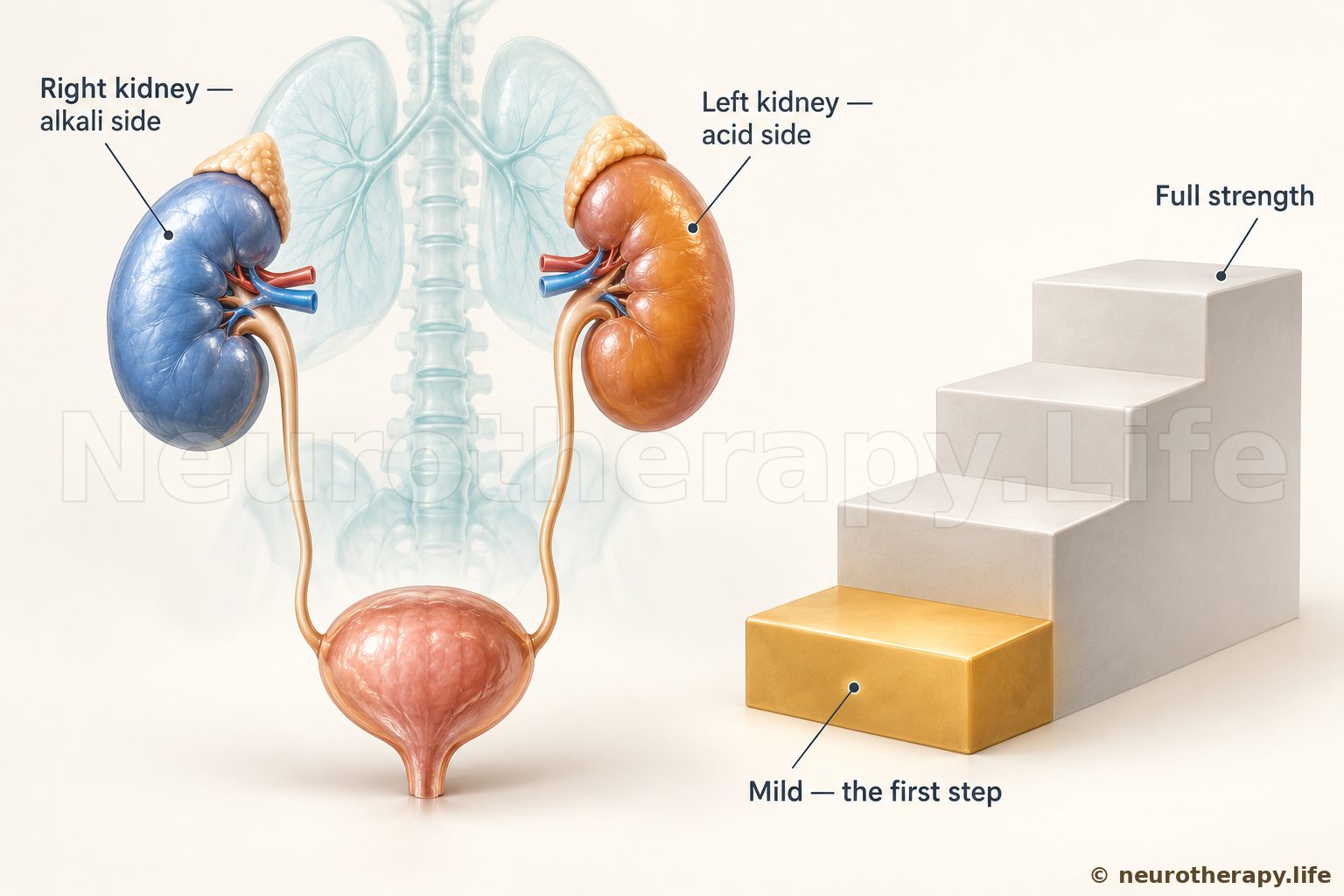
The Kidney Clear formula is Neurotherapy (LMNT)'s formula for rousing the kidneys. It was once given in one heavy form. Later it was rebuilt as a staircase of four graded steps, and the top step is exactly the old heavy form.
Mild Kidney Clear is the bottom step. It has the same four steps in the same shape as the top one, with nothing dropped — only much lighter. The grade is chosen by the patient's condition on that day.
The reasoning is Guruji's light-treatment rule: a gland that is already weak should first be roused less, so that it slowly begins to work. A long-ill patient starts here and climbs as the body allows.
Mild Kidney Clear is the first step of a four-step staircase. It rouses both kidneys, then balances acid and alkali.
What it is for
What is Mild Kidney Clear used for?
To begin the Kidney Clear treatment gently in a frail, elderly or severely chronic patient.
As a stage of the light Jeevan Dhara, given for abdominal pain without loose motions and for tiredness at any age.
For the Kidney Clear patient: a complaint such as low back pain, a left kidney stone, ringworm, itching, allergy, psoriasis or dry skin disease, together with a finding on the acid side.
Points it works through
Which points does Mild Kidney Clear work through?
(1) Liv° (1) Mu° (2) Ch. Only (5) ↑°↓
Four points: the two kidney codes beside the navel, then the balancing pair. They are listed here as a set. The exact method is taught hands-on in the Neurotherapy (LMNT) course. This page lists the points of the formula and what each one contributes; it does not describe how any point is given. For the method, watch the demonstration video of each point on its own page and learn hands-on from a trained Neurotherapist. Please do not give a formula from a written description alone.
The Round Arrow along the spine — the second half of the balancing pair.
Position:Lying on the back for the kidney points and Chest Only, then face down for the Round Arrow.
The exact technique is taught hands-on in the Neurotherapy (LMNT) course. See the course →
How it works
Why does a kidney formula need the balancing pair?
In Neurotherapy (LMNT) the right kidney point, Liv°, is linked with alkali, and the left, Mu°, with acid. Rousing the two alone could trouble some patients, so the formula closes with Chest Only and the Round Arrow to keep acid and alkali in balance.
At every step of the staircase the balancing pair keeps the same proportion. A smaller formula is still a balanced one, because balance is a ratio, not a quantity.
Choosing it needs two keys: a complaint from one list and a finding from the other — such as hard stools, more pain at Mu° than Liv°, periods lasting four days or more, pain in the left ring finger, or blood pressure normal to low.
Its family
Which formulas are related?
Mild Kidney Clear is one rung of a ladder, with a reversed twin and a place in the light Jeevan Dhara.
Kidney Clear — The full Kidney Clear formula, given at four grades; Mild Kidney Clear is its first grade.
Ulta Kidney Clear — The reversed twin, for the alkali side — more pain at Liv°, a right kidney stone or loose motions.
Liv° and Mu° are not roused in kidney failure or kidney cancer. Kidney disease
Mu° is not given to those who have pain only at Liv°. The kidney points are examined on the day before the formula is chosen. Mu°
Chest Only is not given in lung cancer. In chronic illness, the Round Arrow is kept to the lower back only (L1–L5). Round Arrow
When a stone is painful, Neurotherapy (LMNT) swaps the balancing pair for Thymus + Chest. Thymus is not given in pregnancy, inflammatory disease, heart disease, diabetes, RA, autoimmune disease or kidney disease — so the swap is not always allowed. Th + Ch
Severe loin pain, fever with back pain, blood in the urine, vomiting, or passing very little urine need a doctor the same day. How to tell a patient to see a doctor
Keep taking the medicines your doctor prescribed for the kidneys, skin or blood pressure. Neurotherapy (LMNT) works alongside medical care, never instead of it.
A teaching case
Teaching case: starting low with long-standing skin disease
A woman with years of psoriasis, low back pain and a small left kidney stone had hard stools, more pain at Mu° than Liv°, and low-normal blood pressure. Because her illness was long-standing, she was begun on Mild Kidney Clear rather than the full formula. The grade was raised step by step over the following weeks, while her doctor's care continued.
A composite case written to teach the reasoning — not one patient’s file.
Common questions
Why not just give the full Kidney Clear formula?
In a weak or long-ill body, a gland is first roused gently so it begins to work; heavier work can follow if needed. The grade is set by the patient's condition each day.
Is this the same as the Kidney Clear in Jeevan Dhara?
Yes. The light Jeevan Dhara includes Mild Kidney Clear as a named stage.
Can it dissolve my kidney stone?
Neurotherapy (LMNT) does not claim that. Stones need a doctor's assessment. Mild Kidney Clear is given alongside that care to support the kidneys and the acid–alkali balance.
Surprising facts
1Your kidneys filter a bathtub a day
About 180 litres of fluid from the blood pass through the kidneys' filters every day. Only one or two litres leave as urine; the rest — all the sugar and almost all the water and salt — is taken back.
Source: Guyton and Hall Textbook of Medical Physiology, 14th ed., glomerular filtration (about 180 L/day).
2Kidneys make new buffer
Besides taking back filtered bicarbonate, the kidneys make new bicarbonate as they pass acid into the urine — the body's slow but powerful acid control.
Source: Hamm LL, Nakhoul N, Hering-Smith KS. Acid-Base Homeostasis. Clin J Am Soc Nephrol. 2015;10(12):2232–2242.
3Each kidney holds about a million filters
A typical kidney has roughly one million nephrons, though the number varies widely between people.
Source: Bertram JF, Douglas-Denton RN, Diouf B, Hughson MD, Hoy WE. Human nephron number: implications for health and disease. Pediatr Nephrol. 2011;26(9):1529–1533.
Test yourself
Research
Strong evidence
This review explains how the kidneys keep the body's acid level steady by taking back filtered bicarbonate, making new bicarbonate and passing acid into the urine — the organ work this formula aims to support.
This page explains what a Neurotherapy (LMNT) treatment is for; it is not a self-treatment guide and does not diagnose. Neurotherapy (LMNT) works alongside your medical care — keep taking the medicines your doctor prescribed.
Ready to begin?
Send COURSE for course details, or your name, age and health issue for a consultation.