The Angiotensin No. 2 formula: for blood pressure that falls after blood loss
The Angiotensin No. 2 formula is used when blood pressure falls suddenly because about half a litre of blood or more has been lost, as after heavy periods, an injury or an operation. It follows the body's own pressure-raising chain through the liver, the left kidney and the lungs.
Overview
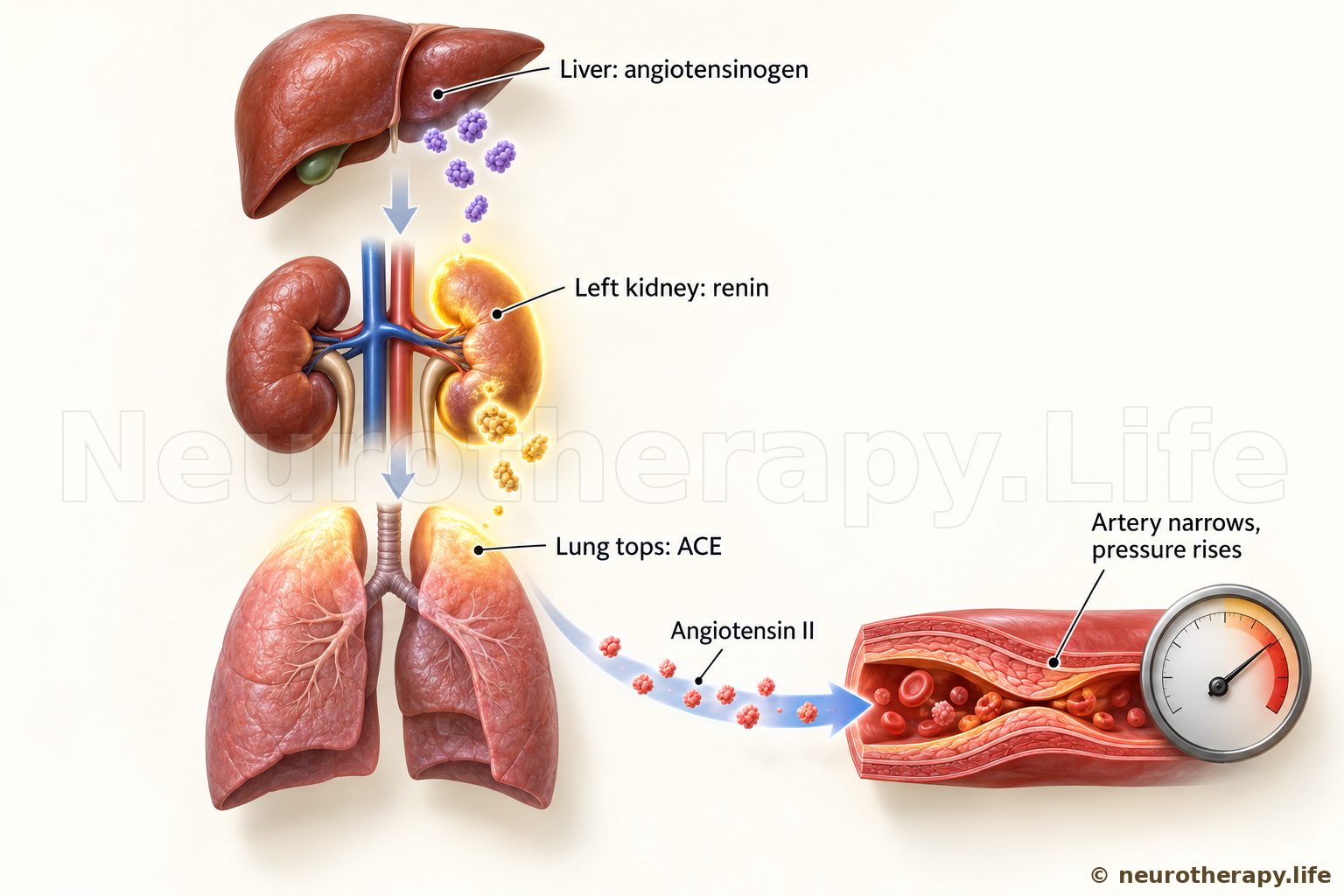
When blood pressure falls, the kidneys cannot filter properly. They answer by releasing renin, which turns a liver protein, angiotensinogen, into angiotensin 1. In the lungs an enzyme called ACE turns that into angiotensin 2, a powerful chemical that narrows the arteries and makes the kidneys hold back salt and water. Blood volume rises, and the pressure with it. This is the renin–angiotensin system.
The formula follows the same chain through Liv, for the liver protein and its stored blood; Mu°, the left kidney point; and Lu+Sh, which reaches the tops of the lungs where ACE is made. It is used for a woman who feels giddy for days after heavy periods, and after an accident, miscarriage or operation. The giddiness comes on with work, not lying down, and may bring shivering, clenched teeth and difficulty speaking.
The therapy explains why it does not overshoot. As blood volume is rebuilt, the signal that calls for angiotensin fades, much as a thermostat switches off once the room is warm. A low pressure of many years is a different story and has a different formula, the Vasopressin formula. The exact method is taught hands-on in the Neurotherapy (LMNT) course.
Key points
- It is for a sudden fall in pressure after blood loss.
- It follows the body's own chain: liver, left kidney, lungs.
- Giddiness on working but not on lying down is a key sign.
- Low pressure of many years needs the Vasopressin formula instead.
- As blood volume returns, the signal fades and the pressure settles.
Go deeper
Angiotensin No. 2
The Angiotensin No. 2 formula page
Vasopressin formula
The Vasopressin formula for long-standing low pressure
ADK
ADK, for those who once had pneumonia
Lu + Sh
Lu+Sh and the tops of the lungs
Low blood pressure
Low blood pressure
Vertigo and giddiness
Giddiness and vertigo
Kidneys
The kidneys and renin
Water and Salt: Kidney, Blood Pressure and Fluid Formulas
The full guide to water, salt and balance
Read the full guide
This topic is part of: Water and Salt: Kidney, Blood Pressure and Fluid Formulas
Safety: when it is held back
- Lu+Sh raises blood pressure, so it is not given in high blood pressure or heart disease, and it is never given in cancer. Lu + Sh
- Mu° is not given in kidney failure or kidney cancer, and Liv is not given in liver cancer. Mu°
- The Vasopressin formula is not used for a sudden fall after blood loss, and (2) Para is not given in high blood pressure. (2) Para
- Bleeding that is still going on belongs in a hospital, not on a therapy mat. Very heavy periods over years need a gynaecologist and a scan to find the cause. Period problems (irregular, heavy or painful)
- Neurotherapy (LMNT) works alongside your medical care. Do not stop or change any blood pressure medicine on your own; ask the doctor who prescribed it.
Watch

A demonstration of the Angiotensin No. 2 formula — (7) Liv, (7) Mu° and (6) Lu + Sh — for low blood pressure that comes on suddenly after very heavy bleeding in a period.
The video suggests using the formula at the moment of fainting. In LMNT teaching, a person who is still bleeding, cold, pale or fainting is taken to hospital first; this formula is for after the bleeding has been stopped. Lu + Sh is not given in cancer.

This video explains the Para point and how (2) Para differs from (4) Para, in relation to low calcium, bone pain and blood pressure.
This page explains what a Neurotherapy (LMNT) treatment is for; it is not a self-treatment guide and does not diagnose. Neurotherapy (LMNT) works alongside your medical care — keep taking the medicines your doctor prescribed.