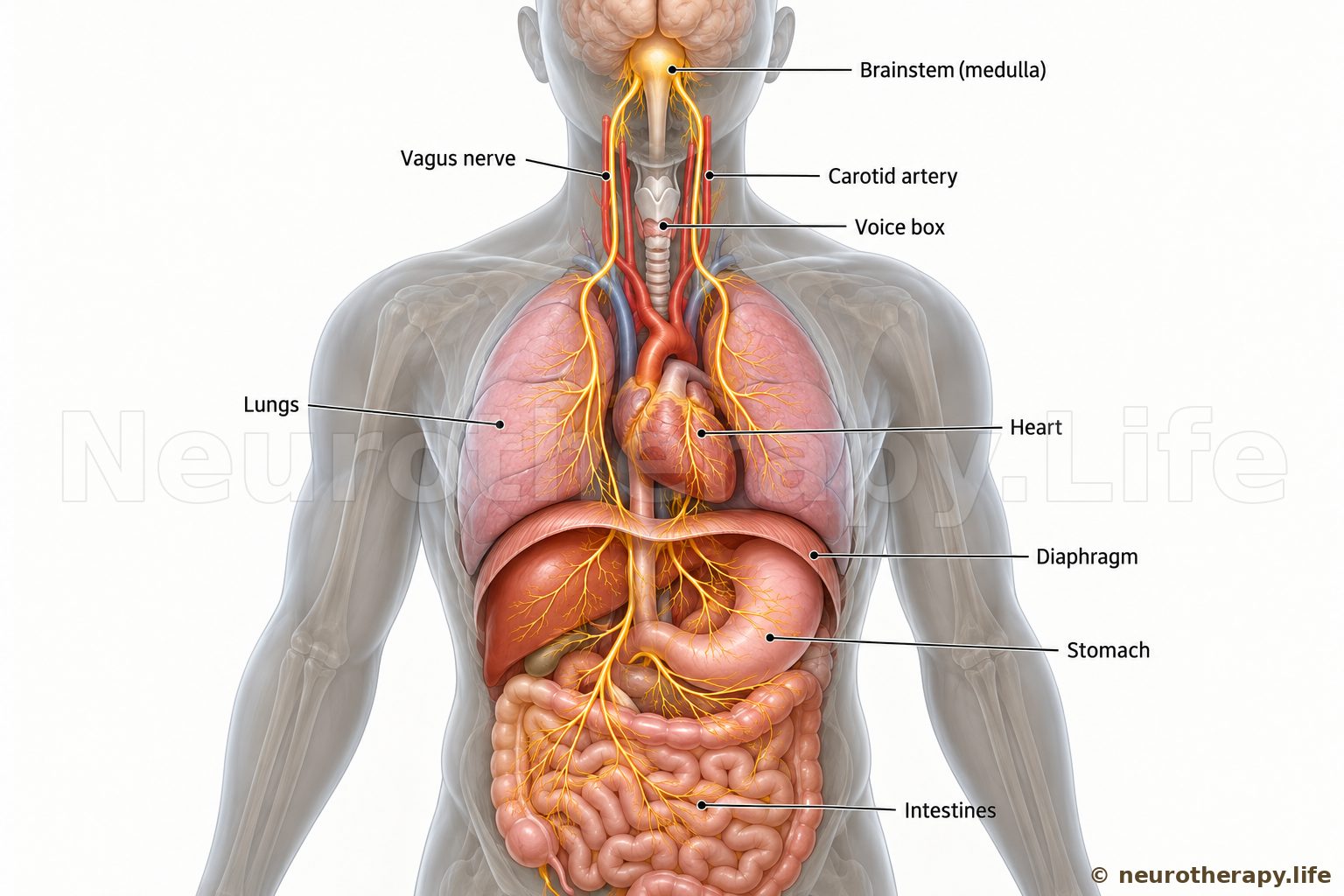
The tenth cranial nerve and the longest of the twelve. Its name means 'wanderer': it runs from the brainstem through the neck and chest into the belly, slowing the heart, running the voice box and switching digestion on — and it spends most of its time listening to your organs.
Overview
What is the vagus nerve?
The vagus nerve is the tenth of the twelve pairs of cranial nerves — the nerves that leave the brain directly. There is a left vagus and a right vagus.
It starts in the medulla, leaves the skull just behind the ear, runs down the neck beside the great artery to the brain, passes through the chest past the heart and lungs, and goes through the diaphragm into the belly.
It is the main nerve of the 'rest-and-digest' system: it slows the heart, narrows the airways a little, and tells the stomach and gut to make juices and move food along. It also runs the muscles of the throat and voice box.
In LMNT, (10) Medulla is the vagus treatment. It stands at the head of many of the therapy's digestive formulas, and it carries some of its strictest rules.
The wanderer: from the brainstem, past the voice box, heart and lungs, down to the gut.
Function
What does the vagus nerve do?
Think of a two-way telephone line between the brain and the organs of the chest and belly. Most of the time the brain is listening — about four in five of the vagus nerve's fibres carry reports up. The rest carry calm, steady orders down.
A brake on the heart: it keeps the resting heartbeat slower than the heart's own natural pace.
The voice and the swallow: it moves the muscles of the throat and the vocal cords.
The airways: it adjusts the width of the air tubes and the mucus in them, and triggers coughing.
Digestion: it stirs stomach acid and juices, gut movement, the pancreas and the gall bladder — as far as the middle of the large bowel, about two-thirds of the way across the part that crosses the belly.
Reports from inside: it tells the brain when the stomach is full or upset, and carries signals from pressure and stretch sensors in the chest.
Calming inflammation: research shows vagus signals can help damp down the body's inflammation.
A patch of the ear: a small branch supplies part of the ear canal.
How does the vagus nerve work with other organs?
Medulla (brainstem) — Its home in the brainstem, where the heart, breathing and swallowing centres give it orders.
Heart — It slows the heart's pacemaker and is why your pulse is slower at rest.
Lungs — It narrows the airways a little, adds mucus, and carries the cough reflex.
Stomach — It orders acid and pepsin and churning; this is the part LMNT's (10) Medulla is aimed at.
Intestines — It drives the waves that move food along the small bowel and much of the large bowel.
Pancreas — It prompts the pancreas to release digestive juice and some insulin as a meal begins.
Gall bladder — It helps the gall bladder squeeze bile into the gut.
Bowel — Beyond the middle of the large bowel, nerves from the lowest part of the spine (S2–S4) take over.
Anatomy
What are the parts of the vagus nerve?
It is easiest to follow the nerve on its journey, from its roots in the brainstem to its last branches in the gut.
Roots and exit from the skull
Nuclei in the medulla — Three groups of cells: one for the throat and voice muscles, one for the calming signals to organs, and one that receives reports from the organs and taste from the throat.
Exit behind the ear — It leaves the skull through a hole at its base, the jugular foramen, together with nerves IX and XI.
Two sensory ganglia — Small swellings just below the skull hold the cell bodies of the fibres that carry reports up.
In the neck
Inside the neck sheath — It runs down in a tube of tissue with the carotid artery and the jugular vein, between and behind them.
Throat branches — Supply the muscles that squeeze food down and lift the soft palate.
Laryngeal nerves — Two branches to the voice box. One of them, the recurrent laryngeal nerve, loops down into the chest and climbs back up to move the vocal cords.
Ear branch — A tiny branch to part of the ear canal and the back of the ear.
In the chest
Heart branches — Join a network at the base of the heart and reach its natural pacemaker.
Lung branches — Run into the lungs along the air tubes.
Around the food pipe — The left and right nerves form a web around the food pipe, then gather into a front and a back trunk.
In the belly
Through the diaphragm — The two trunks pass through the diaphragm alongside the food pipe.
Stomach branches — Spread over the front and back of the stomach to drive acid and churning.
Liver and gut branches — Reach the liver, gall bladder and pancreas, the whole small bowel, and the large bowel as far as about two-thirds of the way across its crossing part (the transverse colon).
Where is the vagus nerve located?
Place two fingers on the side of your neck where you feel the pulse of the carotid artery. The vagus nerve lies deep beside that artery, on both sides of the neck, well protected by muscle.
Lower down it lies behind the lungs, beside the heart and the food pipe, then passes into the upper belly behind and in front of the stomach.
LMNT's (10) Medulla is given on the skin behind the ears and down the sides of the neck. Like every Medulla treatment, it is named for its aim; it does not press on the nerve.
In the neck it is a firm, pale, whitish cord a few millimetres across, running straight down beside the artery.
In the chest it breaks up into fine threads that weave a net around the food pipe, heart and lungs, and in the belly it spreads like the roots of a plant over the stomach and gut.
How big is the vagus nerve?
It is the longest cranial nerve, running from the base of the skull into the abdomen. The left voice-box branch alone travels down into the chest and back up again.
It is not thick — only a few millimetres across in the neck — but it carries a great many fibres, about four in five of them carrying messages up to the brain.
Conditions and disorders
What conditions involve the vagus nerve?
Because the vagus touches so many organs, it plays a part in fainting, heart rate, voice, swallowing, cough and digestion. Some problems come from the nerve being over-active, others from it being damaged.
Heart, pressure and fainting
Low blood pressureA sudden surge of vagus activity can drop pulse and pressure together — the common faint.
High blood pressurePressure sensors report to the brainstem through the vagus and IX, which adjust pressure beat by beat.
Voice, swallowing and breathing
Sore throat and hoarsenessHoarseness can come from the voice box itself or from the vagus branch that moves the cords.
Fainting at the sight of blood, in heat, or after standing for long
A very slow or a racing heartbeat
A hoarse or weak voice that does not go away
Trouble swallowing, or choking on drinks
Hiccups that go on for days
Feeling full after a few bites, bloating, or vomiting food eaten hours before
A long-standing cough with no chest cause found
How do doctors check the vagus nerve?
Throat and voice check — The doctor watches the soft palate rise when you say 'aah', tests the gag reflex and listens to the voice.
Laryngoscopy — A thin camera shows whether both vocal cords move.
Pulse, ECG and heart monitoring — Show a slow heart or pauses, and a 24-hour monitor can catch them.
Tilt-table test — Records pulse and pressure while you are tilted upright, to study fainting.
Heart-rate variability tests — Measure how the pulse changes with deep breathing — a simple test of the vagus brake.
Stomach-emptying study — Tracks how quickly a test meal leaves the stomach.
How are vagus nerve problems treated?
Care for common fainting — Knowing the warning signs, lying down with legs raised, enough fluids, and simple leg- and hand-tensing manoeuvres.
Treating the cause — Controlling diabetes, and treating anything pressing on the nerve in the neck or chest.
Voice therapy and procedures — For a weak vocal cord: exercises, injections or surgery to help the cords meet.
Diet and medicines for slow stomach — Small, frequent, low-fat meals and medicines that help the stomach empty.
Vagus nerve stimulation — An implanted device for some cases of epilepsy and depression, prescribed by specialists.
Pacemaker — Rarely, for a heart that slows or pauses too much.
Neurotherapy (LMNT)
In LMNT, (10) Medulla is the vagus treatment: ten counted strokes on each side, behind the ears and down the neck. It is given to stimulate the vagus, which, in the teaching, stimulates all the glands of the abdomen; LMNT teaching says the stomach's acid increases three times. This is behind one of the therapy's firmest claims: undigested food in the stool comes not from poor chewing but from low stomach acid. In the undigested-food formulas, (10) Medulla and Gas Only go together as a compulsory pair. One exception is written with it: (10) Medulla has no effect on the descending colon, where the S4, S5 treatment is used instead — which matches the anatomy, since the vagus reaches only as far as the middle of the large bowel. Guruji also used it as the 'supervisor' of digestion: when the working organs did not respond, he stimulated the nerve that gives them their orders.
Points
(10) Medulla — The vagus treatment: all the glands of the abdomen; the stomach's acid is said to rise three times. Also for a hoarse voice and a voice without sweetness; certain rows are (10) Left Medulla only.
(15) Medulla — Acetylcholine — the vagus nerve's own messenger at the organs. It opens OLD UDF and is given before any cranial-nerve Medulla.
Gas Only — Its compulsory partner in the undigested-food formulas: Gas Only raises the stomach's blood supply while (10) Medulla rouses the digestive system.
(2) S4 – S5 — Used for the descending colon, the stretch of bowel the vagus does not reach.
Medulla — The base technique: seated, thumbs behind the ears, downward counted strokes on each side; 'Left Medulla' means that side only.
“The coming of UDF is itself a chief cause of the coming of the great diseases.”
— Dr. Lajpatrai Mehra
“In the detailed knowledge of the functions of (6) Medulla and (10) Medulla, some further discovery remains to be made.”
— Guruji's teaching
“In this therapy we do not treat the disease; rather, we improve the body.”
— Dr. Lajpatrai Mehra
Never do this
Emergency: fainting with chest pain, palpitations or breathlessness, fainting during exercise, or a faint that leaves an injury needs urgent medical care (108/112). A hoarse voice lasting more than three weeks needs a doctor's check.
(10) Medulla is not given when stomach acid is raised, in diabetes, or in cancer. In heart disease, (10) Medulla on both sides is barred — only (10) Left Medulla is given, because the vagus slows the heart. These bars travel with every formula that contains (10) Medulla: the undigested-food formulas, X. Heparin, FAN, Chole, Vater, CCK Normal and Formula No. 4. (10) Medulla
(10) Medulla is also blocked in constipation and in piles, fissure and fistula. Constipation
For a narrowed food pipe, or to widen the voice box, the teaching gives (10) Left Medulla only — the side is part of the treatment. (10) Medulla
No pressure on the front of the neck. Pressing hard over the carotid pulse can slow the heart sharply and cause a faint. The Medulla strokes are a light glide behind the ear and down the side of the neck, never a thrust. Neck
If a person feels faint, sweaty or pale during treatment, stop, lie them down and raise the legs. Seated treatments may be given lying down to anyone very ill or weak. Medulla
Keep taking the medicines your doctor prescribed, exactly as told. Neurotherapy (LMNT) works alongside your medical care, never instead of it.
Care
How can I keep my vagus nerve healthy?
There is a lot of hype about 'hacking' the vagus nerve. The plain habits below are the ones with good reasons behind them.
Breathe out slowly
A few minutes of slow breathing with a longer out-breath lets the vagus brake the heart a little more.
Keep active
Regular aerobic exercise is linked with a slower resting pulse and stronger vagal tone.
Eat calmly
Sit down, slow down and chew; the 'rest-and-digest' side works best when you are not rushed.
Stand up slowly
If you tend to faint, sit on the edge of the bed for a moment before standing, and drink enough water.
Control blood sugar
Good diabetes control protects the vagus and other automatic nerves.
Sleep well and limit alcohol
Both poor sleep and heavy drinking weaken the calming side of the nervous system.
Common questions
What does 'vagal tone' mean?
It describes how strongly the vagus is braking the heart at rest. It is usually measured through the small, natural rise and fall of the pulse with each breath. Fitness and slow breathing tend to raise it; long illness and stress tend to lower it.
Why do some people faint at the sight of blood?
A strong emotional trigger can set off a sudden burst of vagus activity: the pulse slows and blood vessels relax, so blood pressure drops and the brain is briefly short of blood. Lying down with the legs raised brings it back.
Can I stimulate my own vagus nerve?
Slow breathing with a long out-breath is a safe, well-studied way to engage it. Implanted stimulators are medical devices for specific conditions, used by specialists. Be wary of gadgets and claims that promise to cure everything through the vagus.
Why do I sometimes cough when I clean my ear?
A small branch of the vagus supplies part of the ear canal. In some people, touching it sets off the cough reflex through the same nerve.
Why does LMNT say (10) Medulla does not reach the descending colon?
Because the vagus nerve supplies the large bowel only as far as about two-thirds of the way across its crossing part. Beyond that, nerves from the lowest part of the spine take over — which is why LMNT uses (2) S4, S5 for that last stretch.
Is it safe to have (10) Medulla if I have diabetes or a heart condition?
In diabetes LMNT does not give (10) Medulla at all. In heart disease only (10) Left Medulla is given. Tell your therapist about every condition and medicine before treatment starts.
What should I ask my doctor or therapist?
Are my fainting spells the common vagus type, or do I need heart tests?
Could my slow stomach or bloating be linked to nerve damage from diabetes?
My voice has been hoarse for weeks — do I need my vocal cords checked?
Which of my medicines can slow my pulse?
(To your therapist) Is (10) Medulla on my card, and is it barred for me because of sugar, acidity, constipation or my heart?
(To your therapist) Should my treatment start with the digestion?
Surprising facts
1The wanderer that knows where to stop
Vagus is Latin for 'wandering'. The nerve roams from the skull to the heart, lungs, stomach and intestines — then stops about two-thirds of the way across the large bowel's crossing part (the transverse colon), where nerves from the base of the spine take over. LMNT teaching separately notes that (10) Medulla has no effect on the descending colon.
Source: Gray's Anatomy — vagal parasympathetic supply to the midgut (to about the distal third of the transverse colon); pelvic splanchnic nerves (S2–S4) beyond; LMNT sec. 31.8
2Mostly a listener
About four out of five fibres in the vagus carry messages up from the organs to the brain, not down. Your gut, heart and lungs are constantly reporting how they are doing.
Source: Berthoud HR, Neuhuber WL. Auton Neurosci 2000;85:1–17 (about 80% of vagal fibres are afferent)
3A long detour for your voice
The branch that moves your left vocal cord does not go straight to it. It travels down into the chest, hooks under the great artery leaving the heart, and climbs all the way back up to the voice box. That is why a hoarse voice can sometimes be the first sign of a problem inside the chest.
Source: Gray's Anatomy — left recurrent laryngeal nerve looping under the aortic arch; hoarseness from mediastinal lesions
4The ear–cough reflex
A tiny branch of the vagus, sometimes called Arnold's nerve, supplies part of the ear canal. In some people, cleaning the ear sets off a cough — the brain reads the touch as if it came from the throat.
Source: Gray's Anatomy — auricular branch of the vagus (Arnold's nerve); the Arnold ear-cough reflex, present in a minority of people
5Why some people faint at the sight of blood
The most common kind of faint is triggered through the vagus: a sudden burst of its activity slows the heart while blood vessels relax, and blood pressure drops for a moment. It is usually harmless, and lying down with the legs raised brings a person round.
Source: Brignole M et al. 2018 ESC Guidelines for the diagnosis and management of syncope. Eur Heart J 2018;39:1883–1948 (reflex/vasovagal syncope the most common cause)
6A nerve that can calm inflammation
Research since 2000 has shown an 'inflammatory reflex': the vagus senses inflammation in the body and can send signals that damp down the release of inflammatory chemicals. Scientists are now testing nerve stimulation for inflammatory diseases.
Source: Tracey KJ. The inflammatory reflex. Nature 2002;420:853–859
7Your heart speeds up and slows down with every breath
Feel your pulse while you breathe slowly: it quickens a little as you breathe in and slows as you breathe out. That gentle swing is the vagus lifting and pressing its brake — which is why a long, slow out-breath feels calming.
Source: Guyton & Hall — respiratory sinus arrhythmia (vagal modulation); Zaccaro A et al., Front Hum Neurosci 2018;12:353 (slow breathing review)
8A pacemaker for the nerve itself
Doctors can implant a small device under the skin of the chest with a wire wrapped around the left vagus in the neck. It sends gentle pulses up the nerve and is an approved treatment for some people whose fits do not respond to medicines, and for some hard-to-treat depression.
Source: Breit S et al. Front Psychiatry 2018;9:44 (review; VNS approved for refractory epilepsy and treatment-resistant depression)
A day in the life of your vagus nerve
≈100,000heartbeats kept slower than the heart's own pace
≈20,000breaths, each one gently rocking the pulse up and down
about 1.5 Lof stomach juice, made partly on its orders
≈4 in 5of its fibres busy reporting back to the brain
Yoga
Ujjāyī — the ocean breath Ujjāyī Prāṇāyāma
Benefits
Naturally slows the breath and lengthens the out-breath
Works gently in the throat and voice box, where the vagus runs
Many people find it steadying before rest or meditation
How to do it
Sit upright and close the mouth.
Narrow the back of the throat slightly, as if you were about to whisper.
Breathe in and out through the nose, letting the breath make a soft, even sound.
Make the out-breath a little longer than the in-breath. Continue for 3–5 minutes.
Take care
Keep the throat soft — never strain. Do not hold the breath if you have high blood pressure or heart disease. Stop if you feel dizzy.
Supta Baddha Koṇāsana — the reclining butterfly Supta Baddha Koṇāsana
Benefits
A fully supported, restful pose that suits the 'rest-and-digest' mood
Opens the belly and chest for easy breathing
Gently opens the hips
How to do it
Lie on your back with a folded cushion ready on each side.
Bend the knees, bring the soles together and let the knees fall open onto the cushions.
Rest your arms at your sides, palms up, and breathe slowly into the belly for 3–5 minutes.
Bring the knees together with your hands and roll to one side to get up.
Take care
Support the knees well if the hips or groin feel strained. With knee or hip problems, keep the feet further away. In later pregnancy, raise the upper body on a pillow or lie on your side instead.
Pavanamuktāsana — the wind-relieving pose Pavanamuktāsana
Benefits
Gently presses the belly; many people find it eases trapped wind
A mild stretch for the low back and hips
Easy to do in bed in the morning
How to do it
Lie on your back with both legs straight.
Bend the right knee and hug it towards your chest with both hands. Keep the head down.
Hold for 5 slow breaths, then change to the left leg.
Finish with both knees together for 5 breaths.
Take care
Practise on an empty stomach. Avoid it in pregnancy, after abdominal surgery, with a hernia or with acute back pain. Keep the head down if you have neck trouble.
Watch
UDF (Anpacha Khaana) ka Neurotherapy Ilaaj | 40+ Bimariyon ki Jad | LMNT
A step-by-step demo of the full UDF (undigested food) treatment: 15 Medulla, Parkhoo at both hips, Half Kundli, 10 Medulla with 1 Gas Only and 1 Gas 'I', then the Gal, Spleen, Liver and Mucus points and Ajay Normal on the thighs and forearms. It is given to support digestion when food passes through undigested.
Chole Treatment in Neurotherapy | LMNT Formula for Digestion, Acidity & Fat Metabolism
A demo of the Chole treatment ((10) Medulla, (6) Gas 'I', (3) Gal), shared for acidity, heavy meals and the digestion of fats.
Stop Vomiting in 1 Minute | उल्टी रोकने का सबसे तेज़ इलाज (15 Medulla) | @neurotherapylife
A short self-help demonstration for vomiting, including travel sickness: a finger strokes straight down the Medulla line just beside and below the ear, 30 strokes on the left and 30 on the right — (15) Medulla — with a one-minute gap, repeated two or three times. Talc or a little oil is used so the skin is not rubbed raw.
LMNT teaching lists (8) Medulla — not (15) — for giddiness with nausea and vomiting, and the first point it gives for nausea and vomiting is Gas Only. Vomiting with blood, severe belly pain, a stiff neck or signs of losing water needs a doctor first.
Test yourself
Research
Strong evidence
A detailed review showing that about 80% of the vagus nerve's fibres are sensory, carrying information from the organs up to the brain.
This page explains how the body works; it does not diagnose. Neurotherapy (LMNT) works alongside your medical care — keep taking the medicines your doctor prescribed, and see a doctor for any new or severe symptom.
Ready to begin?
Send COURSE for course details, or your name, age and health issue for a consultation.