Blocking: marking the points a patient must not be given
In some diseases certain glands are already working too hard, and Neurotherapy (LMNT) works by stirring glands. So the points that must not be given in that disease are written, boxed, on the patient's card at the first visit. This is called blocking, and a block is not for ever.
Overview
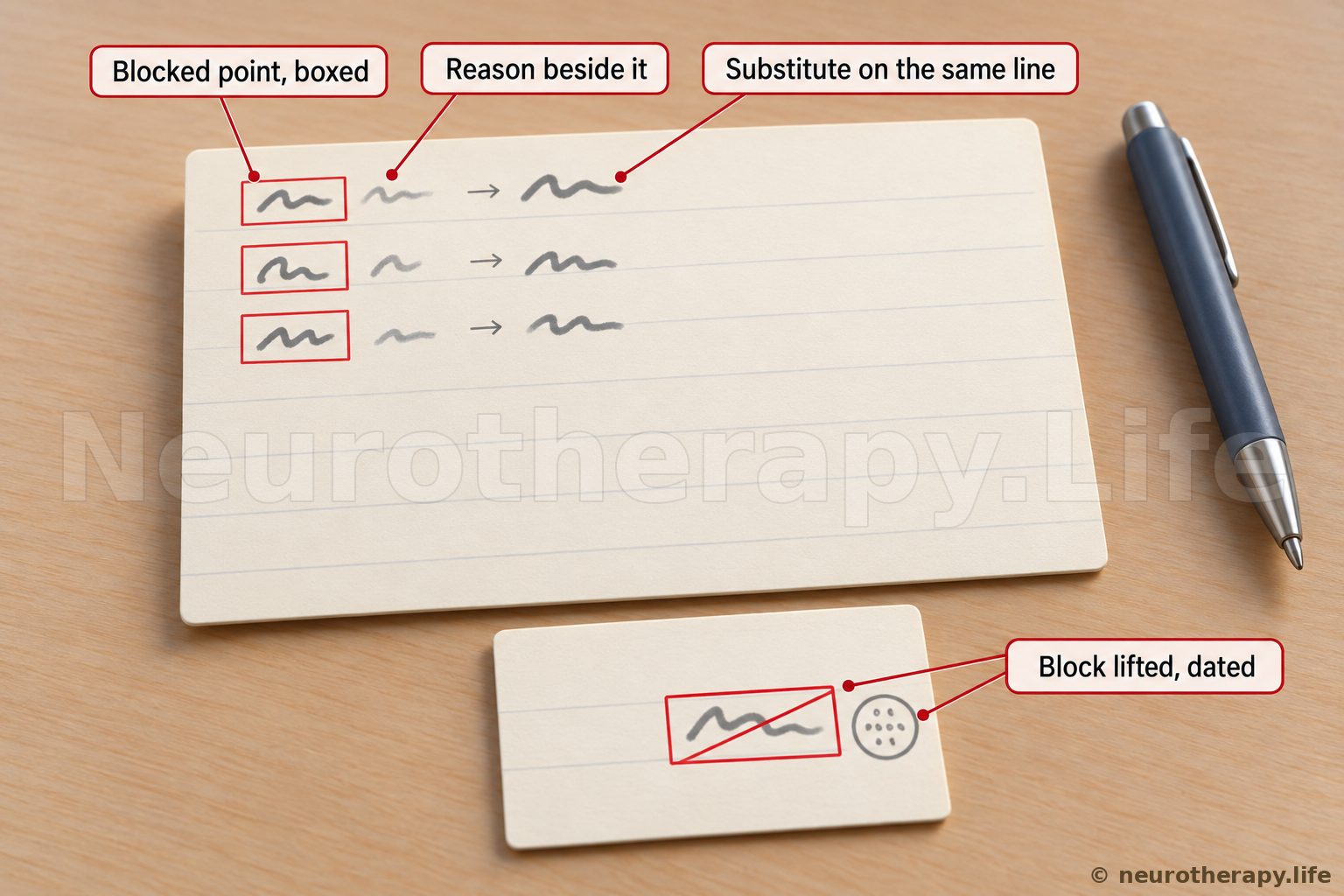
Neurotherapy (LMNT) works by rousing the glands. But in some diseases a gland is already hyper, which means working more than it should. A point that stirs that gland further would push the disease the way it is already going. So in each disease, certain points are not given.
Guruji called marking these points 'blocking'. The points are written on the patient's diagnosis card inside a box, in a fixed place, so that they are visible to every therapist who opens the card. This is done at the first visit, before any treatment is planned. A short reason goes beside each blocked point, and any substitute is written on the same line.
A block is not for ever. As treatment goes on, the working of the glands keeps improving. The point needs to be avoided only until the chief symptoms of that disease have ended; after that, if needed, it can be given. Being able to lift a block is itself taken as proof that the glands have improved.
Lifting a block is a clear decision, written on the card with the date and who decided. Where the disease has a measure, such as a sugar or blood pressure reading, the measure decides, not a feeling.
Key points
- A blocked point is a good point aimed the way the disease is already going.
- Block the card at the first visit: card first, blocks second, plan third, treatment fourth.
- Write the reason beside each block and the substitute on the same line.
- A block lifts when the chief symptoms end, and lifting it is a sign of progress.
Go deeper
When the Hand Must Stop: Blocked Points and Safety in Neurotherapy (LMNT)
When the hand must stop: the whole guide to blocking
The Record That Shows the Truth: The Patient Card in Neurotherapy (LMNT)
The patient card, and how it is kept
From Findings to a Plan: How a Neurotherapy (LMNT) Diagnosis Is Built
From findings to a plan
Glands and hormones
The glands, and what 'hyper' means for a gland
Diabetes
Diabetes, which carries the longest blocked list
Autoimmune disorders
Autoimmune disorders, where the thymus is hyper
Loveleen
Loveleen, the model for how a block is written
Read the full guide
This topic is part of: When the Hand Must Stop: Blocked Points and Safety in Neurotherapy (LMNT)
Safety: when it is held back
- Blocks are checked against every diagnosis the patient carries, not only the one they came about.
- A block that is simply forgotten has not been lifted. Only a dated, written decision lifts it.
This page explains what a Neurotherapy (LMNT) treatment is for; it is not a self-treatment guide and does not diagnose. Neurotherapy (LMNT) works alongside your medical care — keep taking the medicines your doctor prescribed.