Loveleen is a Neurotherapy (LMNT) treatment given lying on the back, sweeping from the chest, the lower ribs and the side of the waist out to the elbow, one side at a time. It is used for chest pain caused by gas in the stomach, and it helps diabetic patients alongside other formulas. It is never given to heart or kidney patients.
Overview
What is Loveleen?
Loveleen is a proper name, not an organ code. Like several treatments in Neurotherapy (LMNT), it is named for a person rather than for a part of the body. It is a physical treatment, not a chemical point: it works over the front and side of the chest wall and along the arm, rather than at one fixed place.
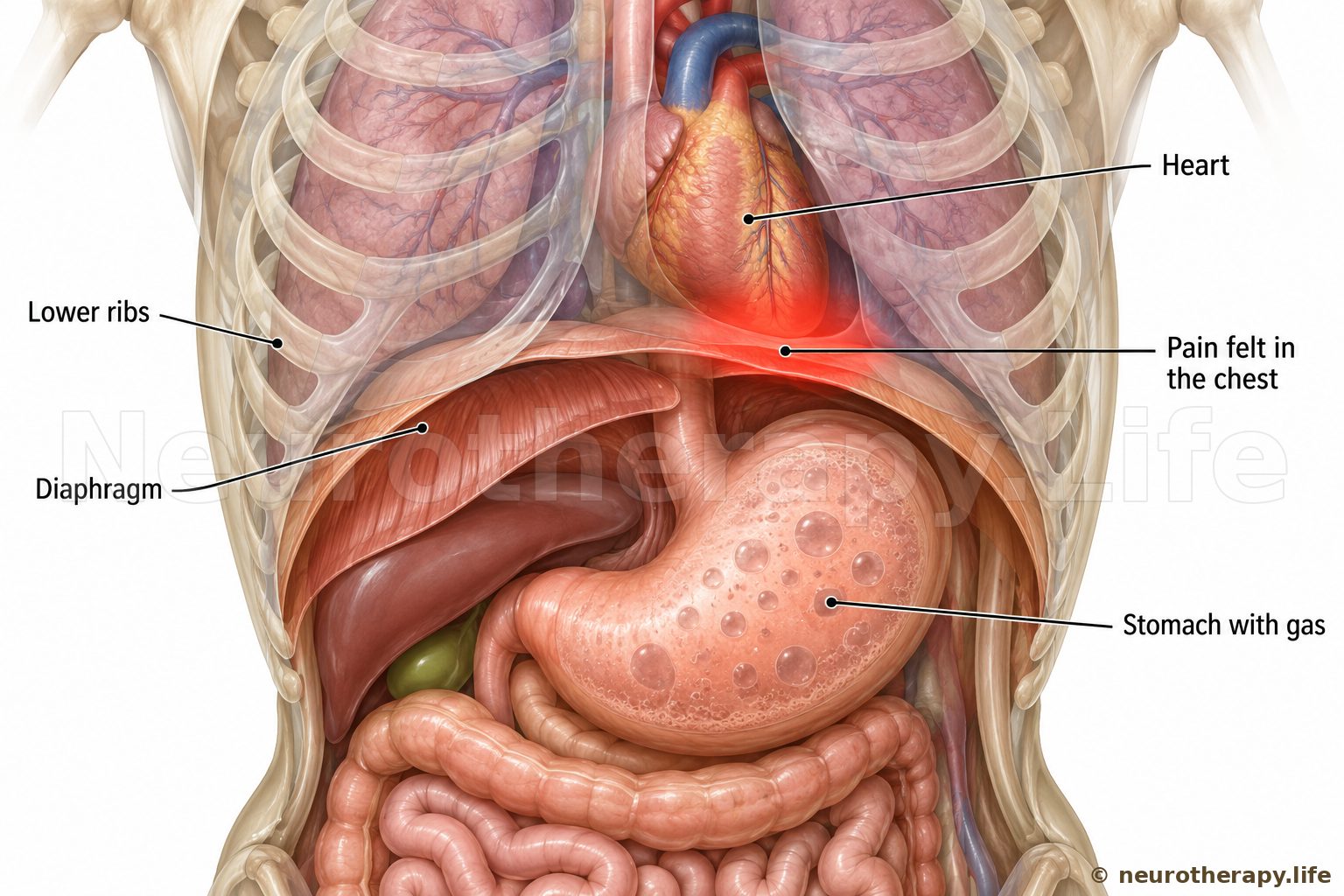
Its chief use is the chest pain that comes from gas in the stomach. A stomach swollen with gas presses up under the diaphragm and can be felt as a tight, painful chest. But chest pain is not gas until someone qualified has said it is not the heart — which is why Loveleen carries one of the firmest bars in the therapy.
A stomach full of gas can push up under the diaphragm and be felt as chest pain. Loveleen is given for that pain — once the heart has been ruled out.
Where it is given
Where is Loveleen given?
PositionLying on the back
Body areaThe front and side of the chest, the lower ribs and the side of the waist, out along the arm to the elbow — one side at a time
You lie on your back with the arm out to the side. Loveleen is given along tracks that start on the trunk and end at the elbow: from above the chest, from below the last rib, and from the side of the waist passing through the inside of the armpit.
One side is completed before the other is begun; both sides are never done at the same time.
How it is given
How is Loveleen given?
How this point is given — the tool, the pressure, the count and the exact movement — is deliberately not described here. A demonstration video for this point is being prepared; until it is on this page, learn the method hands-on from a trained Neurotherapist before giving it. Please do not give any point from a written description alone: a point given in the wrong place or the wrong way can do harm.
The exact technique is taught hands-on in the Neurotherapy (LMNT) course. See the course →
What it does
What does Loveleen do?
The teaching names a narrow, practical set of uses for Loveleen.
Relieves pain in the chest caused by gas in the stomach, given after the full navel-setting work for gas — the teaching calls this of great benefit.
In a diabetic patient, giving Loveleen with Sulta Ulta alongside the acid formula gives further benefit.
Diabetic patients with swelling, numbness or wounds of the feet are said to find Loveleen with Sulta Ulta agreeable, after the A. Heparin work for the feet.
Organs it reaches
Stomach — Gas in the stomach is the source of the chest pain it is given for.
Muscles — The muscles of the chest wall and the side.
Heart — Lies very close to the place of the treatment — the reason for its bar.
Kidneys — Lie behind the lower ribs that the treatment crosses — presumably why it is withheld in kidney disease.
Its family
Which treatments go with Loveleen?
Loveleen is usually written next to its companions.
Sulta Ulta — Its frequent partner. In heart patients, Loveleen is withheld and Sulta Ulta alone is given, with the arms raised.
CNNS — all 3 sides — The navel-setting work for gas that comes before Loveleen in gas chest pain.
Th. Only — Thymus — another chest treatment, withheld in heart disorders for the same reason.
Electrical Waves — A neighbouring physical chest treatment, named for breathing.
What it is used for
What is Loveleen used for?
Only after heart and kidney disease have been ruled out.
Its diabetic-foot variant — Loveleen with Sulta Ulta is found agreeable.
Safety: when it is held back
Heart patients: Loveleen is never given. The place of the treatment is very close to the heart, and the heart can be troubled. In its place, Sulta Ulta alone is given, with the arms raised. Angina (chest pain from the heart)
Kidney patients: Loveleen is never given. On such a patient's card it is written between two full stops — . Loveleen . — so that on later days no therapist gives it by mistake. Kidney disease
Chest pain is not gas until someone qualified has said it is not the heart. The patient most at risk is the one whose heart disease has not been found yet. Sudden, crushing or spreading chest pain, or pain with breathlessness or sweating, is an emergency — call for medical help first. Heart attack (myocardial infarction)
The armpit and inner arm carry the arm's main artery and nerves close to the surface; any tingling or numbness means the contact stops at once.
“Do not give Loveleen to kidney patients or to heart patients. On the card of such a patient, be sure to write . Loveleen . in this way, so that on later days too it is remembered that this point is not to be given.”
— Dr. Lajpatrai Mehra
A teaching case
Teaching case: the two full stops that held for eleven months
A teaching case, put together from several camps: a retired man came twice a week for a burning under the breastbone that his family called gas. Months earlier he had mentioned at the door that he took tablets "for the kidney", and his therapist had written . Loveleen . on his card. When a young therapist covering for a day met those two dots, she asked before giving anything — and the instruction held.
A composite case written to teach the reasoning — not one patient’s file.
Common questions
Why is Loveleen called that?
It is a proper name, like several Neurotherapy (LMNT) treatments named after people rather than organs.
I get chest pain after meals. Can I have Loveleen?
Only once a doctor has made sure the pain is not from the heart, and only if you have no heart or kidney disease.
What do the dots around Loveleen on my card mean?
They mean it has been blocked for you, so that no therapist gives it to you by mistake.
Surprising facts
1The diaphragm is a shared wall
The heart sits directly on top of the diaphragm, and the stomach lies just beneath it on the left — which is why a stomach full of gas and a heart in trouble can feel so alike.
Source: Gray's Anatomy, 41st ed. (diaphragm and mediastinum).
2Not all heart pain feels like heart pain
Heart attacks — especially in women, older people and people with diabetes — can show up as indigestion, breathlessness or tiredness rather than classic chest pain.
Source: American Heart Association, Warning signs of a heart attack (patient information).
3The kidneys hide behind the lower ribs
The upper part of each kidney is protected by the lowest ribs at the back of the body.
This page explains what a Neurotherapy (LMNT) treatment is for; it is not a self-treatment guide and does not diagnose. Neurotherapy (LMNT) works alongside your medical care — keep taking the medicines your doctor prescribed.
Ready to begin?
Send COURSE for course details, or your name, age and health issue for a consultation.