Electrical Waves (the neck-relaxing stroke for breathing)
Also called: Electrical Waves point, इलेक्ट्रिकल वेव्स, ↙↘
Electrical Waves is a Neurotherapy (LMNT) treatment given lying on your back, as a downward stroke from behind the ear along the side of the neck. It relaxes the muscles of the neck and has been found excellent in asthma and other breathing difficulties. It is no longer given for fits.
Overview
What is Electrical Waves?
Electrical Waves is one of the 'physical' treatments of the front-of-body group: it works directly on muscles rather than being named for a gland. Its written symbol is two curved arrows springing apart, and its stated job is to relax the muscles of the neck.
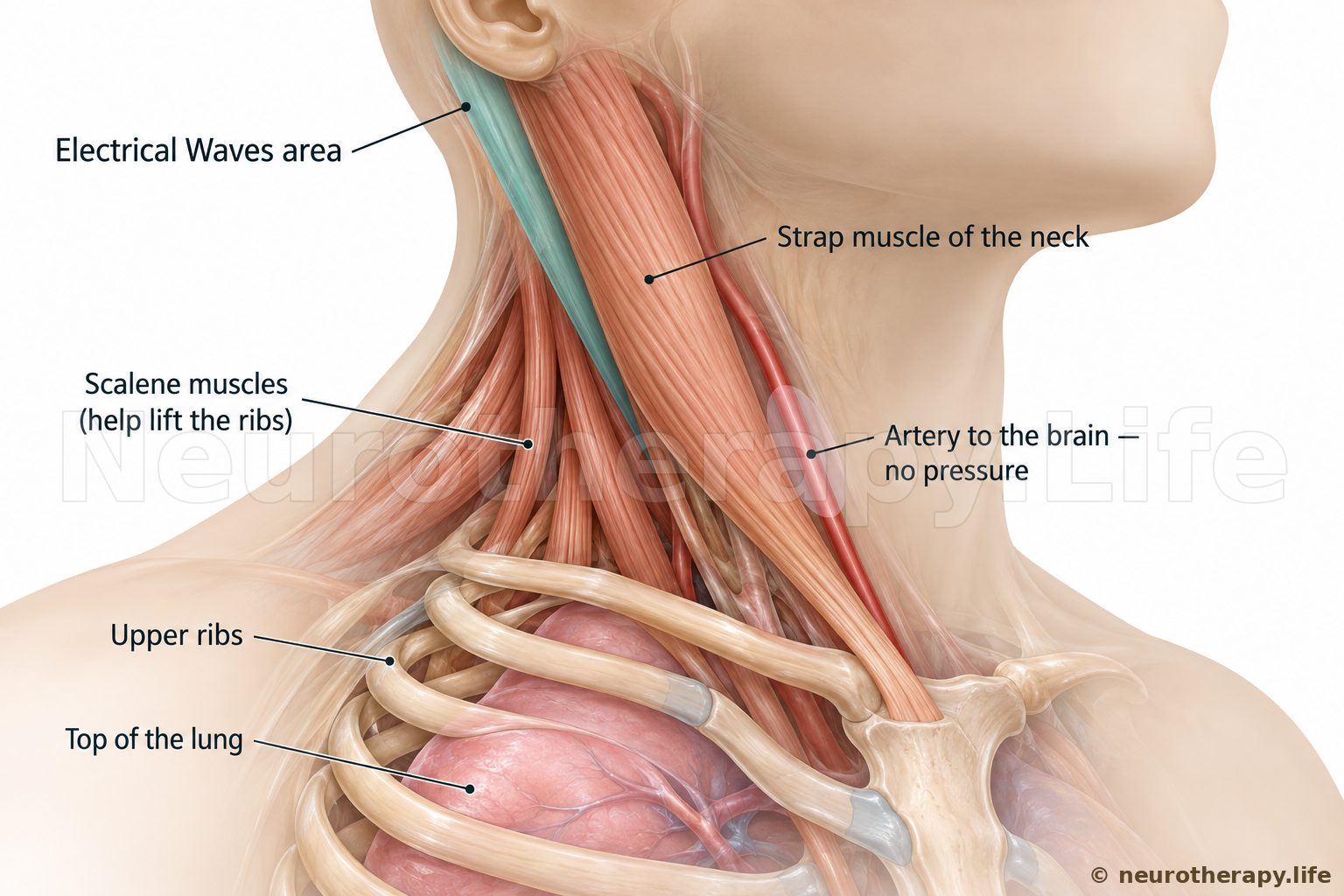
Why the neck for breathing? Several muscles of the neck lift the upper ribs and help the chest draw air in, and in a long asthma attack they become tight and tired. Electrical Waves belongs to a small set of treatments that reach the breath from the neck and the arm rather than from the chest.
Its record also shows how the therapy changes honestly. It was once given in fits; when better treatments for fits arrived, it was withdrawn from that use and the change was written down, not quietly dropped.
Neck muscles help lift the ribs when we breathe. Electrical Waves runs behind the big strap muscle — never over the artery in front of it.
Where it is given
Where is Electrical Waves given?
PositionLying on the back
Body areaHistorical point — the teaching now gives (6) Medulla in its place
Electrical Waves is an older point of Guruji's. The teaching slide in the archive video states that it is 'now superseded by (6) Medulla'. It is kept on this site for the record only; it is not given from this page. See the Medulla page.
How it is given
How is Electrical Waves given?
How this point is given — the tool, the pressure, the count and the exact movement — is deliberately not described here. A demonstration video for this point is being prepared; until it is on this page, learn the method hands-on from a trained Neurotherapist before giving it. Please do not give any point from a written description alone: a point given in the wrong place or the wrong way can do harm.
The exact technique is taught hands-on in the Neurotherapy (LMNT) course. See the course →
What it does
What does Electrical Waves do?
The source states two things: it relaxes the muscles of the neck, and it has been found excellent for asthma and breathing difficulties. The second is a clinical observation of the therapy; the first has a clear link in body science.
Relaxes the muscles at the side of the neck, which tighten when breathing is hard work.
Used in asthma, bronchitis and other breathing difficulties, usually together with Lu + Sh and Stretch.
No longer given for fits — better treatments for fits have taken its place.
Organs it reaches
Muscles — The neck muscles that also act as helpers of breathing.
Lungs — The organs whose breathing these muscles assist.
Cervical spondylosisIts first stated effect is relaxing the muscles of the neck.
Safety: when it is held back
Fits: Electrical Waves is no longer given in fits or epilepsy. An old card may still carry it; what is given for fits now comes from elsewhere. Epilepsy (fits)
The front of the neck is never pressed. Squeezing the pressure sensors at the fork of the neck artery can slow the heart and drop the blood pressure, making a person pale, sick or faint.
The neck rule bites hardest in older people; anyone with a stroke or a passing weakness, numbness or loss of vision in the last three months; anyone with a goitre or swelling in the neck or a fast-running thyroid; and anyone on blood-thinning tablets. Paralysis and stroke
New neck pain or a headache unlike any before, with disturbed vision, unsteadiness, dizziness, slurred speech or numbness: stop, treat nothing at the neck, and get the patient seen urgently. How to tell a patient to see a doctor
A severe asthma attack — lips turning blue, unable to speak in sentences — is an emergency for a hospital, not a treatment on the mat. Inhalers and medicines are never stopped. Asthma
No. 'Electrical Waves' is only the name of a hand stroke. No machine or current is used anywhere in Neurotherapy (LMNT).
Why is my neck treated when my problem is my chest?
Because several neck muscles help lift the ribs when you breathe. In asthma they work overtime and tighten; relaxing them is part of easing the breath.
My old card says Electrical Waves for fits. Should I still have it?
No. It has been withdrawn from use in fits because better treatments came. Your therapist will choose a current treatment, and your fits medicine is never stopped.
Surprising facts
1Breathing helpers in your neck
The scalene and sternocleidomastoid muscles of the neck are 'accessory muscles of breathing'. They join in when breathing is hard, lifting the upper ribs — visible as a straining neck in an asthma attack.
Source: Guyton & Hall, Textbook of Medical Physiology, 14th ed. — mechanics of pulmonary ventilation; Standring S (ed.), Gray's Anatomy, 41st ed.
2A pressure sensor in your neck
Where the main neck artery forks, its wall holds the carotid sinus — a patch of sensors that report blood pressure to the brain. Pressing it can make the heart slow down sharply.
Source: Guyton & Hall, Textbook of Medical Physiology, 14th ed. — baroreceptor reflex.
3Asthma is common
Asthma affects hundreds of millions of people worldwide and is one of the most common long-term diseases of children.
Source: World Health Organization, Asthma fact sheet, 2024.
This page explains what a Neurotherapy (LMNT) treatment is for; it is not a self-treatment guide and does not diagnose. Neurotherapy (LMNT) works alongside your medical care — keep taking the medicines your doctor prescribed.
Ready to begin?
Send COURSE for course details, or your name, age and health issue for a consultation.