Also called: Vocal Ghisai, वोकल घिसाई, Vocal, वोकल पॉइंट
Vocal Point, also called Vocal Ghisai (vocal rubbing), is a gentle Neurotherapy (LMNT) treatment for a bad throat. With cupped palms on both sides of the throat, the therapist strokes the muscles lightly outward and backward so that the muscles of the voice box relax. No pressure ever falls on the Adam's apple.
Overview
What is Vocal Point?
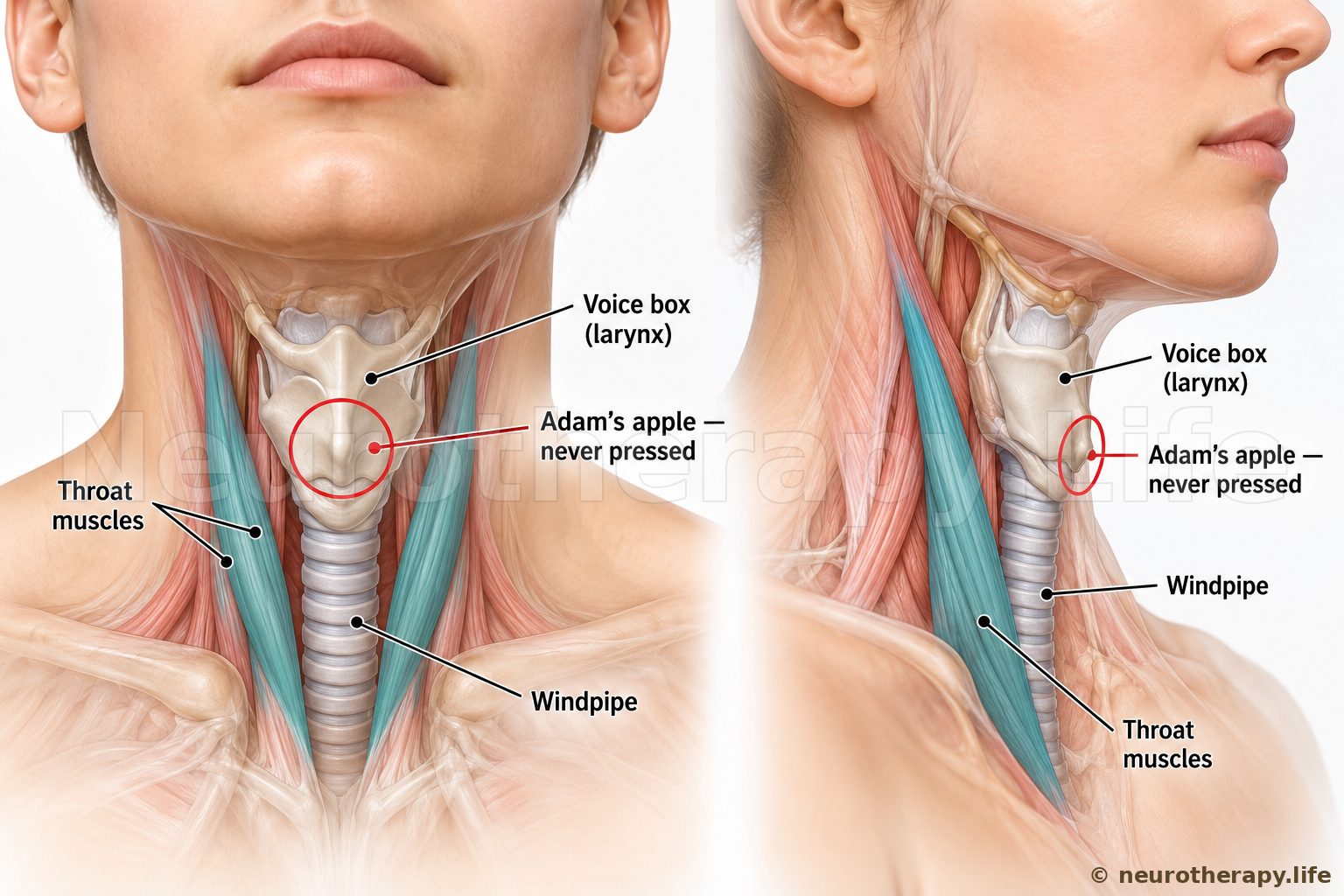
Your voice is made in the voice box (larynx), the hollow organ at the front of the neck whose front edge you can feel as the Adam's apple. Inside it, two small folds of tissue — the vocal cords — vibrate as air passes, and a group of small muscles tightens and loosens them to shape the sound.
When the throat is sore, overused or tense, these muscles and the ones around them tighten. The voice turns hoarse, speaking becomes an effort, and sometimes the voice hardly comes out at all.
Vocal Point is a physical treatment — a ghisai, which means a light gliding stroke rather than a press. The teaching gives it for correcting a bad throat, to relax the muscles of the voice box: for hoarseness, for difficulty in speaking, and for those whose voice does not come out.
The voice box sits behind the Adam's apple. Vocal Point works the muscles beside it — never the Adam's apple itself.
Where it is given
Where is Vocal Point given?
PositionSitting
Body areaThe upper throat below the jaw, either side of the voice box; seated, head rested back
In the demonstration video you sit on a chair and the therapist stands behind you; your head rests back against a pillow held against the therapist. Talcum is put on the throat first.
The place is the upper throat just below the jaw, on both sides of the voice box. The direction and count of the stroke are shown in the video — never press or squeeze the windpipe.
How it is given
How is Vocal Point given?
How this point is given — the tool, the pressure, the count and the exact movement — is deliberately not described here. A demonstration video for this point is being prepared; until it is on this page, learn the method hands-on from a trained Neurotherapist before giving it. Please do not give any point from a written description alone: a point given in the wrong place or the wrong way can do harm.
The exact technique is taught hands-on in the Neurotherapy (LMNT) course. See the course →
What it does
What does Vocal Point do?
Vocal Point relaxes the muscles around the voice box. It works on muscle tension, not on a gland — a point whose purpose the teaching states simply.
Corrects a bad throat by relaxing the muscles of the voice box.
Excellent for hoarseness of the throat that makes speaking difficult.
For those whose voice does not come out at all.
Organs it reaches
Neck — The front of the neck holds the voice box, the windpipe and the great arteries to the brain.
Muscles — The small muscles of the voice box and the strap muscles beside it.
Vagus nerve — Its branches move the muscles of the voice box.
Thyroid — Lies just below the voice box — a swollen thyroid is a reason not to work the neck.
Its family
Which treatments are close to Vocal Point?
A few treatments bring the hands to the throat or the side of the neck. All of them follow the same strict neck rule.
Thrd — The thyroid point at the throat — flat palm, mild, released at once, never a fingertip.
Electrical Waves — Relaxes the neck muscles, working from behind the ear downward — behind the big strap muscle, not in front of it.
Neck Ghisai — Rubbing of the neck, with light hands where it comes near the front.
Speech Point — For speech after paralysis — a different problem: clear speech, not a hoarse throat.
What it is used for
What is Vocal Point used for?
Only after the neck rule has been checked — see the safety notes.
The throat and the voice
Sore throat and hoarsenessA bad throat, hoarseness that makes speaking difficult, or a voice that will not come out.
Safety: when it is held back
No pressure ever falls on the Adam's apple, or on the front or sides of the neck, by hand or by foot, whatever a card says. The stroke stays on the surface and is never held.
Why: pressure-sensors in the great neck arteries can slow the heart and drop the blood pressure when squeezed — the patient goes pale, feels sick and may faint. This reflex is strongest in older people.
No neck work at all for anyone who has had a stroke, or a passing weakness, numbness or loss of vision, within the last three months. Paralysis and stroke
Not on a neck with a swelling, a lump, a goitre or a fast-running thyroid, nor on a neck that is hot, swollen or tender. Take special care in anyone on blood-thinning tablets. Thyroid
New neck pain or a headache unlike any before, with disturbed vision, unsteadiness, dizziness, slurred speech, or numbness of the face or a limb: stop, treat nothing at the neck, and get the patient seen urgently. How to tell a patient to see a doctor
A sore throat with high fever, difficulty swallowing or breathing, or hoarseness that does not settle, needs a doctor's examination. Keep taking any medicines your doctor has prescribed. Sore throat and hoarseness
Guruji says
“Tell the patient to keep the muscles of their throat relaxed; then the treatment will give more benefit.”
— Dr. Lajpatrai Mehra
Common questions
Will the therapist press on my throat?
No. Vocal Point is a light, moving stroke on the sides of the throat, away from the Adam's apple. Nothing is pressed or held at the front of the neck.
Why is it usually given lying down?
A touch on the throat can make a seated person feel faint. Lying down, you cannot fall. If it is given seated, your head rests against a wall.
I lost my voice after a cold. Can Vocal Point help?
The teaching gives it for a bad throat and for a voice that does not come out. If you also have high fever, trouble swallowing or breathing, or the hoarseness does not settle, see a doctor.
Is Vocal Point the same as Speech Point?
No. Vocal Point relaxes the throat muscles for a hoarse or lost voice. Speech Point is given on the head for unclear speech after paralysis.
Surprising facts
1Hundreds of beats a second
When you speak, your vocal cords open and close about a hundred times a second in a deep voice and two hundred or more in a higher one — every one of those is a tiny muscle-controlled vibration.
Source: Guyton & Hall, Textbook of Medical Physiology, 14th ed. — phonation.
2A sensor in your neck
Where the great neck artery divides, near the upper edge of the Adam's apple, its wall carries pressure sensors (the carotid sinus). Pressing on them makes the brain slow the heart — which is why the front of the neck is never pressed.
Source: Guyton & Hall, Textbook of Medical Physiology, 14th ed. — the baroreceptor reflex.
3A long way round
The nerve that moves most voice-box muscles (the recurrent laryngeal nerve) leaves the vagus in the chest and loops back up — on the left side it hooks under the aorta near the heart before climbing to the voice box.
Source: Gray's Anatomy, 41st ed. — the larynx and the vagus nerve.
This page explains what a Neurotherapy (LMNT) treatment is for; it is not a self-treatment guide and does not diagnose. Neurotherapy (LMNT) works alongside your medical care — keep taking the medicines your doctor prescribed.
Ready to begin?
Send COURSE for course details, or your name, age and health issue for a consultation.