All Neurotherapy (LMNT) treatment points, grouped by patient position
Around a hundred and twenty-six treatment points are listed not by organ or illness but by the position the patient is placed in: lying face up, seated, lying on the side and lying face down, plus groups for back pain, knee pain and other points.
Overview
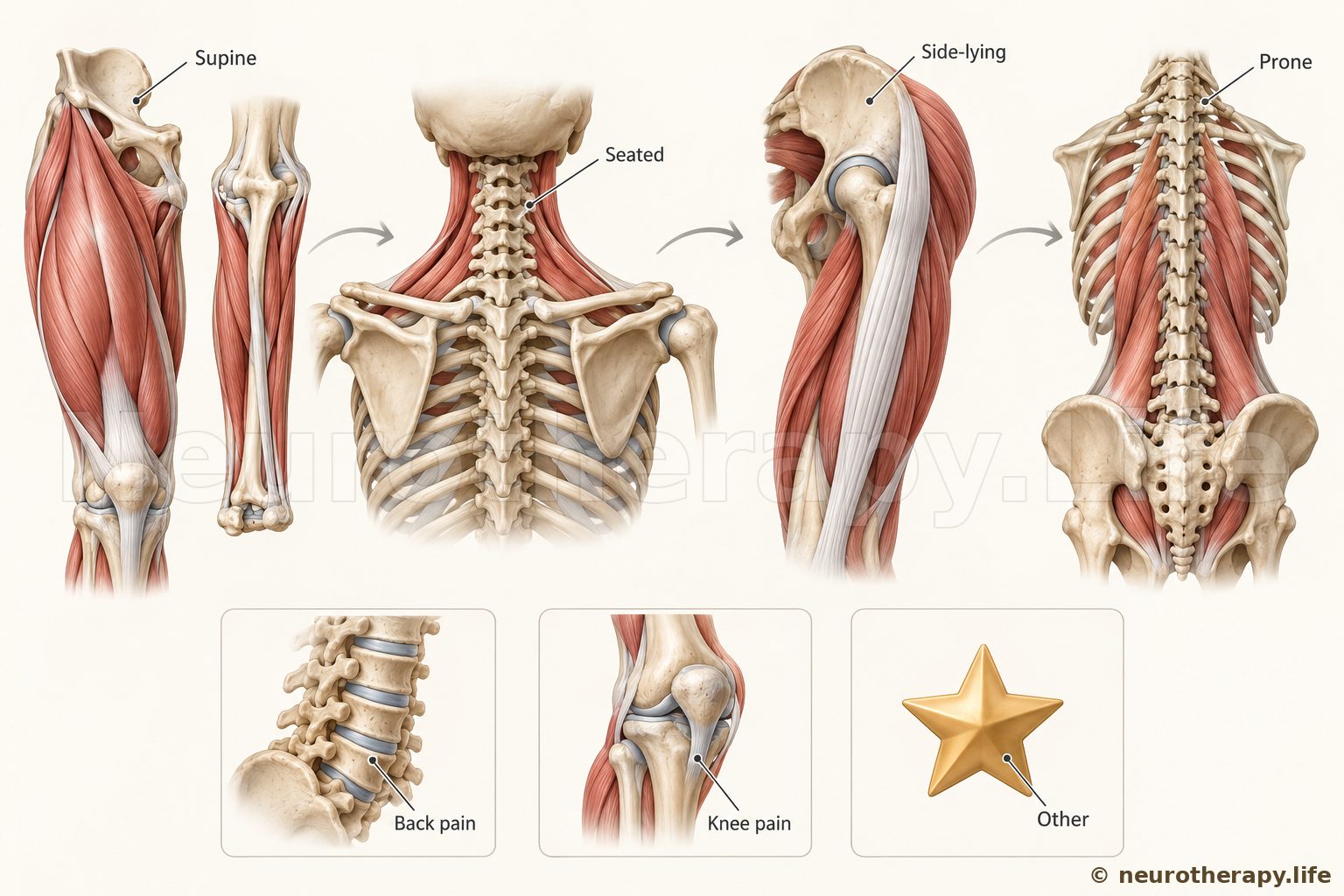
The master list is the index a therapist turns to most often. It is arranged by the position the patient is put into, because turning a patient costs time and comfort, and in the frail it costs more. So a formula is given as a route: everything one position offers is done before the patient is moved.
Lying face up (supine), the list includes the digestive and gland points such as Pan, Gal, Spl, Liv, Mu, Gas, Const, Pit, Para, Thymus and the navel-setting group, along with muscle points like Stretch and BAFA. Seated on a chair come Medulla, Mesencephalon and Dorsal, with the face, jaw, ear and sinus points. Lying on the side come Acid, Parkhoo, the vitamin points such as Folic and B12, and Fluid or Alkali. Lying face down come Adr, Swt, the arrow family on the back, Ku and the Triangle for Piles.
Three more groups hold physical points: back pain, such as L5-S1 ghisai and the sciatica points; knee pain, such as Back of Knees, Giriraj and Bottom of Feet; and everything else, such as the shoulder-blade points and Abdomen Setting. Point names come from anatomy, chemistry, function, the shape traced on the back, or the people in whose cases they were found.
Read each code inside its own group. Gas, also written Gas Only, is on the thighs; Gas ‘I’ is down the calves; Big Toe Gas in the knee group is a third thing again. The exact method of each point is taught hands-on in the course.
Key points
- Points are listed by the patient’s position, not by organ or illness.
- Four positions: face up, seated, side-lying and face down.
- Three extra groups for back pain, knee pain and other points.
- A code must be read inside the group it belongs to.
Go deeper
The Shorthand: How Neurotherapy (LMNT) Treatments Are Written and Read
The shorthand of Neurotherapy (LMNT): the full guide
Placing the Patient: The Four Positions of Neurotherapy (LMNT)
Placing the patient in the four positions
The four treatment positions: on the back, seated, on the side and face down
What each position decides
The Front of the Body I: The Digestive Points Given Lying on the Back
The front of the body: digestive points
Seated Treatments I: The Back of the Head and the Neck
Seated points for the brain, Medulla and neck
On the Side: Treatments Given Lying on One Side
Points given lying on the side
Face Down: Treatments Given on the Back and Spine
Points given lying face down
Point, formula and treatment: the three levels of Neurotherapy (LMNT)
Point, formula and treatment
Read the full guide
This topic is part of: The Shorthand: How Neurotherapy (LMNT) Treatments Are Written and Read
Safety: when it is held back
- Some codes look alike but are different points. A wrong reading gives a different treatment; when a card is unclear, ask the therapist who wrote it.
- In cancer, never give (10) Pan, Thymus, Pit, Lu+Sh, Rt.Ov or Lt.Ov, or (30) Medulla. Cancer care: Neurotherapy (LMNT) support
This page explains what a Neurotherapy (LMNT) treatment is for; it is not a self-treatment guide and does not diagnose. Neurotherapy (LMNT) works alongside your medical care — keep taking the medicines your doctor prescribed.