1Neck muscles that breathe
The scalene muscles in the side of the neck lift the first two ribs with every breath, and the large sternocleidomastoid joins in when breathing is hard.
Source: Gray's Anatomy, 41st ed., Muscles of respiration.
Also called: स्ट्रेच, Stretch point, ←→
Stretch is a Neurotherapy (LMNT) treatment given on the outstretched arm while you lie on your back, palm facing up. Working from the elbow down to the fingertips, it relaxes the muscles of the neck — and it gives great relief in breathing troubles, so it is used in asthma, bronchitis and the Oxygen formula.
Stretch is written on a card as two arrows pointing away from each other. It is given on the arm, but its target is the neck: when the fingertips are pressed and drawn outward, the muscles of the neck relax. It works an arm's length away from where it acts.
Why would relaxing the neck help breathing? Several neck muscles help lift the upper ribs when we breathe hard. In someone struggling to breathe, as in asthma, these helper muscles work overtime and become tight and tired. Easing them is one way of making each breath less of a fight.
Stretch belongs to a small group that reaches the breath from the neck and the arm rather than the chest, together with Electrical Waves and Lu + Sh. In asthma and bronchitis they are given as a group.
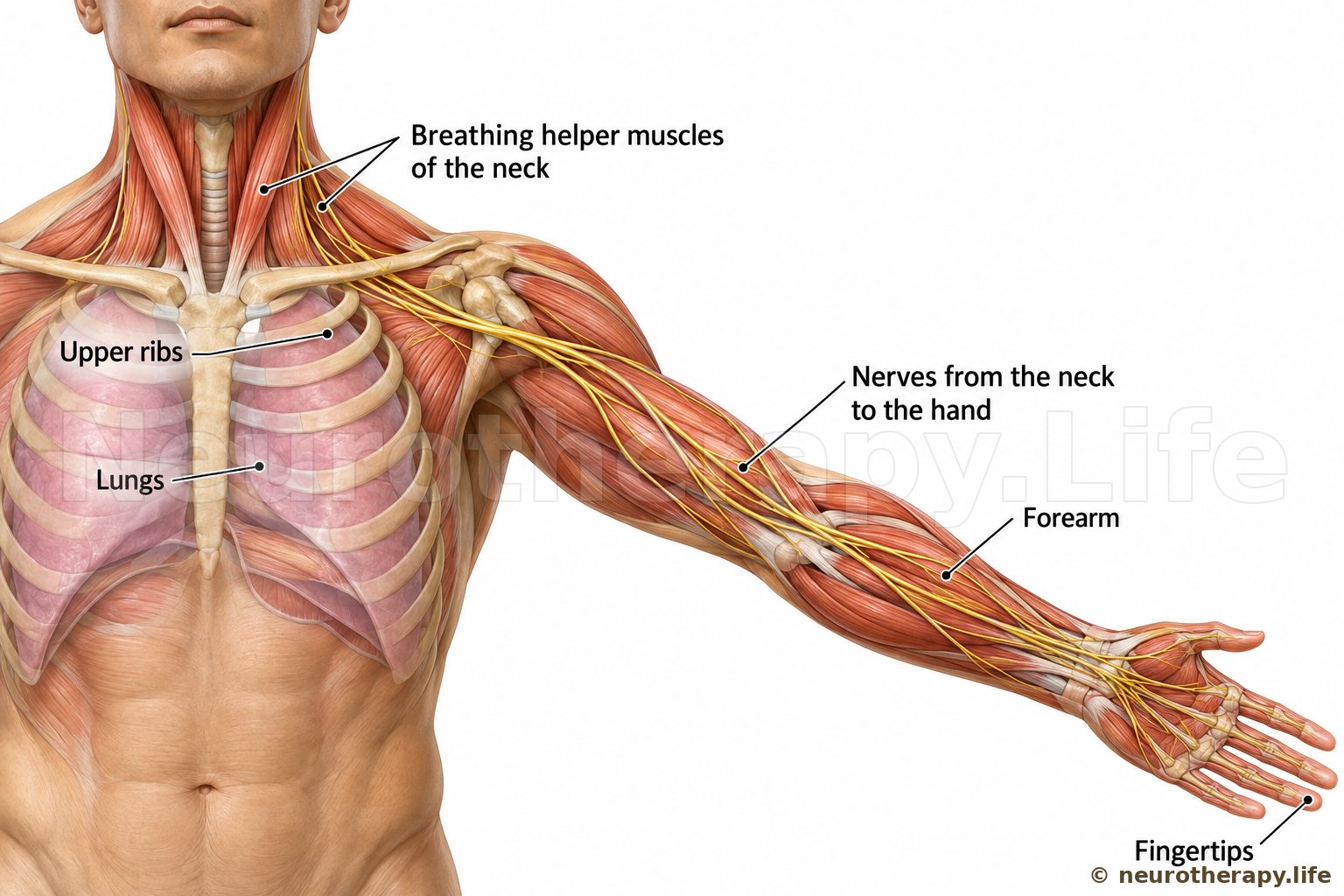
You lie on your back with the arm laid straight out from the shoulder, in line with the shoulders, and the palm facing the sky the whole time.
The area is the forearm from the elbow to the wrist, and then the hand from the wrist to the tips of the fingers. Both arms can be done one after the other — the left first and the right afterwards works just as well as both together.
How this point is given — the tool, the pressure, the count and the exact movement — is deliberately not described here. A demonstration video for this point is being prepared; until it is on this page, learn the method hands-on from a trained Neurotherapist before giving it. Please do not give any point from a written description alone: a point given in the wrong place or the wrong way can do harm.
The exact technique is taught hands-on in the Neurotherapy (LMNT) course. See the course →
The teaching says Stretch relaxes the muscles of the neck and gives tremendous relief in breathing troubles. That neck muscles help breathing is well-established anatomy; that pressing the fingertips outward relaxes them is the therapy's own clinical observation.
Stretch is one of the limb and breathing treatments given lying on the back.
Stretch is one of the points that stays open even on a heavily blocked card — an asthma card is never an empty card.
To raise oxygen in the tissues: within it, Stretch opens the neck muscles so that one can breathe well.
The Oxygen-Hormonal treatment also carries Stretch.
“It gives tremendous relief in breathing troubles. Therefore it is used in asthma, in bronchitis, and in the Oxygen formula.”
Stretch aims at the neck, through the arm. Some neck muscles help lift the ribs when breathing is hard; when they relax, each breath is easier.
No. The left arm first and the right afterwards has been found to work just as well.
Usually yes — Stretch is one of the treatments that stays open when many others are blocked. Your therapist will still check your whole card.
No. In Stretch the palm stays facing up throughout and the arm is straight out from the shoulder. Turning the hand over makes it a different treatment.
The scalene muscles in the side of the neck lift the first two ribs with every breath, and the large sternocleidomastoid joins in when breathing is hard.
Source: Gray's Anatomy, 41st ed., Muscles of respiration.
Visible use of the neck muscles while breathing is one of the signs doctors look for in a severe asthma attack.
Source: Global Initiative for Asthma (GINA), Global Strategy for Asthma Management and Prevention.
Every nerve that reaches your fingers starts in the lower neck, at the spinal levels C5 to T1 — which is why neck trouble can be felt in the hand.
Source: Gray's Anatomy, 41st ed., Brachial plexus.
This page explains what a Neurotherapy (LMNT) treatment is for; it is not a self-treatment guide and does not diagnose. Neurotherapy (LMNT) works alongside your medical care — keep taking the medicines your doctor prescribed.
Send COURSE for course details, or your name, age and health issue for a consultation.