1Five roots, one arm
The nerves of each arm come from five spinal roots in the lower neck and upper chest, which braid together into a network called the brachial plexus.
Source: Gray's Anatomy, 41st ed., brachial plexus.
Also called: Both Arms, Both Forearms, BAFA point
BAFA — Both Arms, Both Forearms — is a Neurotherapy (LMNT) treatment in which the therapist's soles walk down both arms in short, close steps from the shoulder to the fingertips, never resting on the elbow joint. It is given lying on your back, and the teaching recommends it after the shoulder-blade treatments in neck (cervical) problems.
BAFA stands for Both Arms, Both Forearms. It is a physical point — a muscle-relaxing treatment named for the part of the body it covers. Its usual count is a guide, and like other physical points it may be raised slightly for the patient's comfort.
The nerves of the arm all leave the spinal cord in the neck. So a stiff, painful neck often shows up as heaviness, aching or tingling down the arms — and the muscles of the shoulder and arm, tightened by guarding, keep pulling on the neck in return.
The teaching says that after the two shoulder-blade treatments, giving BAFA is of great benefit in cervical problems — so BAFA carries the work on from the shoulders down to the hands.
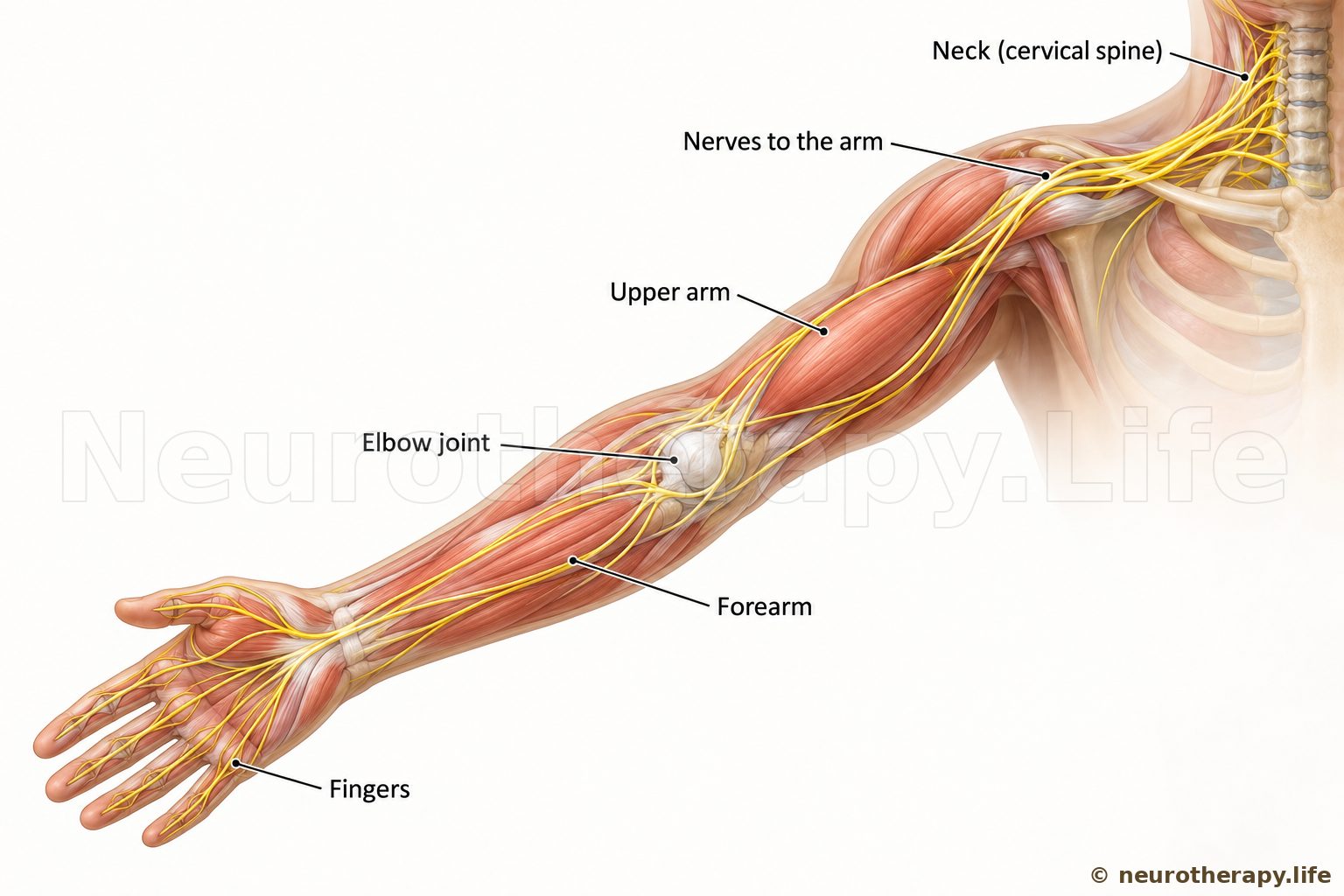
You lie on your back with both arms resting out from the body. The work covers the whole of both arms: from the shoulder down the upper arm to the elbow, then on down the forearm to the wrist and the fingertips.
The one place that is skipped is the elbow joint itself. The pressure passes from above the elbow to below it without resting on the joint.
How this point is given — the tool, the pressure, the count and the exact movement — is deliberately not described here. A demonstration video for this point is being prepared; until it is on this page, learn the method hands-on from a trained Neurotherapist before giving it. Please do not give any point from a written description alone: a point given in the wrong place or the wrong way can do harm.
The exact technique is taught hands-on in the Neurotherapy (LMNT) course. See the course →
BAFA is a muscle-relaxing technique. The teaching is honest that such techniques bring quick relief and comfort, while lasting change depends on the chemical treatments in the plan. Body science supports the idea behind it: the muscles of the shoulder and arm are tied to the neck, and tight arm muscles add to a stiff, painful neck.
In cervical problems, the teaching places BAFA after the two shoulder-blade treatments.
The teaching writes BAFA for cervical problems, after the shoulder-blade treatments — not for shoulder-blade pain in general.
The nerves and many muscles of the arm start in the neck and shoulder. Easing the arms takes some of the pull off the neck, which is why the teaching adds BAFA in cervical problems.
No. The elbow joint is always skipped, and the pressure on the arms is kept gentle.
Both Arms, Both Forearms — the parts of the body it covers.
The nerves of each arm come from five spinal roots in the lower neck and upper chest, which braid together into a network called the brachial plexus.
Source: Gray's Anatomy, 41st ed., brachial plexus.
The tingling jolt when you knock your elbow comes from the ulnar nerve, which runs just under the skin behind the elbow — one reason the elbow joint is never stepped on.
Source: Gray's Anatomy, 41st ed., ulnar nerve at the elbow.
Neck pain is among the leading causes of years lived with disability worldwide, especially in people who work long hours bent over desks and screens.
Source: GBD 2021 Neck Pain Collaborators. Lancet Rheumatol 2024;6(3):e142–e155.
This page explains what a Neurotherapy (LMNT) treatment is for; it is not a self-treatment guide and does not diagnose. Neurotherapy (LMNT) works alongside your medical care — keep taking the medicines your doctor prescribed.
Send COURSE for course details, or your name, age and health issue for a consultation.