Also called: Tennis Elbow Left, Tennis Elbow Right, टेनिस एल्बो
Tennis Elbow is a Neurotherapy (LMNT) treatment for pain or numbness near the elbow bone. You lie on your back with the forearm standing upright, and the therapist gives a steady pressure with the soft sole on the upper arm just above the elbow — on the painful arm only.
Overview
What is the Tennis Elbow point?
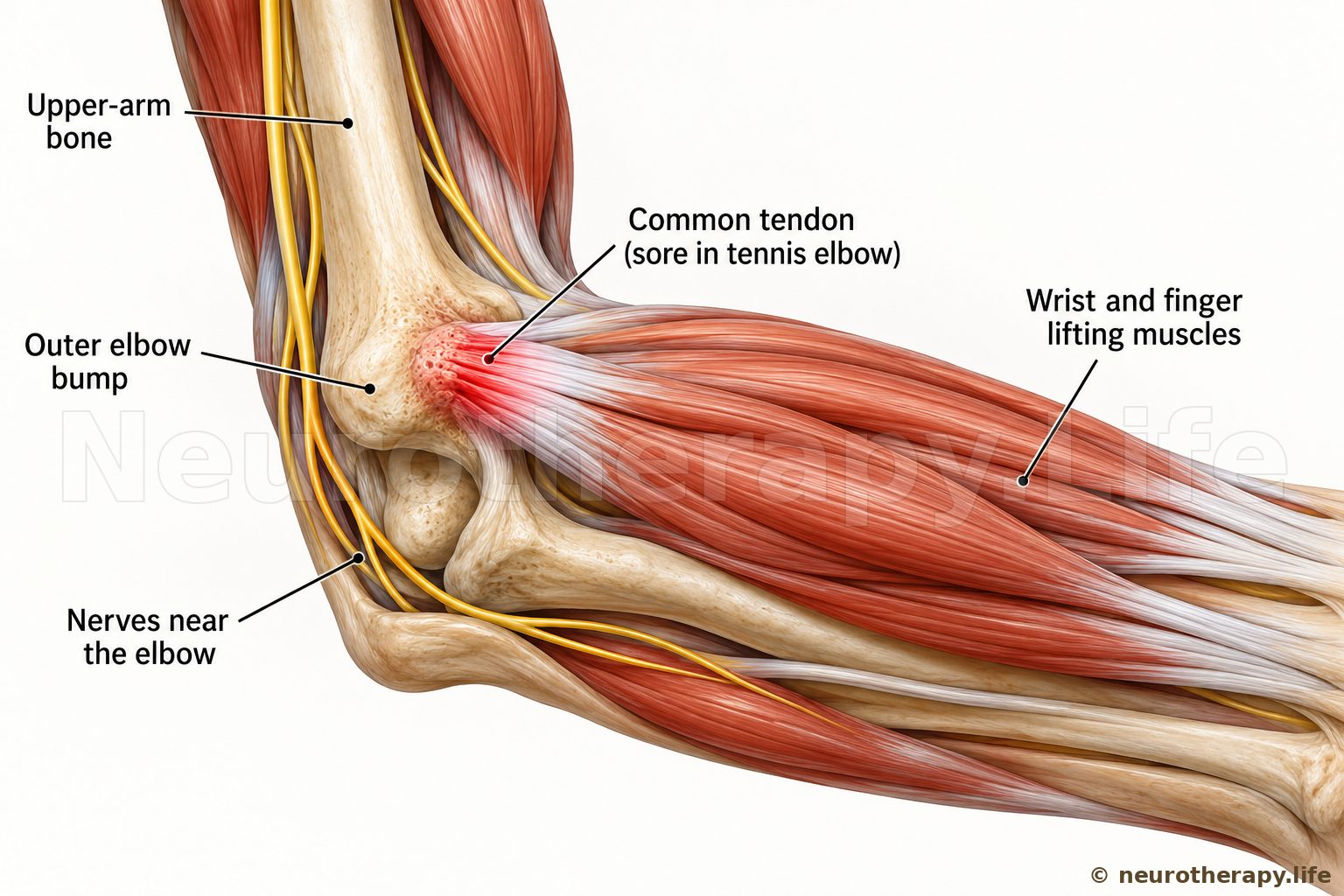
Tennis elbow is the everyday name for pain on the outer side of the elbow, where the muscles that lift the wrist and fingers are anchored to the bone. It is caused by overuse — gripping, twisting, lifting — far more often than by tennis. In bad cases the pain is so great that a person cannot even lift a spoon.
The Neurotherapy (LMNT) treatment of the same name is given to take out the pain of the elbow joint. The teaching calls it a sure remedy for pain or numbness near the elbow bone, given in whichever hand has the problem.
It is a physical point. Its limit is set by the patient, not by a number on the card: the pressure is only ever as much as the patient can bear, and it is given until the pain goes out.
In tennis elbow the tendon that anchors the wrist-lifting muscles to the outer elbow becomes sore.
Where it is given
Where is Tennis Elbow given?
PositionLying on the back
Body areaUpper arm, just above the elbow, on the painful arm
You lie on your back. The painful arm rests with the elbow on the ground and the forearm standing straight up, palm facing upward, supported against a chair or a wall. You are asked not to grip the chair: a gripping hand keeps the arm muscles tight, and the treatment then cannot give its full benefit.
The treatment is given on the upper arm, very close to the elbow — and, if a little pain remains, also at the middle of the upper arm. Only the arm with the problem is treated; if both arms need it, one is done first and then the other, never both together.
How it is given
How is Tennis Elbow given?
How this point is given — the tool, the pressure, the count and the exact movement — is deliberately not described here. A demonstration video for this point is being prepared; until it is on this page, learn the method hands-on from a trained Neurotherapist before giving it. Please do not give any point from a written description alone: a point given in the wrong place or the wrong way can do harm.
The exact technique is taught hands-on in the Neurotherapy (LMNT) course. See the course →
What it does
What does Tennis Elbow do in the body?
Neurotherapy (LMNT) teaching describes the treatment as taking out the pain of the elbow joint, and as a sure remedy for pain or numbness near the elbow bone. Body science confirms that the forearm muscles which pull on the sore outer elbow begin above the elbow, and that a hand which grips tightens them all the way to their anchor; how a held pressure there eases the pain is the therapy's own finding from practice.
Takes out pain of the elbow joint.
Is used for numbness near the elbow bone.
Helps the patient who, because of the pain, cannot even lift a spoon.
Organs it reaches
Joints — The elbow joint and the tendons anchored around it.
Muscles — The forearm muscles that lift the wrist and fingers, pulling on the outer elbow.
Its family
Which treatments are close to Tennis Elbow?
Tennis Elbow belongs to the group of arm treatments given with the sole.
BAFA — Both arms, both forearms — another sole treatment along the arms.
Stretch — A sole treatment from the elbow to the fingertips, for the neck muscles and breathing.
Sulta Ulta — Palm up and palm down along the forearm — for chest pain, front and back.
T8 — The other point whose limit is set by the patient's pain rather than a number.
What it is used for
What is Tennis Elbow used for?
It is used for pain or numbness near the elbow bone, in whichever arm has the problem.
Sprain and injuryElbow pain after strain — once a fracture has been ruled out.
Numbness near the elbow
Carpal tunnel syndromeNumbness in the hand has several causes; it needs a proper diagnosis before treatment.
Safety: when it is held back
One arm at a time, never both together, and only as much pressure as the patient can bear.
The great nerves of the arm pass close to the bone at the elbow. Stop at once if numbness or weakness begins to spread down into the hand.
The hand must rest against the support, not grip it — a gripping hand keeps the very muscles being treated tight.
A swollen, hot, deformed or suddenly very painful elbow, especially after a fall, needs a doctor first. Left arm pain with chest pain, breathlessness or sweating may be the heart — get emergency help. How to tell a patient to see a doctor
Why is the pressure above my elbow and not on the sore spot?
The treatment is given on the upper arm, very close to the elbow. The sore outer elbow itself is not pressed.
Why must I not hold the chair?
Gripping tightens the forearm muscles all the way to the elbow. The hand should only rest against the support so the muscles can let go.
My hand went numb during the treatment. Is that normal?
A little numbness near the pressure can come, but tell your therapist at once if numbness or weakness spreads into your hand — the pressure is then removed straight away.
Do I have to play tennis to get tennis elbow?
No. Most people with it have never played tennis. Repeated gripping, twisting and lifting at work or at home are the usual causes.
Surprising facts
1Most patients never play tennis
Tennis elbow affects roughly one to three adults in every hundred, mostly between 40 and 60 — and only a small share of them play tennis.
Source: NHS. Tennis elbow — overview, 2023; Shiri R et al. Prevalence and determinants of lateral and medial epicondylitis. Am J Epidemiol. 2006;164(11):1065–1074.
2Three nerves round one joint
All three great nerves of the hand — the radial, median and ulnar nerves — pass close around the elbow. The 'funny bone' tingle is the ulnar nerve pressed against bone.
Source: Standring S (ed.). Gray's Anatomy, 41st ed. Elsevier, 2016 — nerves of the elbow region.
3It usually settles with time
Tennis elbow often eases over months with rest from the movements that strain it. Pain at night, swelling or loss of movement points to another cause and needs a doctor.
This page explains what a Neurotherapy (LMNT) treatment is for; it is not a self-treatment guide and does not diagnose. Neurotherapy (LMNT) works alongside your medical care — keep taking the medicines your doctor prescribed.
Ready to begin?
Send COURSE for course details, or your name, age and health issue for a consultation.