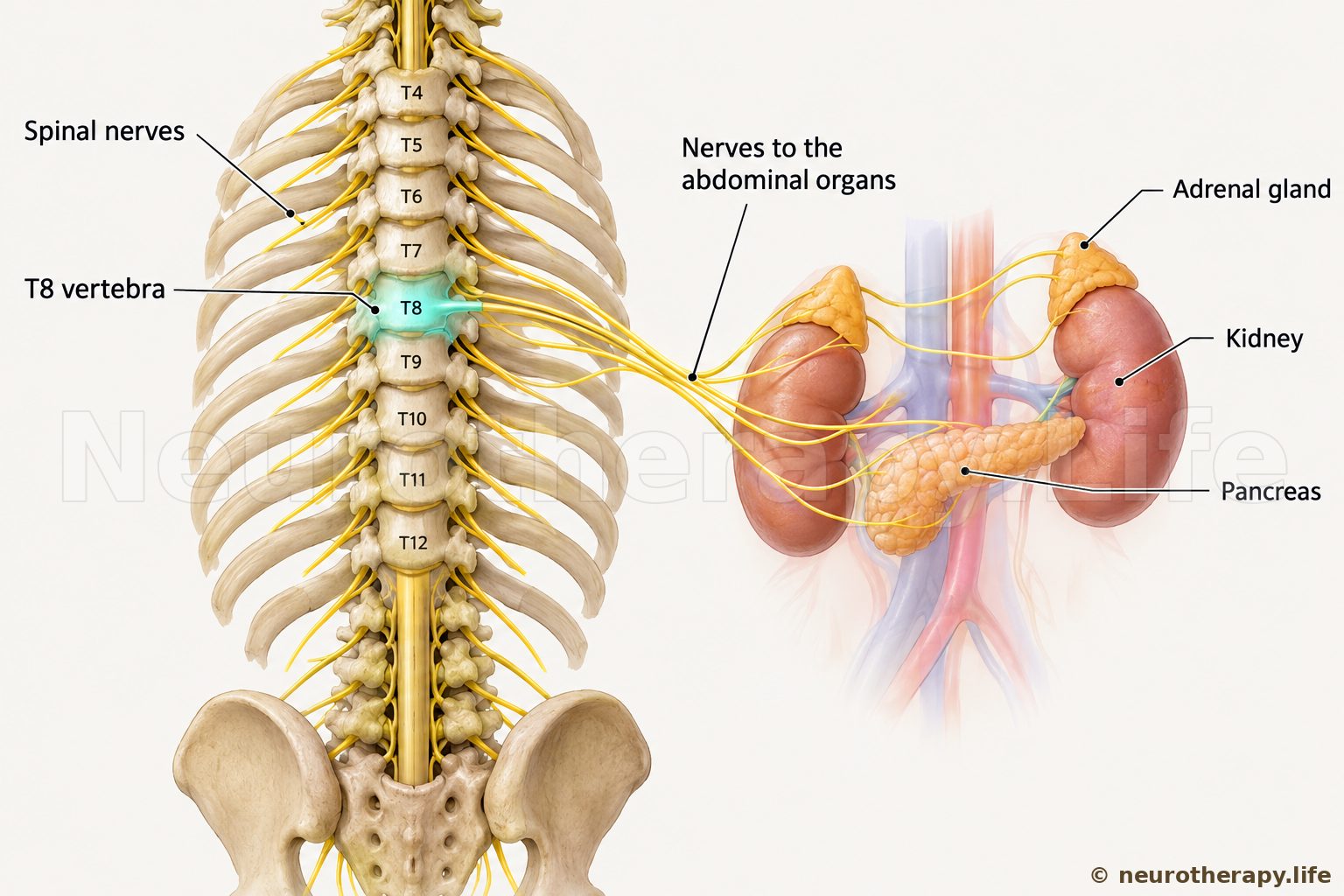
T8 is a Neurotherapy (LMNT) point given all around the eighth vertebra of the chest part of the spine, in the middle of the back. It is used in diseases of the kidney, the pancreas and the adrenal gland, in diabetes, and for cataract and weak eyes — and its one firm rule is that the pressure must never increase the pain.
Overview
What is the T8 point?
The spine of the chest has twelve vertebrae, numbered T1 to T12 from the top ('T' for thoracic, meaning the chest). T8 is the eighth of them, in the middle of the back, roughly level with the lower tip of the shoulder blades when the arms rest at the sides.
T8 is named simply for its anatomy. It is one of the shortest entries in the whole therapy, and half of it is a limit: press and release the area around T8, but never so hard that the pain increases.
Its uses reach well beyond the back: diseases of the kidney, the pancreas and the adrenal gland, diabetes, cataract and weakness of the eyes.
T8 sits in the middle of the back. Nerves from these middle chest levels supply the organs of the upper abdomen.
Where it is given
Where is T8 given?
PositionLying face down
Body areaMiddle of the back, all around the eighth chest vertebra
You lie face down, with pillows under the chest so the chin rests and the head stays straight — the standing arrangement for every face-down treatment.
T8 is given all around the eighth chest vertebra — on the bone itself and on the tissue on both sides of it. A first landmark is the lower tip of the shoulder blades, confirmed by counting down from the big bump at the base of the neck.
How it is given
How is T8 given?
How this point is given — the tool, the pressure, the count and the exact movement — is deliberately not described here. A demonstration video for this point is being prepared; until it is on this page, learn the method hands-on from a trained Neurotherapist before giving it. Please do not give any point from a written description alone: a point given in the wrong place or the wrong way can do harm.
The exact technique is taught hands-on in the Neurotherapy (LMNT) course. See the course →
What it does
What does T8 do in the body?
Neurotherapy (LMNT) teaching gives T8 for diseases of the kidney, pancreas and adrenal gland, for diabetes, and for cataract and weak eyes. Body science confirms that nerves leaving the middle chest levels of the spinal cord supply the organs of the upper abdomen, including the pancreas and the adrenal glands; how a press at T8 helps these organs, and the eyes, is the therapy's own teaching from practice.
Given for diseases of the kidney.
Given for diseases of the pancreas, and in diabetes.
The pressure must never be so much that the pain increases. A patient who feels pain and does not report it may be left sore, or with a feeling of weakness — so the patient is asked to speak up the moment it changes. How the therapist presses to examine your belly
Mid-back pain that is new and severe, comes with chest pain or breathlessness, or follows a fall in someone with weak bones, needs a doctor first. How to tell a patient to see a doctor
Cataract and weak eyes are named among T8's uses in Neurotherapy (LMNT) teaching. It is used alongside your eye doctor's care, not in place of it.
Should T8 hurt?
No. Its one firm rule is that the pressure must never increase the pain. Tell your therapist the moment it starts to hurt more.
How do I find T8?
With your arms at your sides, the lower tips of your shoulder blades lie at about the same level. The therapist confirms it by counting down from the big bump at the base of your neck.
Surprising facts
1Nerves from the mid-back feed the upper belly
The greater splanchnic nerve gathers fibres from about the fifth to the ninth chest levels of the spinal cord and carries them forward to the stomach, liver, pancreas and adrenal glands.
With the arms by the sides, the lower tip of the shoulder blade lies at about the level of the seventh or eighth chest vertebra — a landmark students use to count the spine.
Source: Standring S (ed.). Gray's Anatomy, 41st ed. — surface anatomy of the back.
3Organ pain shows up on the back
A troubled pancreas often bores through to the middle of the back, and kidney trouble is felt in the loin — the body reports its inner organs as aches on the back wall.
Source: Hall JE, Hall ME. Guyton and Hall Textbook of Medical Physiology, 14th ed. Elsevier, 2021 — referred visceral pain.
This page explains what a Neurotherapy (LMNT) treatment is for; it is not a self-treatment guide and does not diagnose. Neurotherapy (LMNT) works alongside your medical care — keep taking the medicines your doctor prescribed.
Ready to begin?
Send COURSE for course details, or your name, age and health issue for a consultation.