1The most movable joint
The shoulder moves more freely than any other joint in the body — and for the same reason it is the joint that dislocates most often.
Source: Gray's Anatomy, 41st edition, the glenohumeral joint.
Also called: Rocket, Rocket treatment, रॉकेट पॉइंट
Rocket Point is a Neurotherapy (LMNT) hand treatment for the arm that cannot be raised after a blow to the shoulder, neck or arm. Everything in it travels upward — up the troubled arm towards the shoulder, then upward behind the ear — which is how it got its name. It is given only after a doctor's problem has been ruled out.
Rocket Point answers one specific problem. When a blow has been taken on the shoulder, neck or arm, teaching says the muscles 'come down', so that the person cannot raise the arm. Rocket Point is given to drive them up again.
The name describes a direction, not an organ. A rocket is entirely about going up, and every movement in this treatment travels upward. Neurotherapy (LMNT) names some techniques for a sound, some for a place, some for a person — this one is named for where it goes.
Because its indication begins with an injury, Rocket Point always starts with a question: is this simply muscle, or something a doctor must see first?
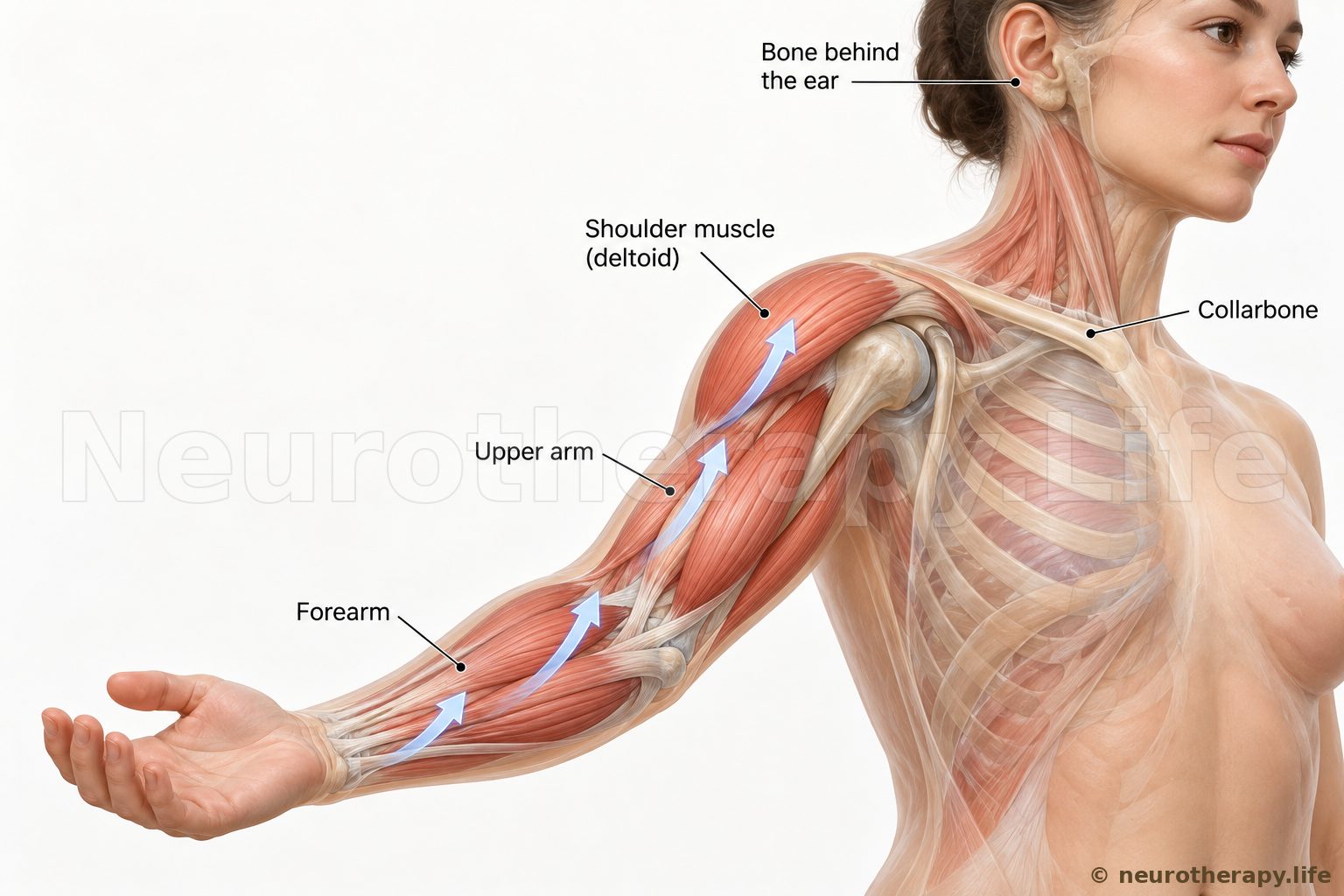
It is given on the side of the shoulder that has dropped or hurts after a fall — left for the left shoulder, right for the right. You may lie on the side with the troubled shoulder up, or sit.
The place is just below the edge of the skull bone behind the ear — about the line of the Necklace point — three close points there. It is always given LAST, after the other treatments of the sheet. (Earlier text on this page described a stroke along the arm; the demonstration video shows only the work behind the ear.)
How this point is given — the tool, the pressure, the count and the exact movement — is deliberately not described here. A demonstration video for this point is being prepared; until it is on this page, learn the method hands-on from a trained Neurotherapist before giving it. Please do not give any point from a written description alone: a point given in the wrong place or the wrong way can do harm.
The exact technique is taught hands-on in the Neurotherapy (LMNT) course. See the course →
Its stated purpose is a single one.
Rocket Point belongs to a group of points found one at a time, each for one problem. They are learnt by the problem, not by the body map.
One complaint: an arm that cannot be raised after a blow — once a doctor's injury has been excluded.
Because everything in it travels upward — up the arm, and up behind the ear. The name tells you the direction.
First see a doctor. A fall that stops the arm lifting may have broken, torn or dislocated something. Rocket Point is considered only after that has been ruled out.
It is given on the firm bone behind and below the ear lobe, well away from the throat. Tell the therapist at once if you feel dizzy.
The shoulder moves more freely than any other joint in the body — and for the same reason it is the joint that dislocates most often.
Source: Gray's Anatomy, 41st edition, the glenohumeral joint.
The shallow shoulder socket is held together largely by the rotator cuff — four small muscles whose tendons can tear after a fall, leaving an arm that will not lift.
Source: Gray's Anatomy, 41st edition, the rotator cuff.
The mastoid bone behind the ear is full of small air cells, like a honeycomb, connected to the middle ear.
Source: Gray's Anatomy, 41st edition, the temporal bone.
This page explains what a Neurotherapy (LMNT) treatment is for; it is not a self-treatment guide and does not diagnose. Neurotherapy (LMNT) works alongside your medical care — keep taking the medicines your doctor prescribed.
Send COURSE for course details, or your name, age and health issue for a consultation.