1The most mobile joint
The shoulder has the widest range of movement of any joint in the body — which is also why it is the joint most often dislocated.
Source: Gray's Anatomy, 41st ed., Shoulder (glenohumeral) joint.
Also called: शिवाजी, Shivaji treatment, Shivaji trt.
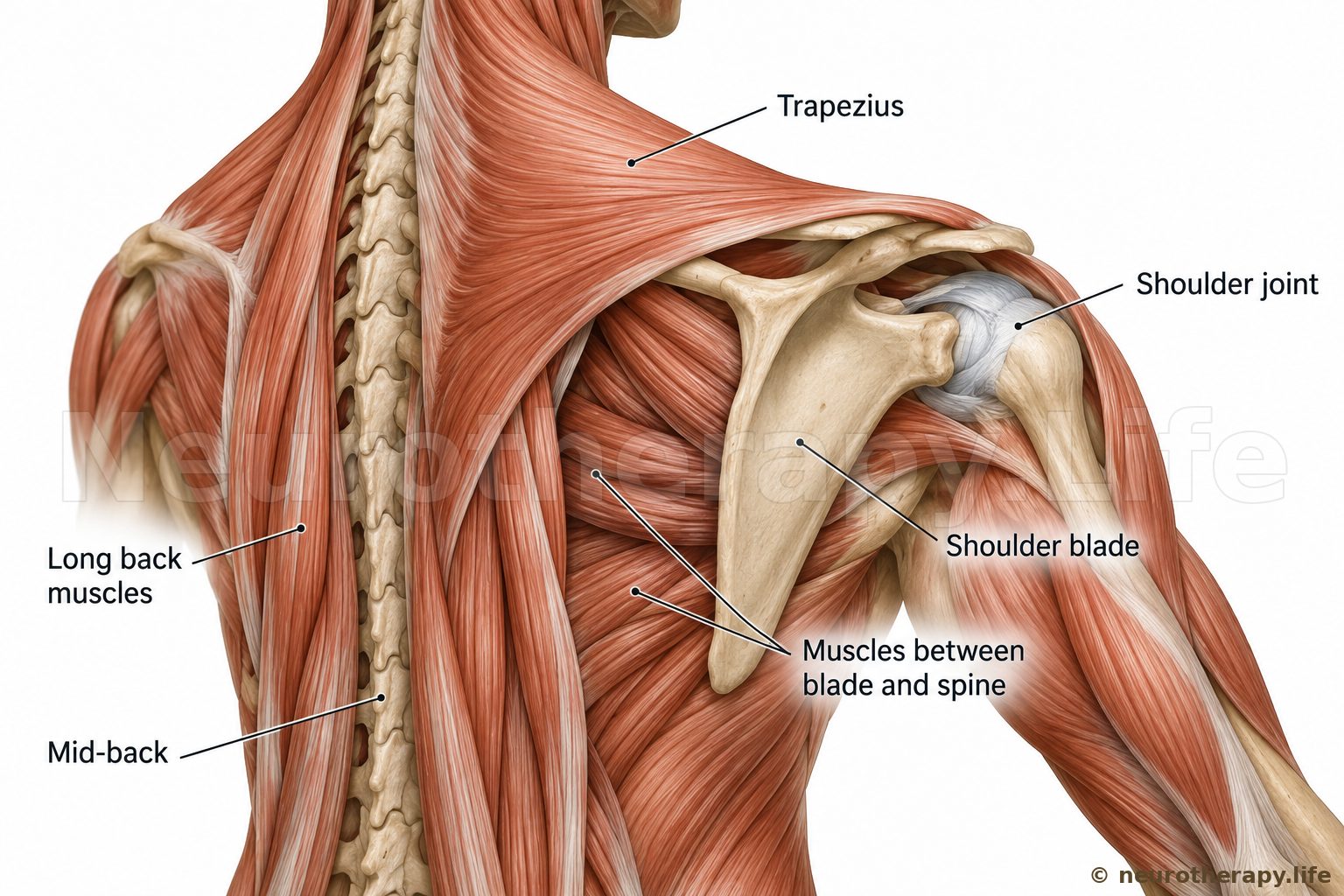
Shivaji is a seated Neurotherapy (LMNT) treatment for the shoulder. With the base of the palm turning in small clockwise circles, the therapist works around the shoulder, the shoulder blade and both sides of the mid-back. It is described as excellent for frozen shoulder and also gives relief in neck pain.
Shivaji is named after a person, not a place on the body — in Neurotherapy (LMNT), a treatment is often named for the student or patient in connection with whom it was first worked out. The name tells you nothing about the body; the treatment itself is all about the shoulder.
It is given to the patient who cannot raise the arm properly because the shoulder has become painful and stiff — a frozen shoulder. Its aim is to relax the muscles all round the shoulder and neck, especially the trapezius, the large flat muscle that runs from the neck across the top of the shoulder and down the upper back.
Shivaji works as a widening circuit, not as three unrelated rubs. It moves from the front of the shoulder and the armpit fold, to the muscles between the shoulder blade and the spine, and finally to the long muscles that run beside the spine in the middle back.
You sit on a chair and place the palm of your own hand on your forehead, letting the shoulder go loose. This simple set-up turns the shoulder blade so that its lower corner swings clear of the ribs. If you cannot hold it, your elbow can rest on a table, a pillow or the therapist's forearm.
The areas are: the front of the shoulder and down the side of the chest; the back, from the lower edge of the shoulder blade up to the top of the shoulder; and both sides of the spine in the middle and lower back. Because it depends on sitting, Shivaji is not adapted for a patient who must lie down.
How this point is given — the tool, the pressure, the count and the exact movement — is deliberately not described here. A demonstration video for this point is being prepared; until it is on this page, learn the method hands-on from a trained Neurotherapist before giving it. Please do not give any point from a written description alone: a point given in the wrong place or the wrong way can do harm.
The exact technique is taught hands-on in the Neurotherapy (LMNT) course. See the course →
The teaching explains Shivaji simply: by pressing again and again around the shoulder, the muscles relax, their blood circulation increases and flexibility comes back, and the patient begins to get relief. This is a description of muscle work that body science readily recognises.
Shivaji sits among the seated treatments and the shoulder-and-arm group.
Shivaji is chosen for a shoulder that is stiff and painful — after making sure the 'shoulder pain' is not something more serious.
“This treatment is to relax the shoulder and neck muscles. It is excellent for frozen shoulder, that is, stiffness of the shoulder. It also gives relief in neck pain.”
It turns your shoulder blade so its lower corner swings clear of the ribs, letting the therapist reach the muscles beneath it. If you cannot hold it, your elbow can be supported.
No — it depends on the seated position. If you cannot sit, your therapist will choose other shoulder treatments.
The treatment is named for a person, following the custom of naming a technique after the student or patient in connection with whom it was found. The source does not tell the story behind this name.
Frozen shoulder often takes many months to settle. Patients have reported relief and easier movement with Shivaji, alongside gentle daily movement and their doctor's advice.
The shoulder has the widest range of movement of any joint in the body — which is also why it is the joint most often dislocated.
Source: Gray's Anatomy, 41st ed., Shoulder (glenohumeral) joint.
Frozen shoulder usually passes through a painful 'freezing' phase, a stiff 'frozen' phase and a slow 'thawing' phase, often over one to three years.
Source: NHS, Frozen shoulder; American Academy of Orthopaedic Surgeons, OrthoInfo: Frozen Shoulder.
People with diabetes are several times more likely to develop frozen shoulder than people without it.
Source: Zreik NH, Malik RA, Charalambous CP. Adhesive capsulitis of the shoulder and diabetes: a meta-analysis. Muscles Ligaments Tendons J. 2016;6:26–34.
This page explains what a Neurotherapy (LMNT) treatment is for; it is not a self-treatment guide and does not diagnose. Neurotherapy (LMNT) works alongside your medical care — keep taking the medicines your doctor prescribed.
Send COURSE for course details, or your name, age and health issue for a consultation.