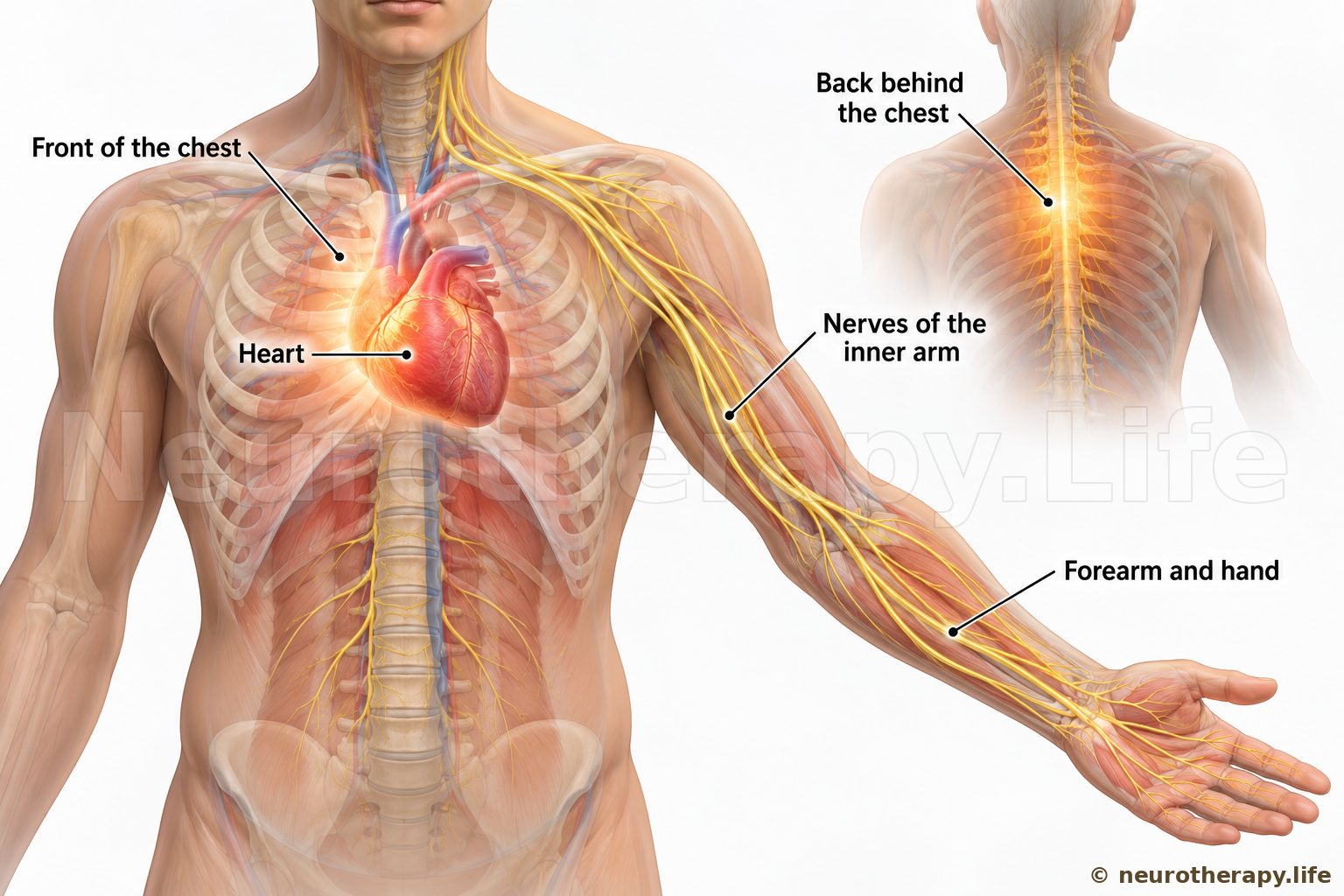
Sulta Ulta is a Neurotherapy (LMNT) arm treatment given lying on the back, first with the palm facing up and then with the palm facing down. Palm up is for pain at the front of the chest, palm down for pain in the back behind it — and, with the arms raised, it is the chest treatment allowed in heart patients.
Overview
What is Sulta Ulta?
The name is two Hindi words. Sulta means 'right way up' — here, the palm facing the sky. Ulta means 'upside down' — the palm facing the ground. The treatment is given along the forearm and hand in both positions, one after the other.
It is a treatment for the chest that is given far from the chest. The palm-up part is used to take out pain at the front of the chest; the palm-down part takes out pain in the part of the back that lies behind that same place.
Its special place is in heart disease. Treatments given on the chest itself, such as Loveleen and Thymus, are withheld from heart patients because the pressure falls close to the heart. Sulta Ulta is given in their place — with the arms raised a little above shoulder level and one side at a time.
Sulta Ulta is a physical point: it relaxes muscles and tissues. Its look-alike, Stretch, is given palm up only and with the arm straight out — a different treatment with a different purpose.
The chest, the upper back and the inner arm share nerve pathways. Sulta Ulta works on the arm to reach the chest.
Where it is given
Where is Sulta Ulta given?
PositionLying on the back
Body areaForearm and hand, elbow to fingertips — palm up, then palm down
You lie flat on your back on a firm mattress. Ordinarily the arm rests straight out from the shoulder. When there is pain in the chest, and in angina, both arms are raised a little above that line — about 135° from the body — or as far up as they comfortably go. The angle is a target, never forced.
The treatment runs along the forearm, from the elbow to the wrist, and over the hand to the fingertips — first with the palm facing up, then with it facing down. One arm is treated at a time, never both together.
How it is given
How is Sulta Ulta given?
How this point is given — the tool, the pressure, the count and the exact movement — is deliberately not described here. A demonstration video for this point is being prepared; until it is on this page, learn the method hands-on from a trained Neurotherapist before giving it. Please do not give any point from a written description alone: a point given in the wrong place or the wrong way can do harm.
Feels likeA light, smooth glide down the forearm and over the hand
SidesOne arm at a time, never both together
The exact technique is taught hands-on in the Neurotherapy (LMNT) course. See the course →
What it does
What does Sulta Ulta do in the body?
Neurotherapy (LMNT) teaching says Sulta takes out pain at the front of the chest and Ulta takes out pain in the back behind it, and that with the arms raised it ends chest pain or the feeling of suffocation in heart patients. Body science offers a reason why the arm and the chest are linked: the heart, the chest wall and the inner arm all report to the same upper segments of the spinal cord.
Sulta (palm up) — to take out pain at the front of the chest.
Ulta (palm down) — to take out pain in the part of the back behind that same place.
In angina and heart disease, given with the arms raised, to ease chest pain and the feeling of suffocation — in place of Loveleen, which is withheld.
In diabetic patients, given along with the acid formula, it is reported to add further benefit.
Organs it reaches
Heart — The heart reports its pain to the same spinal segments that serve the chest wall and inner arm — the reason chest pain from the heart often runs into the left arm.
Muscles — The muscles and tissue of the forearm and hand, drawn and relaxed by the glide.
Spinal cord — The upper chest segments of the spinal cord, where heart, chest wall and arm signals meet.
Its family
Which treatments are close to Sulta Ulta?
These arm and chest treatments are easily confused with Sulta Ulta, or are given in its place or beside it.
Stretch — Palm up only and the arm straight out — for the neck muscles and breathing. Turning the hand over at the end turns it into Sulta Ulta under the wrong name.
Loveleen — The chest-wall treatment for chest pain from poor digestion — withheld in heart patients, where Sulta Ulta replaces it.
BAFA — Both arms, both forearms — another sole treatment along the arms.
Tennis Elbow — A sole treatment on the upper arm near the elbow, for elbow pain.
What it is used for
What is Sulta Ulta used for?
Sulta Ulta answers chest pain, front and back. In heart patients it is given only in the raised-arm form, and only alongside the doctor's care.
Diabetic patients with foot trouble on this formula are also said to find Loveleen with Sulta Ulta agreeable.
Safety: when it is held back
Chest pain is never the therapist's to diagnose. Chest pain or pressure with breathlessness, sweating, nausea, or pain running to the jaw or arm is an emergency: stop, sit the patient up and get medical help at once. So is new, worsening or resting chest pain, and severe tearing pain in the chest or back. Heart attack (myocardial infarction)
In heart patients Sulta Ulta is given only with the arms raised a little above shoulder level and one side at a time — never flat, never both sides together. The angle is never forced on a stiff or once-dislocated shoulder. Angina (chest pain from the heart)
Heart disorders carry their own blocked list: Loveleen, Thymus, Swt, Lu+Sh, Katka, (4) Thrd, (20) and (30) Medulla are not given, and (10) Medulla is never given on both sides — only (10) Left Medulla. Conditions that block certain points: the six families
Breathlessness from a failing heart — waking at night gasping, unable to lie flat, swollen ankles — needs a cardiologist soon. Keep taking your heart medicines; Neurotherapy (LMNT) works alongside them, never instead. How to tell a patient to see a doctor
Because the chest, the upper back and the inner arm share nerve pathways in the spinal cord. Working on the arm reaches the chest without putting any pressure near the heart.
Why are my arms raised so high?
In chest pain and heart disease the raised angle is part of the treatment itself. It is only taken as far as your shoulders comfortably allow.
I have heart disease. Is Sulta Ulta safe for me?
It is the chest treatment written for stable, medically managed heart patients, in the raised-arm form. It is not for new or changing chest pain, which needs a doctor at once. Keep all your heart medicines.
How is it different from Stretch?
Stretch is palm up only, with the arm straight out, and is for the neck and breathing. Sulta Ulta turns the palm both ways and, in chest pain, raises the arms higher.
Surprising facts
1The heart speaks through the arm
Pain nerves from the heart enter the spinal cord at the same upper chest segments as nerves from the chest wall and the inner arm. The brain cannot tell them apart, so heart pain is often felt in the left arm, jaw or back — called referred pain.
Source: Hall JE, Hall ME. Guyton and Hall Textbook of Medical Physiology, 14th ed. Elsevier, 2021 — referred pain from the heart.
2A map on the skin
Each spinal nerve serves its own strip of skin, called a dermatome. The strip for the first chest nerves runs down the inner side of the arm — a direct link between the chest and the arm.
Source: Standring S (ed.). Gray's Anatomy, 41st ed. Elsevier, 2016 — dermatomes of the upper limb.
3Angina is a warning, not an attack
Angina is chest pain that comes when the heart muscle briefly gets too little blood, usually on effort, and settles with rest. Pain that comes at rest or keeps worsening is unstable and needs emergency care.
This page explains what a Neurotherapy (LMNT) treatment is for; it is not a self-treatment guide and does not diagnose. Neurotherapy (LMNT) works alongside your medical care — keep taking the medicines your doctor prescribed.
Ready to begin?
Send COURSE for course details, or your name, age and health issue for a consultation.